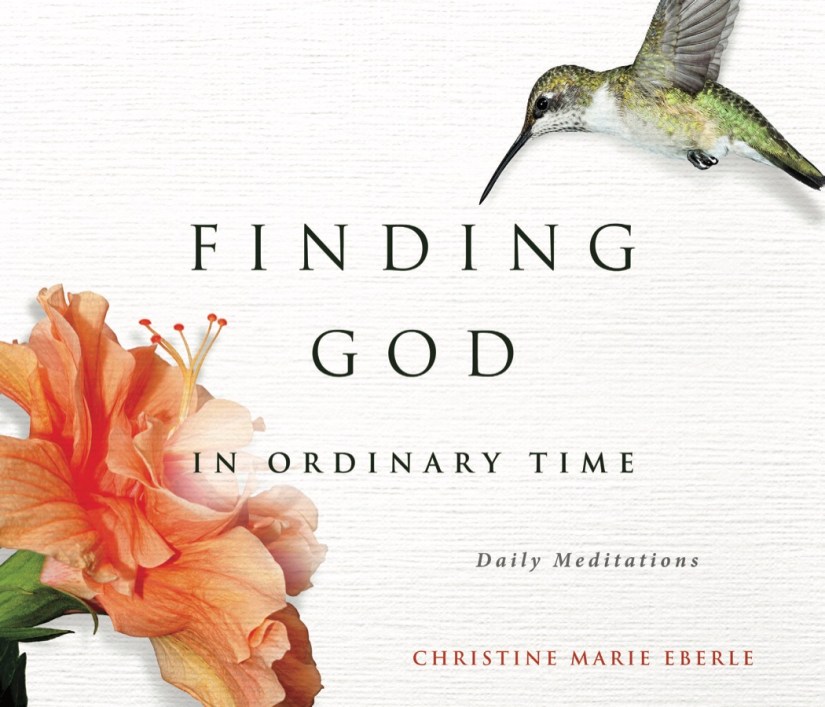
Friends, I am getting closer to having a completed manuscript of my first book, Finding God in Ordinary Time. The process has been fascinating; I’ve been working with Peggy Moran, a gifted editor in New York, who has been helping me to make sure that every word counts, that my thoughts flow freely, and that no “insider” jargon jars the reader’s experience. On the other side of the country, Asha Hossein has designed a beautiful cover that I will post here as soon as it’s not a violation of any copyright. I head back to Vermont on August 22 to meet the judges for Pitch Week X. But meanwhile, this word cloud reveals the heart of the book. Enjoy!
Category: Spirituality
Exciting News!
Friends, I am delighted to announce that I have been selected as a finalist in a writing competition held at the When Words Count Retreat in Rochester, VT. (Click here to see all six finalists!) No matter who wins “Pitch Week X,” I am certain that I will emerge a better writer–with a manuscript ready for publication! Stay tuned for progress on Finding God in Ordinary Time.
Help Our Unbelief!
Of all the Gospel stories, none illustrates the poignant chasm between one’s professed and operative theologies better than this Sunday’s account of the raising of Lazarus.
I have been intrigued by those technical terms since grad school. Professed Theology: that which we say we believe–what we even believe we believe. And Operative Theology: that which–when push comes to shove–it turns out we actually believe.
Martha, in today’s Gospel, articulates a magnificent professed theology. Confronting Jesus after the death of her brother, she boldly proclaims, “Lord, if you had been here, my brother would not have died. But even now I know that whatever you ask of God, God will give you.” Amen, sister; preach!
But as soon as they get to the tomb, she changes her tune. “Take away the stone,” Jesus instructs. And Martha protests, “Lord, by now there will be a stench; he has been dead for four days!”
So which is it, sister? Do you really believe that God will give Jesus whatever he asks? Or is the inside of that tomb the last thing you want to see . . . or smell?
There’s nothing like a little genuine distress to bring our operative theology zooming to the surface. That truth is summed up even more succinctly by the father of a possessed boy in Mark’s Gospel (9:14-29) who cries out “I do believe; help my unbelief!”
Which honestly is okay.
People of faith are supposed to be lifelong learners. We are taught things, and we memorize things, and we repeat things, and often there is no need to examine whether or not we really believe these things–until there is. The awful beauty of being backed into a theological corner is that we might need to confront what we really believe for the very first time. (Hence my trouble with the phrase everything happens for a reason!)
But the good news–for Martha today, for the possessed boy’s father another day, and for us every day–is that God doesn’t need our faith in order to work wonders. Jesus rolled away the stone despite Martha’s apparent disbelief. He healed the possessed boy despite his father’s acknowledged disbelief. And God moves in our lives, no matter how far apart our professed and operative theologies may be.
We do believe, Lord. Help our unbelief!
Surrounded by the Serenity Prayer
I don’t usually write about my day anywhere but in my own journal. But this morning I am making an exception to share the remarkable bookends of a rough 24 hours.
On Monday evening a group of faculty and staff women met for our monthly book group dinner in the Campus Ministry center, Visitation House. It had been a full and hectic day, and if I had not been the host, pausing to reflect over soup and bread would not have come anywhere near the top of my to-do list.
And yet of course we did gather, and had such a rich and meaningful conversation about Eileen Flanagan’s book about the Serenity Prayer, called The Wisdom to Know the Difference: When to Make a Change, and When to Let Go. Our chapter for this month was Letting Go of Outcomes, and we talked about how suffering is compounded by the way we cling to the conviction that things should be different. We ended by acknowledging how hard it is to be on the receiving end of generosity, but sometimes we just need to let go and let others be as good to us as we wish to be to them.
The women left, and I went back to my office to do a couple hours of work organizing the gift cards that had been donated for this Friday night’s BINGO fundraiser.
That’s when I discovered the theft.
Several hundred dollars worth of donations had disappeared from my desk drawer, as well as from what I thought was a carefully concealed (by which I mean piled among many other things) shopping bag on my office floor.
Our Public Safety officers responded to my call at once, took my report, returned the next morning and called the police, who also came at once, took a more complete report, and promised to begin an investigation. Did I mention this was a busy and hectic week getting ready for a major fundraiser? I was losing not only dollars but also hours I could not afford to replace.
And yet something amazing happened yesterday afternoon. As word of the theft began to spread on campus, people rushed in to help us. All day long, people called or showed up to ask, What can I do? What do you need? People dropped off gift cards. They wrote checks. They stopped by just to ask if we were okay. And at a time of the semester when most students are stressed beyond the breaking point, several appeared out of the blue to volunteer to help with other pressing tasks. Marissa and Brianna decorated cupcakes for a Take Back the Night promotional event; Emily and Kate helped organize merchandise we are selling for disaster relief in Peru this morning; Allison inventoried the kitchen for baking supplies so we will have plenty of treats at the BINGO food table. Visitation House was abuzz with life.
I worked until I had to walk out the door for choir practice at church. We worked on several songs for the coming Easter Triduum then ended with . . . wait for it . . . a musical setting of the Serenity Prayer.
The very last thing we did was to sing it acapella in three-part harmony, and I marveled at the peace I felt, not just during the song, but really all throughout the day. Grounding the beginning of those 24 hours in a profound conversation about serenity and letting go really had helped me enter the fray without falling apart. Being a victim of a crime (albeit a non-violent one) was discouraging and embarrassing, but the wave of kindness that came in its wake was so very moving and humbling. There is so much goodness on our Mercy campus. There is so much goodness in our world. Sometimes we have to stand in need of it in order to perceive it.
Walking Out of the Desert
Jesus returned from the Jordan, and was led by the Spirit into the desert for forty days, to be tempted by the devil. -Luke 4:1
We only hear about the 40th day.
What happened during the other 39?
Jesus was propelled out into the desert after his baptism, after he heard those life-changing words: You are my beloved son. Did it take him that long, perhaps, to figure out what it meant to be God’s son, and what on earth he should do next?
And this “devil” – more appropriately translated “opponent” or “obstructor” – what exactly was he trying to oppose and obstruct? And how?
I believe that, during those 40 days, Jesus wrestled with his understanding of his mission – not just the “why” and the “what” but especially the “how” of his public ministry. Opposed and obstructed at every step.
And since the good is often the enemy of the best, I suspect that the great obstructor suggested all sorts of tangential issues to care about, alternate strategies to pursue. Maybe Jesus needed those 40 days (the Biblical number for “a really long time”) to clear his head of all that rubbish, to be calm and focused and purposeful, to learn exactly how to direct his energy.
Here’s how I picture that final day:
It’s over.
Plans and possibilities have been considered and rejected. Powers, perhaps, have been explored, and reliance on them restricted. Hungry, weary, yet resolute, Jesus begins to trudge back towards civilization, leaning on his staff.
He is really hungry.
The stones at his feet shimmer in the heat; squint your eyes and they look like bread.
Then that damn voice again. “If you are the Son of God, command this stone to become bread.” If? If? Always if! The Spirit had said so; hadn’t he heard it? Hadn’t everyone? He’d just spent 40 days growing into that identity. Why was the “if” back? If you are the Son of God … and not some delusional freak!
Turning the stone to bread; would that silence the “if” for good? The walk back was so long, and he was so hungry. This was so hard. What harm would it do? Who would know? What was the use of being God’s son, if you couldn’t feed yourself when you were hungry?
As he leans on his staff, he realizes that hunger and weariness are feeding him insecurity and taking him to the brink of unraveling all the resolutions he made when he was feeling stronger. Mental note – fatigue and hunger are dangerous. The strongest resolutions can start to slip away under their siege. He must steel himself against such lapses in logic; he cannot use his “magic powers” for his own comfort or convenience. (And though he does not know it yet, If he can’t resist making bread when he is hungry, how will he resist the jeers of the crowd telling him to come down off that cross … baiting him with that word “if” again?)
More importantly, he can’t cave to the urge to prove himself for the sake of his pride. That can’t end well.
Once the first temptation is resisted, the subsequent ones get easier. (Probably a good lesson for the rest of us.) Though they do have their own specific appeal.
Then he took him up and showed him all the kingdoms of the world in a single instant. The devil said to him … all this shall be yours, if you worship me. (Luke 4:5-7)
Now that is tempting. All the kingdoms of the world in a single instant. Just think of all the places he will never visit in his lifetime. All the places it will take his followers years … decades … even centuries to reach, and how much his message could be warped in transmission!
And yet the devil here has overreached, showed his hand. He doesn’t have the power. The kingdoms are not his to give. Easy to resist.
So the obstructor takes a step back. Returns to what almost worked the first time. If you are the Son of God … throw yourself down (from the parapet of the temple). For he will command his angels to guard you … (Luke 4:9-10).
Again, there is a certain draw. It would get people’s attention, that’s for sure. He wouldn’t have to struggle against their disbelief in the “carpenter’s son.” Wouldn’t have to take the hard road. (Might not even wind up on the cross.)
But no.
The devil’s lures are getting tiresome.
This is not the way, and he knows it. He walks on, feeling stronger, resolute. And so the devil retreats, waiting for Jesus’ defenses to go down again.
To do the right thing, in the right way, for the right reason. That’s the challenge that was laid before Jesus, and that lies before each of us every day.

Things I Believe about God
I have started working in earnest on a book whose working title is Finding God in Ordinary Time. During a hash session at the When Words Count Retreat last week, someone I respect told me that if I was going to write a book about spirituality, I really needed to be clear within myself about what I believe about God. I prayed about it by the fireplace that night, and the next morning got up and wrote this.
I believe that God is less interested in right answers than in right relationship . . . less committed to creeds than to how we treat one another.
I believe that God wants to be intimately involved in each person’s life. Don’t ask me how the math works. But if Eve can love her six children as fiercely as Eileen loves her two, then God, being God, can love the whole world that way.
Though it is not (as I once believed), a saying of Saint Augustine, I am convinced of the wisdom of the French expression: “to understand all is to forgive all.” God knows us better than we know ourselves, understands the complicated threads that lead to our worst behavior, and would much rather help us untangle those threads and lead us back to wholeness than just throw the whole mess in the trash can and start over. There’s a little story about judgment day, how everyone has entered the pearly gates but Jesus is still standing at the top of the escalator (yes, in this story there’s an escalator to heaven). Jesus is peering down wistfully when Peter comes out and says, “Lord, come on in! We’ve got quite the party going on. What are you waiting for?” Jesus replies, never taking his eyes off the escalator, “I was hoping that Judas might have had a change of heart and would still be joining us.” The story is ridiculous, but dammit it makes me cry every time, even just typing it. I think it gets me because it says something true about the heart of God, overflowing with mercy.
I believe that God wants me to be my best self, and consequently doesn’t let me get away with anything. If I criticize someone harshly for a mistake or a weakness—even in my own head—I’m almost bound to make or manifest the exact same thing any day, and feel from across the room God’s eyebrows humorously raised in my direction.
I believe that God suffers with us. To me the most powerful thing about the Incarnation of Jesus was the idea that the almighty, eternal, omnipotent, omniscient God would choose to become limited, helpless, and earthbound. That he would eat and drink and sweat and shit and go to parties and have good friends and get betrayed by some of them. That he would struggle to pray, to figure out his mission, to communicate his vision to people predisposed to skepticism or religious fanaticism. That makes him a person I want to get to know better.
I believe that the suffering of God and the omnipotence of God are hard but not impossible to reconcile. On the one hand it’s the pesky free-will thing. Much of the pain that comes our way is from other people’s (or our own) misuse of God-given free will. But if we are not free to do terrible things to one another then we are not free to do amazing things either; we’re just puppets here for God’s amusement and what’s the point of that? The catch for many people, I know, is the whole miracle business. When one person narrowly escapes a harrowing accident or beats the odds of a cancer diagnosis, people of faith are quick to call it a miracle and thank God for the intervention. But why, then, does God not always intervene? At least in the case of deserving people—young children, mothers of young children, scientists on the brink of curing the cancer that afflicts young children—why does God withhold the magic wand? Well I have an answer for you, and it’s this: I don’t know. But I do know that CS Lewis said when we get to heaven we will not learn all the answers; we will just discover that we were asking the wrong questions. So I’m okay dwelling in that particular mystery.
I believe that “everything happens for a reason” is one of the worst bits of pop theology ever to hit the charts—which is why I published a whole article about it. Quick synopsis: the things we say we believe have to be true even in the hardest circumstances or they were never true to start with. So if you can’t stare at the Rwandan genocide or the tsunami that hit Fukushima and say, placidly, “Everything happens for a reason,” then don’t say it when you miss the plane that had engine trouble and get bumped to business class on the next flight. And for God’s sake don’t say it when somebody’s baby dies.
I believe in the paschal cycle . . . the suffering, death, and resurrection of Jesus. I believe that Jesus’ radical love and defiance of authority landed him where it lands most people, but that somehow—insert mystery here—death, for him, did not have the final word, and that he continued and continues to be a real and active presence in the lives and hearts of his followers. And because of this, I am tuned in to the way that paschal cycle plays out in our own lives as well . . . that we suffer, “die,” and rise to new life many times in our lives, as tragedies take us to our knees and somehow we stand up again. (Which is the topic of my article “The Faithful Wait.”)
I believe in prayer. Sometimes that means sitting quietly in a church or a garden, very intentionally “descending from my head into my heart.” Sometimes it means taking a text—whether a piece of Scripture or a Mary Oliver poem—and ruminating on it, letting God lead me deeper, revealing something God wants me to know. Sometimes it is so much less formal . . . the running dialogue in my head as I’m driving, or off for a long walk, or doing the dishes. Although I do most of the talking, sometimes God does weigh in. Or at least that’s what I call it when the thought that pops into my head is both clear and also nothing I would have scripted. (I’m sure other people call it the subconscious mind at work. I’m okay with that as long as I’m allowed to call it the voice of God.) And sometimes—often—prayer is a communal experience. See next point.
I believe in liturgy. Good liturgy. Liturgy that becomes a trellis on which our meandering thoughts can raise themselves together towards higher things. I am firmly committed to liturgies with beautiful music that is also theologically sound, to well-proclaimed readings and thoughtful preaching and intentional ritual. And while I firmly believe that we should commit ourselves to common worship because of what we give, not what we get, I also think that the people in charge should make sure there’s something to be gotten.
I believe there are many paths to God, many roads up the mountain. I believe that the faithful practitioners of any tradition have more in common with each other than they do with the lukewarm or fanatic practitioners of their own faith. I believe religious people should spend less energy trying to convert others to their own denomination and more energy converting hearts—their own included—into a thriving, consequential relationship with the God of their understanding.
Can I get an Amen?
UPDATE: Finding God in Ordinary Time was published in 2018, followed by Finding God Abiding in 2022; Finding God Along the Way is coming in February 2025 from Paraclete Press.
The things I said I believe about God–I’m happy to say–are still my bedrock truths.