
Picture of a Goat
Liturgy, Retreats, Scripture, Spirituality

Prodigal Mic Drop

The most pointed insight I ever gained into the Prodigal Son story (Luke 15:11-32) came during a retreat skit performed by a group of West Chester University Newman Center students.

I remember no context—only that they’d been put into groups and assigned parables to act out. (BTW I can’t believe I made them do this. I skipped my own college orientation because I heard there were skits!)

Truly, I remember nothing about the enactment of the Prodigal Son until right after the guy playing the older brother—scandalized by the fatted calf’s having been killed to celebrate his rascally sibling’s return—turned on his father, saying, “You never gave me so much as a kid goat to celebrate with my friends.” Christopher Jowett, the tall, ponytailed dude who was playing the father (and who surely wouldn’t mind my quoting him without permission here, because it was awesome), spun around and thundered:

“YOU NEVER ASKED ME FOR A KID GOAT!”

I’m sure the skit went on from there, but I was done. Mic drop done. Convicted done.

Here’s what I grasped, in an instant. The younger boy’s departure had been a dagger in the heart, sure. “Give me the share of your estate that should come to me” was was just a polite way of saying, “I (literally) can’t wait for you to die.” But the older one’s reaction to his brother’s reappearance? That was a knife in the back.

The one who had seemed to serve faithfully by his side was actually in it for the reward? The one about whom he could say “you are with me always, and everything I have is yours” wanted more? The one who had borne witness to the depths of his grief still did not know him well enough to share his heart’s rejoicing?

This was a stranger.

The one who had borne witness to the depths of his grief still did not know him well enough to share his heart’s rejoicing.

Over the course of our lives, we may all vacillate along the continuum from the younger brother’s “dissolute living” to the elder brother’s life of “dutiful service,” with readers of this blog probably mostly avoiding the more dissolute end. We can’t be on our high horses about that, though, because it only means that’s not where our temptation lies.

That’s not where our temptation lies.

Our temptation—should you recognize yourself among the “older brother” types—is to serve dutifully but resentfully. Keeping careful records. Believing all the things that go right in our lives are because of our hard work and responsibility. Not recognizing the four hundred things a day that go right because of happenstance, privilege, or mercy.

Each time we fail to share God’s parental distress over every lost and suffering soul, or wholeheartedly celebrate each return to grace, we are the older brother.

I suspect there’s something there to convict us all, so I’ll end simply with this beautiful poem by Rumi, which I first encountered in Marilyn Lacey RSM’s marvelous book This Flowing Toward Me: A Story of God Arriving in Strangers. May we all recognize God’s flowing toward us today.

For sixty years I have been forgetful,
every minute, but not for a second
has this flowing toward me stopped or slowed.
I deserve nothing. Today I recognize
that I am the guest the mystics talk about.
I play this living music for my host.
Everything today is for the host.
Book Tour, Pilgrimage, Retreats, Spirituality, Writing

It’s In There

When I returned from the Ignatian Camino, my challenge was to transform a personal experience of pilgrimage into a book that could touch the hearts of people who might never be able to walk away from their life for a month. Now that Finding God Along the Way is out in the world, a new challenge has arisen: transforming words on a page into living, interactive retreat experiences.

I can’t think of a more hospitable place to begin than the Cranaleith Spiritual Center, where last Saturday I led a morning retreat called “The Long Pilgrimage to Justice.” Moved by a spectrum of concerns, ten souls braved the cold to gather in a sunny room and ground themselves for the work ahead. Together, we considered how the metaphor of pilgrimage could allow us to keep our goal on the horizon while staying deeply present to what is right in front of us. Drawing on wisdom from the Ignatian Camino, we discussed finding our “one thing,” taking the next step, redefining failure, and equipping ourselves spiritually.

My favorite part came near the end. Thoughout the morning, I’d been sharing snippets that speak to me—Scripture verses, songs, poems, quotes, etc. Finally, I read a passage from Chapter Sixteen of my book, “It’s in There,” and invited people to share what they carry in their own “go-bag” of inspiration.

The responses began as slowly as an afternoon snowfall, but each offering encouraged the next until the room was blanketed by consolation. It was such a joy to hear people ask one another, “Wait, who was that author?” “What was the name of that song ?” “Tell me that website again!” Phones came out so folks could look things up; pens came out so we could write them down.

One gentleman shared a reflection from Unfolding Light that captured the spirit of the day. It began: Hope is not anticipation of a certain outcome, but trusting goodness. Though the world around us abounds in hateful rhetoric right now—with even people on “our side” (whichever side that may be) delighting in mean memes and zinging caricatures—it was refreshing to remember how much goodness dwells in people’s hearts and memory banks.

Hope is not anticipation of a certain outcome, but trusting goodness.

Steve Garnaas-Holmes

It made me realize that, just as January is a month in which many of us return to a healthier diet after the excesses of the holiday season, so is this a time to be careful about our mental consumption. What we read, watch, and listen to has a profound effect on our spiritual health. Let’s resolve to choose wisely!

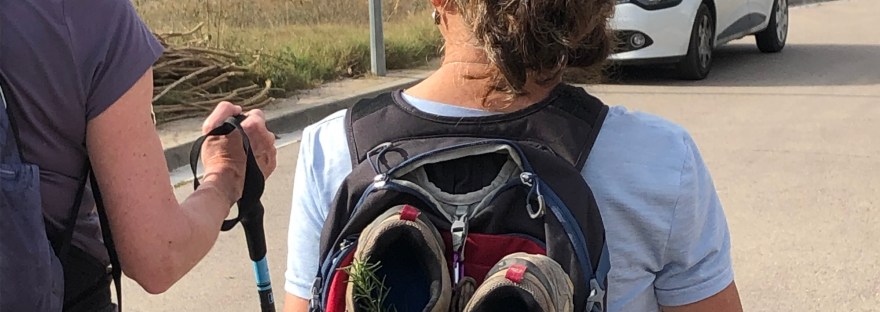
Can you spot the potassium-rich banana in Betsy’s backpack?
What’s in your “go-bag” of inspiration?

Excerpt from Chapter Sixteen, “It’s in There”

“I know we’re supposed to be praying during the first two hours of every walk. Does repeatedly taking the name of the Lord in vain count?”

I cracked this joke at the end of a particularly pressured segment of hiking, but I wasn’t actually swearing my way across Spain. The only truth in that snarky remark was the word “repeatedly.” When the pace or terrain overwhelmed my ability to pray deeply (by which I mean conversationally, meditatively, or imaginatively), I took comfort in repeating words and phrases lodged in my memory.

It began during that long ascent to Arantzazu. Knowing that we were going to “visit” the Blessed Mother, I was thrown back to one of my mom’s favorite prayers, the Memorare. As I grew more exhausted by the climb, I resorted to repeating the last sentence like a mantra, in cadence with my steps: O Mother of the Word Incarnate, despise not my petitions, but in your mercy hear and answer me.

Gradually, other words emerged from the deep. Once upon a time, I’d memorized a few prayers in Spanish, so I was able to pass a satisfying hour trying to drag those beloved lines out of the mental vault. Later, I challenged myself to piece together all four verses of Tagore’s “Friends Whom I Knew Not,” which I’d quoted extensively in my book Finding God Abiding. In both cases, something about the combination of meaningful words and mental exercise sustained me for quite a while.

Various Scripture passages joined the parade of words in my head. Walking through the mountains, I recalled the beginning of Psalm 121: “I will lift up my eyes unto the hills, from whence shall come my help.” On another day, I clung to St. Peter’s incredulous exclamation after Jesus asked if he wanted to jump ship like other faint-hearted followers: “Lord, to whom shall we go? You have the words of everlasting life.” Mile after mile, the rhythmic “Lord, to whom shall we go?” reminded me that there was nowhere I’d rather be.

Certain hymns also provided prayerful refuge. Gospel songs such as “Guide My Feet” and “We’ve Come This Far by Faith” encouraged me to press on. The sight of a little dead bird evoked “His Eye is on the Sparrow,” assuring me that I was not alone. Even though such repetitive prayer isn’t ordinarily my style, I’m grateful to have had access to such richness under duress.

In the age of smartphones, the ability to “look anything up” is both a gift and a curse. Though vast amounts of information are there at our fingertips, the convenience discourages committing things to memory. But even if I’d had cell service in the Cantabrian mountains, what would I have done—pulled out my phone and said, “Hey Siri: What’s a good prayer, poem, Scripture, or song for when you’ve climbed higher than you would have thought possible but still have an impossible distance to go?” (Okay, I just tried it, and got a link to “30 Prayers to Give You Peace of Mind When You Need It Most,” but there’s no way I could have flipped through them without dropping my phone or dropping out of the pack!)

Back in the late 80s, a series of Prego spaghetti sauce commercials featured the slogan “It’s in there!” (All the ingredients a home cook could want, right in one convenient jar.) Prego is Italian for “You’re welcome,” so perhaps that’s God’s response as I offer thanks for all the heartening words that dwell in my memory banks and offer themselves as needed. “Prego!”

NYC Skyline
Retreats, Spirituality, Writing

Jennifer Sawyer

Part of the Thankful Thursday Series

Jennifer Sawyer is my road not taken.  

When I was a sophomore in high school, I attended forensics nationals in NYC and fell in love with the place. I began dreaming of going to Fordham, whose Lincoln Center campus had hosted some of the events. After four years as a communications major in the Big Apple, I figured, I’d snag a job as an editor and pursue my own writing after hours.

NYC Skyline

All it took to derail that dream was my mother’s discovery that the Fordham campus where I’d be living and studying was in the Bronx. (Cue scary music.) Whatever she was picturing there did not include her only daughter. Mom put her foot down, and I followed a different path.

Jen Sawyer headshot

Two decades later, a Massachusetts gal had a similar dream—and a more accommodating mother. Jen Sawyer is a Fordham alum holding a degree in communication with a concentration in American Catholic studies. After graduation, she deployed her storytelling talents in some fascinating venues, working for “The Martha Stewart Show,” and “Who Wants to Be a Millionaire,” as well as the Cooking Channel and Yahoo. As a freelance writer, she has contributed to “Good Morning America,” Metro, the NY Post, Fordham Magazine, America, and more. She and her husband lived the dream in a tiny apartment in New York before finding a home in New Jersey, where they now live with their 2-year-old daughter, Nora.

Thanks to Jen’s Jesuit education, one question pursued her through the whirlwind of writing, editing, and producing: “Am I doing the most good that I can in my job?” That question led her to combine her skills and passions at Busted Halo, an online platform that presents “a more joyful and meaningful experience of Catholicism” through articles, videos, podcasts, radio, and more. She began as Digital Content Producer; by the time we met in Jonathan Malesic’s spiritual nonfiction class, she was Editor-in-Chief.

One question pursued her through the whirlwind of writing, editing, and producing: “Am I doing the most good that I can in my job?” 

As the culminating exercise of the class, we had to pitch an article. I crafted a pitch for Busted Halo, then actually pitched it. Jen and I bounced some ideas around. I wrote the piece. She made it better. In December, BH published “This Advent, Let’s Pray with Our Foremothers in the Faith.” Throughout the process, Jen was a delight to work with. Half a year later, she and I had the joy of participating in the Ignatian Creators Summit together, along with Jon Malesic and several other members of the class.

I so enjoyed getting to know Jen personally in the “temporary alternative space” that the good folks at the Jesuit Media Lab created for us. From taking risks in small-group sharing to swapping stories on the bus ride home from Camden Yards (Let’s go, O’s!), we were at ease in one another’s company. Jen has a great smile. She’s funny, friendly, and fully engaged in the work of helping others connect life and faith in meaningful ways. The world is lucky to have her.

Here’s what she had to say about Finding God Along the Way: Readers don’t have to trek 300 miles across Spain to appreciate the wisdom gleaned from Christine Eberle’s time walking in the footsteps of St. Ignatius of Loyola. With profound insight, vulnerability, and humor, Eberle invites readers to journey alongside her as she reflects on the modern-day relevance of Ignatius’ life and teachings. “Finding God Along the Way” is a must-read for those curious about Ignatian Spirituality and its capability—like pilgrimage—to transform our hearts, our minds, and our perspectives.

For the opportunity to cross paths with the road not taken—and to admire it wholeheartedly yet without regret—I am truly grateful.

Picture of a Goat
Book Tour, Retreats, Spirituality, Travel, Writing

Sneak Peek: So Many Goats!

As I’ve been playing “what-were-we-doing-two-years-ago” all month, so many profound and silly memories have surfaced. Here’s one of the latter, told as part of Chapter Forty, “La Cova.” It takes place on the evening of October 30—the day after what we thought had been our final hike, from Montserrat to Manresa. Enjoy!

At three-thirty that afternoon, Fr. José told us, we were to meet in the garden to walk to Mass at Our Lady of Good Health. We should be sure to wear our boots, he added, and bring our hiking poles. Oh, good grief, I thought. How are we not done with those? And why are we hiking to Mass when there are more chapels than I can count right here in our residence?

The hour’s walk took us through the old town and surrounding commercial district, then onto a rocky path through the fields beyond. I will confess, I was grumpy.

My mood lightened when I discovered that we’d be sharing the road with goats. In the field beside us strode an actual goatherd—wearing sandals, carrying a crook, and accompanied by a frisky dog. (A twenty-first-century goatherd, he was also wearing jeans and a camo baseball cap, but still, it was pretty cool.) Close on his heels were at least fifty goats of varying colors and sizes, each sporting a noisy bell. As we hustled forward, the goats followed, kicking up a cloud of dust behind us until our ways diverged.

The surreal goat encounter banished what was left of my petulance. And, of course, the walk was worth it. Santa Maria de la Salut is a tenth-century hermitage. Preserved in the entryway is a rectangular slab identified (in Catalan, English, and French) as “the stone where Saint Ignatius knelt down on his visits to this sanctuary.”

How is it that a hunk of rock touched by Ignatius’ knees has been preserved for five hundred years? Fr. José explained that the ordinary people of Manresa kept Ignatius’s memory alive, realizing that they had been in the presence of a holy man. According to Tellechea Idígoras’s biography, when the saint’s canonization process was opened in 1594—seventy-two years after his sojourn in Manresa—many testified to the lasting impression Ignatius had made on them or on their parents and grandparents. Perhaps that’s why he continues to feel so present in this place.

As daylight was no longer being saved, the sun had dipped below the horizon already by the time we finished Mass. We started back at a good pace, hoping to reach the paved roads before dark; nevertheless, we had to navigate the treacherous end of the rocky path by flashlight. At last, we reached the bright Burger King and KFC signs on the outskirts of the city—a sharp contrast to the millennium-old hermitage and timeless goatherd. Like many of the towns we visited, Manresa is a place where the past and present coexist.

After dinner, we gathered for our final reflection . . .

Coming January 14, 2025 from Paraclete Press
A red cardinal in a tree in winter
Grief, Retreats, Spirituality, Writing

Paula D’Arcy

Part of the Thankful Thursday Series

“Wait, you know Paula D’Arcy?” I’ve loved Paula’s writing for decades; my Camino buddy Jane Lafave might as well have told me she’d been hanging out in Ann Patchett’s kitchen! Jane explained that she’d known the author for many years, since going on a pilgrimage she led to Notre Dame (Paris) as part of her grief ministry.

Paula D’Arcy

The ability to write or speak authentically about loss is hard earned, and Paula D’Arcy paid a terrible entrance price to the world of grief ministers. When she was a young mother, pregnant with her second child, her family was struck by a drunk driver. She awoke in the hospital, alone except for the child in her womb. Her beloved husband and twenty-one-month-old daughter were gone.

That she built a beautiful life in the wake of such tragedy is a testimony to the power of resurrection. I first encountered the story in her 2004 book Sacred Threshold: Crossing the Inner Barrier to a Deeper Love. When my mother died a few years later, I clung to D’Arcy’s next book, When People Grieve. It is full of sanity-saving wisdom and practical advice about the physical, mental, and emotional aftermath of a profound loss. I owe much of my patience with the slow course of grief to her gentle guidance.

D’Arcy’s devastating accident was almost fifty years ago. What defines her life now is not the tragedy, but her consequent commitment to helping others keep the doors of their hearts propped open, even in the midst of grief. She is the founder of the Red Bird Foundation, whose mission is to assist others in the transformation of pain and the restoration of hope.

What defines her life is not the tragedy, but her consequent commitment to helping others keep the doors of their hearts propped open . . .”

I am thrilled to announce that Paula soon will be offering a retreat via Zoom through the SSJ Center for Spirituality in Ocean Grove, NJ. Mark your calendars for Thursday, February 13 from 6-8 p.m. for “Beauty Beyond Loss: Finding Your Way Through the Mystery of Grief and Gratitude.” I just signed up; you can learn more and register here.

Knowing that pilgrimage has been a meaningful part of Paula D’Arcy’s life, I asked my friend Jane if she could reach out to her on my behalf. Paula read my manuscript, then swiftly responded with these lovely words: Finding God Along the Way is equal parts adventure and strong spiritual experience; I felt like I was being given a private retreat as I read along. In this beautifully written book, Eberle encourages readers to risk what it means to step into the unknown each day, putting the Camino experience within every person’s reach.

According to the Talmud, every blade of grass has an angel bending over it, whispering “Grow, grow, grow!” For every angel on earth who whispers hope into the hearts of grieving people, I am truly grateful.

Retreats, Spirituality, Writing

While the Kid’s at Camp

Three weeks ago, I emailed the manuscript of Finding God Along the Way to my editor, and now I don’t know what to do with myself. Is this what it’s like to send a child to sleepaway camp? I’d been paying such steady attention to my little darling, guiding it from scattered notes and random chapters into a bona fide grownup book with a table of contents and everything. Now it’s having an NYC adventure without me, and I miss it.

Of course, it’s coming back. Any day now, I’ll open the door of my inbox and there it will be, three inches taller and badly in need of a haircut, with loads of laundry to be done and lots of opinions it didn’t posses before I let it out of the house.

I can’t wait.

I truly love editing season–because I truly love my editor. Peggy Moran gets me; she laughs at my jokes, understands what I’m trying to accomplish, and always makes my work better. I get such a kick out of our conversations in the comments section, where we hash out adverbs and cadence and what-constitutes-a-commonly-known-word. She never fails to challenge obscure expressions (Brigadoon, anyone?) and will call me out on overused vocabulary (like the phrase “of course,” which apparently I often deploy to sneak the reader around to my side of an argument before making it). My manuscript will return to me changed, but that’s not a bad thing.

Until that ragamuffin shows up on my doorstep, however, I am using the time to focus on other work–the freelance equivalent of organizing closets and canning vegetables. I took an eight-week online class this summer for writers of spiritual nonfiction (fascinating), and leave tomorrow for the Ignatian Creators Summit; both of these cool opportunities have been sponsored by the Jesuit Conference. I’ve also been prepping for fall retreats, which include a day of prayer with the IVC Baltimore community and a women’s weekend for St. Elizabeth of Hungary parish in Wycoff, NJ, as well as several Advent engagements. (Check out my Speaker page for details; there’s room for more!)

Another upside to this hiatus: not constantly reading my own book has created space for others’. I know I’m late to this party, but I just devoured Erik Larson’s Devil in the White City and Tara Westover’s Educated. Both were recommended by my friend/Pilates instructor Elysabeth Gelesky, who left this world abruptly (and way too young) in May. How I miss our weekly conversations about books, movies, recipes, travel, and so many other things! I wish I could recommend to her Otherwise, a lovely book of poems by Jane Kenyon which I received as a birthday gift. The closing line of the title poem reminds me of Elysabeth as it invites me to cherish all my loves and friendships, because “one day, I know, it will be otherwise.”

More inspiration that’s come my way this summer includes two preaching podcasts (one new, one new-to-me). If you’re hungry for really solid homilies, check out “believe. teach. practice” by BJ Brown and Fr. Walter Modrys, SJ (who alternate weeks and introduce each other’s sermons) as well as America Media’s new podcast, “Preach,” which presents a homily then invites the preacher to reflect on the process.

Finally, allow me to rhapsodize about a book coming out on September 5 from Woodhall Press: Heart of Stone by David W. Burns. Dave is a college friend of mine (Go Hawks!) who entered the Pitch Week XXV competition at When Words Count in Vermont last year and swept all the categories. His heroine—a fast-thinking, wise-cracking, self-deprecating Gorgon working as a hit-woman in Chicago—takes readers on a satisfying romp, cheating death (in the form of mythical assassins) at every turn. This is an awesome read with a redemption theme; treat yourself and pre-order a copy! (Or, if you’re local, stop by Dave’s table at the Collingswood Book Festival on October 7.)

However you are spending these waning days of summer, I pray that you are carving out quality time for yourself and those you love. In, through, and above all, may you find God along the way!

Blessings,
Christine

Retreats, Spirituality

Ode to the Summer Retreat

I’m preparing to give my first week-long retreat, and it’s got my mind wandering down memory lane to the many times I made a summer retreat at the Jesuit Center in Wernersville.

The pack list was simple: Comfortable clothes, in layers. Quiet shoes for inside, and supportive ones for morning miles. Sketch pad with colored pencils. Weathered Bible. Spanish Bible. Perhaps a book of poetry, or another slim inspirational volume. Whatever cross-stitching project I was working on at the time (which I might not have touched since my last retreat). Above all, my journal and good pens—by which I mean inexpensive medium ballpoints. (Blue.)

rocking chair at sunrise

It would take me a couple days to fall into the rhythm of retreat; some years I’d start twitchy, not quite sure what to do. Other times I’d arrive dog tired, entrusting myself to the assurance of Psalm 127: God pours out blessings on the beloved while they slumber. Until I got my bearings, the framework of retreat would carry me along–meals, Mass, spiritual direction–as would the space itself: a rocking chair in the east garden at sunrise; a cozy cushion in the chapel balcony before bed.

Decades later, certain memories remain fresh. Particularly poignant is the first retreat after my mother died. Bent by grief and not sure how to move forward, I sat for hours in my once-favorite garden, where they’d dug up all the irises (and other perennials) but hadn’t quite figured out what to replace them with. I’d brought Mary Oliver’s book Thirst for company, and found deep solace in her poem “Praying,” which spoke to both the garden and my life:

It doesn’t have to be
the blue iris, it could be
weeds in a vacant lot, or a few
small stones; just
pay attention, then patch

a few words together and don’t try
to make them elaborate, this isn’t
a contest but the doorway

into thanks, and a silence in which
another voice may speak.

(Copyright © 2006, Mary Oliver)

By the end of the week, the other voice I was listening for had spoken, bringing me a measure of peace.

Other years found me praying imaginatively with various Scripture passages. Once, I was on Psalm 116 for so long that I rewrote the words to express my gratitude more personally. And I can still remember the brink of the hill where I was standing when struck by the certainty that, like the Samaritan Woman at the Well, I was seen, known, and cherished by God—an awareness that returned to me powerfully along the Ignatian Camino last fall.

We can and should pray anywhere, at any time, just like we can squeeze in conversations with our beloved friends and family on the fly. But in our relationship with God, as in all those other relationships, there is no substitute for quality time. A retreat week creates the environment for us to settle into prayer and the time for that prayer to become expansive. It trains us to listen for the voice of the one who calls us by name, leading us (as today’s Gospel promises) to abundant life.

I know that not everyone has the time, freedom, money, or even desire to escape for a week of retreat. But oh my goodness, if you do . . .

There are still a few spaces left on the guided retreat I’m leading during the last week of June at St. Joseph Villa, which overlooks beautiful Shinnecock Bay in Hampton Bays, Long Island. Each morning, I will open the day with material for reflection around the themes of Finding God in Ordinary Time. Each afternoon, those who wish may gather for some gentle conversation about what’s been happening in prayer. For the rest of the day, including meals, we’ll enjoy the gift of shared silence. The retreat runs from the afternoon of Sunday, June 25 to the morning of Saturday, July 1, and the cost is $560 (which includes a private room and all meals). Click the link above for more information or to register.

Whatever your summer holds, I hope it finds you somewhere you can listen to the voice of the One who sees, knows, and cherishes you.

Christine

Retreats, Spirituality, Writing

After Hibernation . . .

I just checked the date of my last entry and realized I’ve gone a quarter of a year without blogging, and even longer without posting anything on social media. What’s up with that? Have I been hibernating?

Actually, I’ve been writing, which feels just as delightfully restorative. When I returned from the Ignatian Camino in November, I took some time to ease back into “regular” life. Knowing that my speaking schedule would pick up in February with the beginning of Lent, after the holidays I made a decision: devote January to working on my next book, Finding God Along the Way: Wisdom from the Ignatian Camino for Life at Home.

Hank, the Basset Hound

What a luxury! I spent much of the last month slipping out of bed at 5:30 a.m. to write, giving myself permission to ignore all other tasks until the last of my creative energy was spent. This was particularly satisfying during the five days I dog-sat at my brother’s house; there’s nothing like snuggling up with an eighty-pound basset hound to keep you in one place. (Pictured here: Hank overseeing my progress from the back of the sofa.)

Originally, the subtitle of this new book was going to be “Lessons from the Ignatian Camino for Life at Home.” While I like the pairing of “lessons” and “life” (adoring alliteration as I do), the more I wrote, the less appropriate the subtitle felt. The effects of the Camino are dynamic, continuing to unfold. The word Lessons feels too pat—like I should be tying an instructive bow at the end of every chapter. So I’ve shifted to Wisdom, which feels more open-ended. Here’s how I describe it in the introduction:

The wisdom of the Ignatian Camino is not just for those with the resources to fly to Spain, lace up their boots, and hit the road.  It is everyday wisdom, useful whether or not your life is marked by good health, financial freedom, or job flexibility.  Like all wisdom, it needs to be savored, so I would encourage you not to race through this book to find out “what happened.” 

I’m trying not to race through the book, either. After drafting a few chapters that belong somewhere in the middle (starting there because they were fun to write), I’ve gone back to the beginning, paging through my notes, photos, and reflections to stir my memories. Sometimes I get lost down an internet rabbit hole, looking at maps of the terrain we crossed, or trying to figure out the name of that church / park / village we visited. And yet, this is not a travelogue; despite veering away from the word “lessons,” with every chapter I ask myself what I learned, and how that wisdom is bearing fruit back at home. If it’s not, it’s not worth sharing.

My January hibernation got me almost to the midpoint of Finding God Along the Way, making me optimistic about my (self-imposed) June deadline for a finished first draft. Now that February is here, I still take most mornings to write, but after that I turn my attention to the Lenten programs on my horizon. Allow me to highlight the newest here:

On the weekend of March 10-12, at the Loyola House of Retreats in Morristown NJ, I’ll be co-leading a retreat called “Brother and Sister and Mother to Me: God’s Holy Family is Wider Than We Know.” The idea for this retreat came when Loyola invited presenters to design retreats for the 2023 season around the theme of “family.” My mind immediately went to how many people feel omitted or excluded—for a variety of reasons—when the Church starts using that word, and I knew I wanted to do something for them. For us.

Here’s how my friend and co-presenter Linda Baratte and I are describing the retreat:

A treasured insight in our Catholic tradition is the idea of family as the domestic Church—an honored place where, like the Holy Family, we first learn to love.  But what if our family bears little resemblance to that sacred threesome? We can often feel on the fringe of Church and parish life.  Whatever our family configuration, what would it mean to embrace the radical, wider vision of family that Jesus is inviting us to—with faith, not blood nor history, as our DNA?  In our retreat weekend together, we will explore and celebrate the richness of all the ways God has called us to be family to one another.

Now, that feels worth coming out of hibernation for! If it piques your interest–for yourself or someone you love–check out Loyola’s website for details. And be sure to visit my Speaker page for other Lenten offerings; Ash Wednesday is two weeks from today!

Now, back to Spain (if only in my brain) I go . . .

Book Tour, Retreats, Service, Spirituality, Writing

A Very Unusual Request

Many of you have heard the story of how this shy English major got involved in Campus Ministry. At the beginning of my sophomore year in college, my advisor introduced me to Jim Karustis, the editor of the literary magazine, who also happened to be on the SEARCH retreat team. Boom. Life changed.

I tell the story of that pivotal encounter in Chapter Nine of Finding God Abiding, entitled “Finding God for All the Wrong Reasons.” I’ll share the chapter below as a little sneak peek in advance of Tuesday’s publication, but first, an unexpected addendum and a very unusual request.

My favorite bit in the chapter is this: “No, if you’re wondering: girl met boy, but girl didn’t even come close to getting boy. Jim was already dating the love of his life and is married to her still.”

This week, I learned that Jim’s beloved wife is in kidney failure. Cindy (Lucinda)–a vibrant, cheerful soul, adored by her husband and their two daughters, Anjali and Simone–needs a kidney transplant if she is to live to become the feisty Italian grandmother she was born to be. The Karustis family is searching for a living donor to save Cindy’s life.

When Jim reached out to ask if I would consider being that living donor, my reluctance and slate of excuses saddened me, in a way I’ll probably be praying about for some time. But I know that there are many good and generous people out there who might have a different initial reaction. If you would consider this life-saving gift, visit Penn Medicine’s Living Donor Program to learn more. (For example, did you know that donating a kidney through the Penn transplant service guarantees a top-of-the-waiting-list slot if you OR one of the five people closest to you should need a kidney one day?) You can also go straight to their donor screening site to see if you might be a match. Key info: the woman in need is Lucinda Karustis, DOB 2/25/63, YES on dialysis and YES in the Penn Transplant system. Kindly share this info widely; you never know who will prove to be an angel in disguise.

UPDATE: Eventually, Cindy received a kidney from their daughter and is doing very well! I’m keeping this post up, however, for the good info it conveys!

SEARCH Retreat, Christine & Cindy, Fall 1984
Cindy & Jim’s First Dance, July 16, 1988
Karustis Family, Easter 2022

Finding God for All the Wrong Reasons

For surely I know the plans I have for you, says the Lord, plans for your welfare and not for harm, to give you a future with hope. — Jeremiah 29:11

            Despite wondering about a religious vocation at the end of eighth grade, nothing about my teenage years suggested a career in ministry. In high school, I didn’t join the community service corps, sing in the choir, or serve as a chapel aide like some of my friends. All I ever wanted to do was read and write. I chose English as my college major, hoping that editing books by day and crafting them by night could leverage my two loves into one modest income—at least until I published my first bestselling novel.

            Unfortunately, my freshman year was fairly miserable. I was an introverted commuter, working part-time at a bakery and driving my little brother to nursery school each day so I could have the car. I didn’t join any activities or make a single friend.

            At the beginning of sophomore year, however, I was chatting with my advisor outside his office when the editor of the literary magazine walked by. “You two should know each other,” Dr. Gilman said, so I exchanged pleasantries with a dreamy-looking senior named Jim. A few days later, I spotted Jim outside the cafeteria, working the sign-up table for a weekend getaway in beautiful Cape May, New Jersey. He was dashing. I loved the shore. And oh, by the way, it was a religious retreat. Motivated by those three things—in that order—I registered on the spot.

            No, if you’re wondering: girl met boy, but girl didn’t even come close to getting boy. Jim was already dating the love of his life and is married to her still. Cheesy as it sounds, however, that retreat changed my life. It introduced me to campus ministry, plunged me into a community of like-minded friends, and began to transform my understanding of faith. As a junior, I began double-majoring in theology. By senior year, I was researching graduate schools and re-imagining my career trajectory, eventually spending twenty-six years as a campus minister. Writing continued to be an essential component of my work, but in a context more satisfying than I’d ever envisioned.

            In the movie Sliding Doors, Gwyneth Paltrow’s character experiences two dramatically different futures based on the simple happenstance of catching or missing one train. What would my future have held, had a random hallway encounter not drawn me through the doorway to ministry? When I think of that passing crush now, I picture God delightedly plotting how to capture my attention. I’m not suggesting that I was tricked into pursuing a path I never would have chosen, like a striped bass chasing a nice minnow and winding up in a nice lemon garlic sauce instead. It’s just that I’d been following the only road I knew, until an attractive stranger (sent by God, I believe) turned my head and set me off in a in a new direction.

            If we believe that God created us, it makes sense that God would know how best to lead us toward our true vocation—a full and fulfilling life. In order to get us to bite, however, God may have to lure us with a tasty morsel or two. This is not trickery and deceit, but simply a manifestation of love from the One who knows us far better than we know ourselves.

            Did you get where you are today by any curious twists or turns? What first lured you in that direction? Smile at the loving cleverness of our God, whose handiwork is most often visible in retrospect.

Retreats, Spirituality

A Litany for Lent

I wrote the following litany for this year’s Lent retreats, and offer it now for your personal prayer; feel free to share. For a delightful musical rendition of the Scripture passage below, check out this video by The Porter’s Gate.

“You shall love the Lord, your God, with all your heart, with all your soul, and with all your mind. This is the greatest and the first commandment. The second is like it: You shall love your neighbor as yourself.”
– Matthew 22:37-39

Lord Jesus, as we notice your invitation to prayer this Lent . . .
Response: May we love you with all our soul.

As we ponder the Scriptures of the day or a chosen daily devotional . . .
As we carve out moments of solitude to ponder things in our hearts . . .
As a line of a favorite hymn jogs through our mind . . .
As news of war, violence, racism, or hatred drives us to our knees . . .
As the realization of our good fortune turns our thoughts to those with less . . .
As the coo of a mourning dove reminds us of someone who is grieving . . .
As the glimpse of a rainbow signals your promise of hope . . .

Lord Jesus, as we notice your invitation to sacrifice this Lent . . .
Response: May we love you with all our mind.

As we forgo customary pleasures to focus on your desires for us . . .
As we consume less . . .
As we reduce our carbon footprint . . .
As we limit our distractions . . .
As we hold our tongues . . .
As we suspend judgement . . .
As we let someone else be right, go first, or get the credit . . .

Lord Jesus, as we notice your invitations to generosity this Lent . . .
Response: May we love you with all our heart.

As we support the charities we love and the causes we value . . .
As we respond to unexpected demands on our time, talent, or treasure . . .
As we meet the needs of someone too embarrassed to express them . . .
As we do a kindness for someone who can never repay us . . .
As we give the best possible interpretation to another’s words . . .
As we open our imagination to new forms of giving . . .
As we resolve to do what we can, with what we have, from where we are . . .

As we give and forgive,
as we turn and return,
hold us in Your mercy, now and forever. 
Amen.