
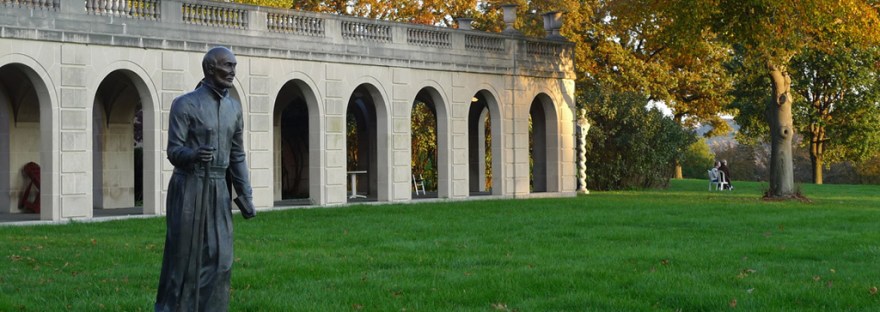
The Jesuit Center for Spiritual Growth in Wernersville, PA is closing its doors next month. For those of us who have been formed and sustained by this holy place, the closure is cause for weeping and wailing and gnashing of teeth. Can there also be peace, gratitude and acceptance?
Here’s the reflection I wrote on my final morning there . . .

June 4, 2021
How do we say goodbye to Wernersville?
For those of us who have been touched and formed by our time at the Jesuit Center—and we number in the thousands—this is not a rhetorical question. August 15th approaches. Waiting lists overflow for every remaining retreat, as people try to get here one last time, each making a personal pilgrimage to our various holy places.
This spring, I’ve been fortunate to offer a program at the Center during four consecutive weeks, giving me ample opportunity to wander the house and meander the grounds. Having made my first retreat at Wernersville as a college student 34 years ago, I find these walkabouts rich with memory. Yet, each step is accompanied by a quiet drumbeat, painfully echoing, it’s the last time . . . the last time . . . the last morning watching the sunrise from the east garden . . . the last walk to the fishpond . . . the last evening curled up in a library nook . . . the last bedtime prayer in the chapel balcony . . . the last contemplation punctuated by a train whistle, urgent as the voice of God. It is excruciating. How do we say goodbye?
One retreatant had an idea. Upon arrival, Elaine announced that, on behalf of friends at a distance unable to make a final visit, she’d be taking home a bag of soil from the property. In the good earth of Wernersville—even transplanted to flowerpots in distant locations—life would continue to flourish. She was sure of it.
Elaine’s idea had solid scriptural roots. In the second book of Kings, we meet Naaman the Syrian, a military commander with leprosy who travels to visit the prophet Elisha at the suggestion of a captive Israelite servant girl. Elisha sends word that Naaman should plunge himself seven times in the river Jordan. Initially put off by the command—such an ordinary act, such an unimpressive river—Naaman relents, goes for a sevenfold dip, and emerges from the water both healed and converted. “Now I know that there is no God in all the earth, except in Israel,” he says. “Please let me have two mule-loads of earth, for your servant will no longer make burnt offerings or sacrifices to any other god except the LORD” (2 Kings 5:15, 17).
Until I started trying to figure out how to say goodbye to Wernersville, Naaman’s request made me chuckle. Having figured out that there was only one God, why wouldn’t he also realize that he could worship that God anywhere—that he didn’t need special dirt to stand on? Scripture commentary notes that Naaman was suffering from “a common ancient misconception that linked and limited a deity to a particular territory.” Ah, yes. Poor Naaman. An ancient misconception.
And yet . . .
Sometimes the dirt matters. As I have been listening to countless people grieving the impending loss of the Jesuit Center, the stories they tell are about such particular spots. This tree. That vista. This corner of the garden. That angle of light in the Holy Spirit chapel. God has been very real for us here, and the house carries the weight of those experiences in its bones.
Praying in the east cloister walk recently, I said to God, “This is the place where I learned to encounter You.” I was thinking of my first retreat, where I had a powerful introduction to imaginative prayer, but also of the many subsequent retreats where God continued to show up in reliably surprising ways. What came to me immediately was this: Please remember that the important word in that sentence is “You,” not “place.”
Oh. Right. Yes.
The holiness of this place—this thin place, where the saints and beloved of God have walked and prayed and wept and laughed for nine decades—has facilitated our encounter with the Divine. But what happened inside these gates always has been for the good of the world beyond them, as generations of Jesuits, spiritual directors, and retreatants have carried that living relationship wherever we went. God has been the one doing the work, and God is everywhere—firmly linked to this place, but never limited to it.
Losing our locus of effortless encounter is painful. But everything important is already on the inside—of each of us. To ease the transition, perhaps we could return to that image of Naaman’s mule-loads of earth. What do we need to take with us, that we may know how to encounter God elsewhere?
More simply: What’s in your mule cart?
I don’t mean the question literally (though coffee cans of dirt might start disappearing, I know). Rather, I’d suggest, this is a propitious time to do an inventory. What are you really taking with you? What’s already inside? What are the gifts of your history here? What insights, what healings, what conversations and conversions, what discovered freedoms or renewed commitments are yours because of this place? What relationships abide, unbound by these walls? All these things are firmly packed in your metaphorical mule-cart.
I am writing this from a comfortable recliner in a third-floor bedroom on the main corridor, looking out over the Grove and Hain’s cemetery beyond. I’m pretty sure I just woke up here for the last time. In a few minutes, I will close my laptop, zip my suitcase, and stand in the doorway trying to absorb as much as I can before I depart for good. I wish I could bottle the smell, mysteriously unchanging over the years.
How do Isay goodbye? With a full heart. Grateful, grateful, grateful to have had this place for such a long time. Thankful for the Ignatian education I received here: a 34-year practicum in the movements of the Spirit. Remembering these words of the First Principle and Foundation: Everything has the potential of calling forth in me a deeper response to my life in God.
Even this?
Even this.
Amen.
 Christine Marie Eberle
Beautiful reflection, Christine. I have never been to this particular center, but I feel the same about the sacred ground in the retreat centers where I have had my special encounters with the Lord. I could feel your sadness and gratitude.
Blessings,
Elena
LikeLike
Dear Christine,
Thank you for your beautiful reflection which has touched my heart. I’m sitting in my first floor room here at Wernersville. And when I arrived on Monday evening it seemed I wasn’t alone in my desire to come one last time and to say goodbye to this special place.
I met you here on retreat too, and recently did a Saturday reflection with you by zoom at Cranaleith. I hadn’t thought of bringing dirt home but I do have many memories including (you might be surprised), the train whistle and the wheels making their clacking sound on the rails especially at night. My grandfather was a train engineer for the C&O railroad and has always been my loving image of God. So for me, the sounds of the train has been a reminder that God is near.
I can’t imagine what will become of this building and land, nor do I know where I will retreat hereafter (even St. Marys in Cape May has closed) but I hope our paths will cross again.
Blessings, Valorie
On Thu, Jul 15, 2021, 9:12 AM Christine Marie Eberle wrote:
> Christine Eberle posted: ” The Jesuit Center for Spiritual Growth in > Wernersville, PA is closing its doors next month. For those of us who have > been formed and sustained by this holy place, the closure is cause for > weeping and wailing and gnashing of teeth. Can there also be” >
LikeLike
HI, Christine,
This was beautiful. I am sorry that a place you love is closing, but this is a wonderful tribute to all it has provided to you and the many others who walked their grounds.
I suppose there is all kinds of grieving for many different things. This might be good for book # 3.
Take care, Mary
Mary R. Reilly
Assistant Professor of Psychology
School of Arts & Sciences
Gwynedd Mercy University
216 Connelly Faculty Center
215-646-7300 ex. 21147
Office Hours: MR 3:00-4:30; W 9:00 – 12:00; F 10:00 – 12:00 via Zoom during the Fall 2020 semester
Advisor, Sigma Phi Sigma, National Mercy Honor Society
The Center for Disease Control reports that due to COVID, young adults are now more susceptible to SUICIDE.
If you or someone you know feel overwhelmed by the challenges of our time, please, call
THE NATIONAL SUICIDE PREVENTION LIFELINE AT 1-800-273-8255.
What we do for ourselves, dies with us. What we do for others, remains immortal. R. Pines
________________________________
LikeLike
Very beautifully said. Bernadette
LikeLike
This is beautiful. I will go pull out my journals of a first and last retreat I had there in 2013 – reminded how this should live on in me.Thank you.Josie Moretto
LikeLike
Thank you for this beautiful reflection, Christine. I too am one of the many who have been privileged to know and love Wernersville. I was introduced to it by my friend and Chestnut Hill College colleague Jack Carboy S.J. When Jack was transferred from CHC to be on the staff of Wernersville, he invited me in his very low key to come up for a weekend and just rest and read ( we shared a mutual love of books). He, of course, knew that a lot more would happen for me there. I returned many times after that. It was there that I fell in love with the practice of silence which sustains me to this day. I also first learned about the Enneagram there. And yes I had so many favorite spots…many the same as yours. By the age of 71, I have had to let go and say goodbye to so many people and places. They all are a part of me still. I say goodbye to Wernersville with sadness that it will no longer be available for a new generation. But also with deep gratitude for all that it was for me and so many others. I will be praying for all of you who will be there in these final days. If you think of it, say a prayer for me up there in the choir loft (which I also liked to visit in the evenings) Peace and love, Laura
Sent from my iPhone
>
LikeLike