Spirituality, Travel, Writing

The Pelican

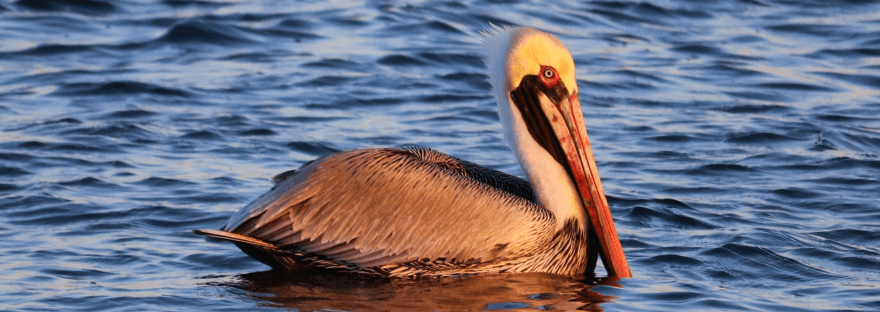
“There’s something wrong with that pelican,” I said. My husband and his brother and I had just completed half of an annual tradition: a Thanksgiving weekend beach walk on Marco Island, FL. We’d just reached the southern tip of the island and were preparing to turn around when I spotted the bird.

It had landed in a crevice between rocks on the jetty, presumably pursuing prey, but then it kept hanging out there in a most un-pelican-like fashion. Maybe it was just resting? (Porter and I did once see a hummingbird–one of those those masters of perpetual motion–sit in a tree for several minutes!) But then the pelican raised its wings as though intending to fly, yet did not achieve liftoff. It settled back down, tried again a minute later, and a minute after that. Something was definitely wrong.

I didn’t know which direction the tide was headed, but if nothing changed, eventually the water would be over the bird’s head. I kept hoping someone would notice . . . the man fishing off the end of the jetty, perhaps, or the woman collecting shells at the water’s edge. But the pelican was camouflaged, brown against brown, and each person walked away, unseeing.

Finally, another man and woman picked their way across the rocks, fishing poles in hand, and the pelican’s struggle caught the woman’s attention. She called her partner over, and together they snapped into action. He reached down and grabbed the end of the creature’s long, prehistoric beak, holding it firmly shut, while she pulled a knife from her pocket and went to work on the fishing line that had entangled the bird.
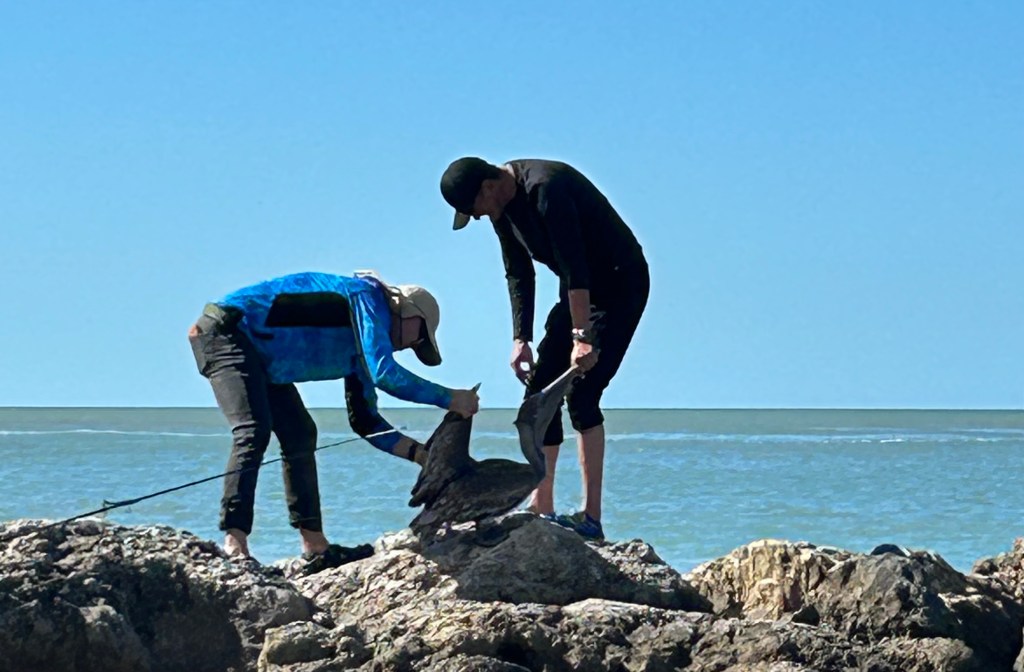
It wasn’t quick; the pelican’s thrashing had only made matters worse. But she kept at it, patiently, and the bird submitted to her care. Once they were satisfied that no strands remained, the man let go and the bird flew off, to applause from the small crowd that had gathered to watch.

The pelican landed in the water just a few yards away and remained there. Was it injured? Periodically, it gave a big flap of its wings without gaining altitude. Maybe the formerly trapped wing was damaged. Perhaps the bird was waterlogged from its captivity in the crevice, or maybe it was just stunned, trying to get its bearings. It really was time for us to turn around, but I couldn’t stop watching.

You know the story has a happy ending, right? Eventually, with a few strong flaps, the pelican lifted out of the water and flew an enormous test-circle, practically buzzing its rescuers as it passed the jetty. They noticed, and pointed, and the beachgoers cheered again.

The story didn’t stop with the rescue, though. As the pelican floated there, gathering strength, the couple was gathering all the old fishing line they could find among the rocks, eventually amassing armloads. It wasn’t their mess, but they cleaned it up anyway.

It wasn’t their mess,
but they cleaned it up anyway.

These days, when so much of the news makes us heartsick (yet unable to look away), what a relief to witness a reminder of the basic goodness of humanity.

This is the point in a blog post where I’d ordinarily launch into a little lesson. I’d unpack the pelican story, musing about our Advent call to be attentive, perhaps, or to help others with the gifts and skills God has given us, or to care for creation, or to leave a place better than we found it. But honestly, I think this story speaks for itself.

More importantly, Eric Clayton has already written that essay, in a beautiful post from Ireland called “The Man Who Untangles Seagulls.” Different coast, different bird, but a similar (amateur) rescue, which led Eric to muse about our call to show up in the moment and respond as best we’re able. Click the image below to read it!
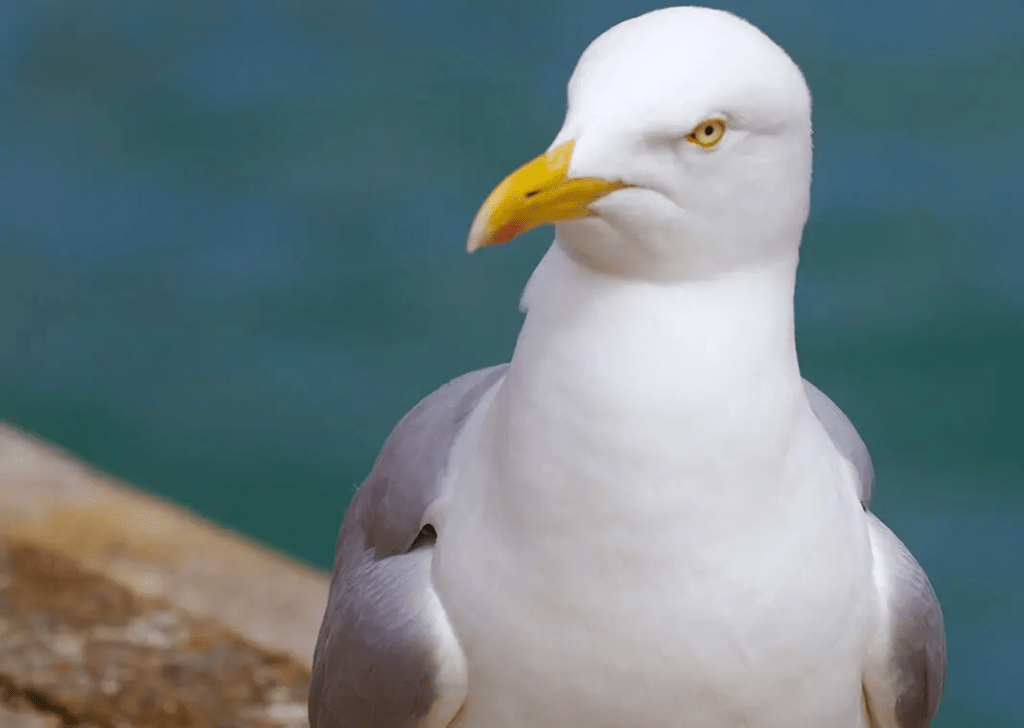
“The Man Who Untangles Seagulls” by Eric Clayton at IgnatianSpirituality.com

May you reap the blessings of attentiveness, this Advent and always!
Scripture, Spirituality

Play Ball!

The Wisdom of Occasional Obliviousness

I watched a lot of baseball last month. (To be clear: I watched a lot of baseball for me.) After the Phillies were eliminated in post-season play, I embraced those scrappy Toronto Blue Jays and followed them all the way to the heartbreaking eleventh inning of game seven of the World Series.

A curious thing happens to me when I’m watching baseball.  I don’t exactly forget which team I’m rooting for, but occasionally I do cheer at the wrong time. Sometimes, when the “other” side pulls off a spectacularly good play or “my” side makes an egregious error, I respond in a way that causes my husband to shoot me a baffled look.

I could blame it on the change of uniforms from home to away, or on my divided attention. But maybe it’s something more human. The player diving into a stolen base with a quarter inch to spare deserves my admiration, just as the player running backwards to catch the ball but losing it in the lights deserves my sympathy. In that moment of relief or disappointment, the categories of “us and them” dissolve. I’m happy for the guy; I’m sorry for the other guy, even if I’m not “supposed” to be.

In Fr. Greg Boyle’s new book, Cherished Belonging, the Jesuit founder of Homeboy Industries says that God’s dream for the world would be to replace “Us VS. Them” with “Nobody VS. Anybody.” Perhaps that’s what Saint Paul was getting at when he encouraged us to “rejoice with those who rejoice, weep with those who weep” (Romans 12:15).

No Us and Them, just Us. This is, indeed, God’s dream come true.

Fr. Greg Boyle, SJ

In these polarizing times, it is so easy to demonize the “other side” (whichever side of whatever thing that happens to be for us). But can we also recognize goodness or sorrow, even in people whose views and actions we abhor? Can we acknowledge flaws and blind spots, even in people pursuing causes dear to our hearts? Can we forget—just for a moment—who we’re supposed to be rooting for, and simply be humans together?

Nobody VS. Anybody is a tall order. Most days, I’m not there; I’m too angry at politicians and corporations who put job security and profits ahead of human decency, and who gin up enemies for people to fear in order to keep us pitted against one another. That’s why I’m grateful to baseball: for providing the occasional moments of obliviousness that allow me to glimpse how God’s dream might be possible.

Grief, Spirituality

Walking Toward Love

A Friendship in Ten Movements

1–2 minutes
Jeffrey Noel Draine, 1962 – 2025

The world lost a good one this month, when, at the age of 62, Jeff Draine went home to the God he loved after eleven years living and dying with Alzheimer’s. (You can read his beautiful obituary here.) Jeff was the first friend I made as a full-blown adult. After college graduation, I moved into the Freedom House community in Richmond VA, where Jeff and I overlapped for just a week. He left briefly to run a local day care center but soon returned, moving into the bedroom next to mine. (Our headboards each backed up to a connecting door, upon which I frequently pounded when Jeff’s thunderous snoring awoke me. “I dreamed the house was falling down again,” he would say.)

Neither of us would have suspected, in those early days, that we would be friends forever—let alone family—and we certainly never envisioned that I’d be one of the last people to kiss that big head of his before he died. But there you have it. We wound up walking together for thirty-eight years, all the way to the end of his road. Here then, in honor of Jeff, is a “top ten” list of sorts: ten movements that capture our ever-shifting relationship. I hope this chronicle of how one friendship endured and evolved over time will speak to your own uncategorizable loves. Cherish them!

Continue reading “Walking Toward Love”
Spirituality, Travel, Writing

An Analog Adventure Awaits

Yesterday morning, I found myself missing the oddest thing: not having a laptop.

Let me explain. For more than thirty years, at least one morning in August has found me on the deck at my uncle’s beachfront condo in Wildwood NJ, drinking coffee and watching the sunrise. Yesterday was one of those days. I was resisting the pull of my devices, temporarily keeping at bay the emails to read, the editing to do, the blog post to write. In prayer, I let images of previous years on that deck wash over me, until I settled on a particularly fond memory: vacation mornings when my mom was still alive.

Wildwood Deck, circa ???

I’d rise first, slip out of our room, brew the coffee, head to the deck, pray and/or journal, then get comfortable with whatever novel I was reading at the time. Presently, the sliding door would open and there would be Mom, coffee in one hand, novel in the other. We’d talk a while, then sink into our books until the sun drove us back into the air conditioning.

Mom died in 2007, before everyone was schlepping their MacBooks to the shore, before anyone but the earliest adopters had a smartphone. Unless I brought some thinking to do, there was simply no such thing as working on vacation. What a luxury!  Although I appreciate the flexibility of my freelance existence, the danger—as I’m sure you well know—is that work-from-anywhere easily morphs into work-from-everywhere, devouring the very notion of down-time.

That’s why I’m very excited about the week ahead.

Tomorrow, Porter and I fly to Ottawa to begin a bucket-list adventure: traveling across Canada by train. Picture a sleeping compartment, dining car, observation lounge, the works!  There will be only one thing missing, I discovered as I read the fine print recently: there is no WIFI on the Canadian. I wasn’t going to be bringing my laptop anyway (in the interest of traveling light), and since international roaming is wicked expensive on my mobile plan, I’m just going to have to pass the time the old-fashioned way.

I’ll confess, I’m equal parts psyched and anxious. I’ve probably packed too many books; for months, I’ve been curating train-worthy paperback novels I can leave behind as I finish. (More, of course, are downloaded on my various book apps.) Should I choose to write instead of read, I have a notebook (the analog variety), plus I’ve saved the last several Sunday Times crossword puzzles. We have a deck of cards. There will be three meals a day, with people to meet across the table at each, and of course there’s the sleeping, but still . . . even if the train runs on time (which we are assured it will not), it’s a 96-hour, four-day journey without WIFI.

I can’t wait to tell you all about it . . . but I must! Stay tuned for stories from the far side.

May your own August days come bearing whatever graces you need.

Christine

NYC Skyline
Retreats, Spirituality, Writing

Jennifer Sawyer

Part of the Thankful Thursday Series

Jennifer Sawyer is my road not taken.  

When I was a sophomore in high school, I attended forensics nationals in NYC and fell in love with the place. I began dreaming of going to Fordham, whose Lincoln Center campus had hosted some of the events. After four years as a communications major in the Big Apple, I figured, I’d snag a job as an editor and pursue my own writing after hours.

NYC Skyline

All it took to derail that dream was my mother’s discovery that the Fordham campus where I’d be living and studying was in the Bronx. (Cue scary music.) Whatever she was picturing there did not include her only daughter. Mom put her foot down, and I followed a different path.

Jen Sawyer headshot

Two decades later, a Massachusetts gal had a similar dream—and a more accommodating mother. Jen Sawyer is a Fordham alum holding a degree in communication with a concentration in American Catholic studies. After graduation, she deployed her storytelling talents in some fascinating venues, working for “The Martha Stewart Show,” and “Who Wants to Be a Millionaire,” as well as the Cooking Channel and Yahoo. As a freelance writer, she has contributed to “Good Morning America,” Metro, the NY Post, Fordham Magazine, America, and more. She and her husband lived the dream in a tiny apartment in New York before finding a home in New Jersey, where they now live with their 2-year-old daughter, Nora.

Thanks to Jen’s Jesuit education, one question pursued her through the whirlwind of writing, editing, and producing: “Am I doing the most good that I can in my job?” That question led her to combine her skills and passions at Busted Halo, an online platform that presents “a more joyful and meaningful experience of Catholicism” through articles, videos, podcasts, radio, and more. She began as Digital Content Producer; by the time we met in Jonathan Malesic’s spiritual nonfiction class, she was Editor-in-Chief.

One question pursued her through the whirlwind of writing, editing, and producing: “Am I doing the most good that I can in my job?” 

As the culminating exercise of the class, we had to pitch an article. I crafted a pitch for Busted Halo, then actually pitched it. Jen and I bounced some ideas around. I wrote the piece. She made it better. In December, BH published “This Advent, Let’s Pray with Our Foremothers in the Faith.” Throughout the process, Jen was a delight to work with. Half a year later, she and I had the joy of participating in the Ignatian Creators Summit together, along with Jon Malesic and several other members of the class.

I so enjoyed getting to know Jen personally in the “temporary alternative space” that the good folks at the Jesuit Media Lab created for us. From taking risks in small-group sharing to swapping stories on the bus ride home from Camden Yards (Let’s go, O’s!), we were at ease in one another’s company. Jen has a great smile. She’s funny, friendly, and fully engaged in the work of helping others connect life and faith in meaningful ways. The world is lucky to have her.

Here’s what she had to say about Finding God Along the Way: Readers don’t have to trek 300 miles across Spain to appreciate the wisdom gleaned from Christine Eberle’s time walking in the footsteps of St. Ignatius of Loyola. With profound insight, vulnerability, and humor, Eberle invites readers to journey alongside her as she reflects on the modern-day relevance of Ignatius’ life and teachings. “Finding God Along the Way” is a must-read for those curious about Ignatian Spirituality and its capability—like pilgrimage—to transform our hearts, our minds, and our perspectives.

For the opportunity to cross paths with the road not taken—and to admire it wholeheartedly yet without regret—I am truly grateful.

Uncategorized

David W. Burns

Part of the Thankful Thursday Series

There’s an almost thirty-year gap in the story of my friendship with Dave Burns. I have clear (ish) memories of our time together as undergrads at Saint Joe’s: arguing in honors seminars, collaborating on SEARCH retreats, that sort of thing. When the Challenger exploded, Dave and his girlfriend (now wife) Kate and I watched the coverage together in Xavier Hall. There’s a fun cap-and-gown picture of us in front of the student center in 1987, and then . . . I was forty-nine, walking into church for my father’s funeral, trying to figure out who that vaguely familiar middle-aged man was, smiling at me kindly from a back pew.

Cultivating the “Man of Mystery” look!

Since I reconnected with Dave ten years ago, our shared passion for writing has helped us make up for lost time.  He sent me an unpublished draft of a fun romp in which his protagonist was a fast-talking, wise-cracking, self-deprecating Gorgon (yup—snakes for hair, paralyzing death-gaze). Then he confessed to having also written a six volume post-apocalyptic series with some surprisingly Biblical turns. I asked for the manuscripts one at a time, and thoroughly enjoyed the ride.

Dave’s writing chops garnered some attention in 2019 when his excellent short story “Night Surf” won a Writer’s Digest grand prize. (You can read the story and an interview about it here.) And in 2022, he entered a Pitch Week competition at When Words Count—the writers’ retreat in Vermont that opened the door to my first published book—and swept all the categories, winning the top prize with that little Gorgon tale, now out in the world as Heart of Stone: Book One of The Medusa Chronicles. (Keep writing, Dave; we want to know what’s next for Kyra!)

Besides being a prolific writer, Dave is a New Jersey trial attorney. What do world-building in a fantasy novel and making a persuasive case to a jury have in common? They both rely on his gift for storytelling. In the Writer’s Digest interview, he says that’s the aspect of trial work he enjoys most: “having the opportunity to tell what I hope is a true story to a jury and then letting them weigh in on what they think of it.”

I haven’t seen Dave in the courtroom, but as a fan of his fiction, I believe that the truth at the core of each of his stories is what makes them so good. His characters wrestle with eternal, relatable themes of meaning and purpose, even when they’re battling mythological assassins or defending a citadel from vampire attacks.

His characters wrestle with eternal, relatable themes of meaning and purpose, even when they’re battling mythological assassins or defending a citadel from vampire attacks.”

Dave was one of the early readers for Finding God Along the Way, and I can picture exactly where I was when he called to tell me he had finished reading itI was giving a retreat in Hampton Bays NY, out for a long walk after dinner when my cell phone rang. “I remember finishing the last Lord of the Rings book as a kid,” Dave said, “and bursting into tears because I knew it was over and there wouldn’t be any more. Not since then have I been so sorry to reach the end of a book!”

Here’s what he had to say in writing: “Do you want to go for a walk with me?” With this deceptively simple question, author Christine M. Eberle launches us on a journey that is both physical and spiritual as she recounts her month-long, 300-mile trek through northern Spain with a group of fellow pilgrims to visit the key sites in the life of Ignatius of Loyola. In Finding God Along the Way: Wisdom from the Ignatian Camino for Life at Home, Eberle shares the perils and pitfalls of each stage of her travels, as well as the moments of sublime grace and beauty she encountered, while recreating each wild and wide vista of the Ignatian Camino trail—from the formidable heights of its mountains to the fragrant vineyards and arid deserts of its lowlands.

With her trademark tongue-in-cheek wit and relentless honesty, Eberle crafts both an entertaining and accessible memoir and a guidebook for meditating life’s most important questions. At turns harrowing and joyous, this is a book that lets the reader inhabit each step of an uplifting and transformative odyssey few will get to experience firsthand. By the time the author reaches the pinnacle of her journey and arrives at the monastery at Montserrat, the reader will feel an undeniable sense of accomplishment and triumph.

For new iterations of old friendships, I am truly grateful.