Spirituality, Travel, Writing

The Pelican

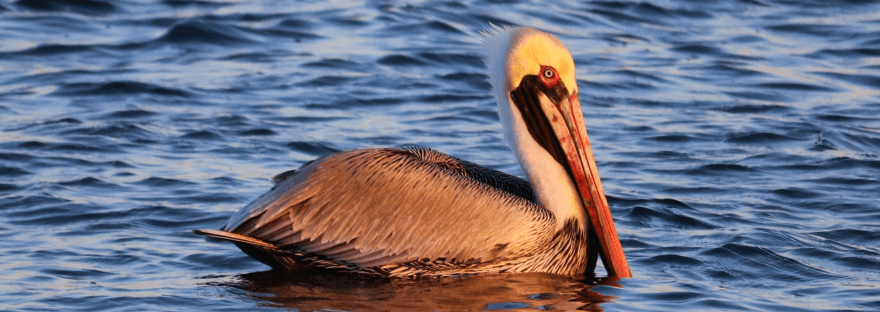
“There’s something wrong with that pelican,” I said. My husband and his brother and I had just completed half of an annual tradition: a Thanksgiving weekend beach walk on Marco Island, FL. We’d just reached the southern tip of the island and were preparing to turn around when I spotted the bird.

It had landed in a crevice between rocks on the jetty, presumably pursuing prey, but then it kept hanging out there in a most un-pelican-like fashion. Maybe it was just resting? (Porter and I did once see a hummingbird–one of those those masters of perpetual motion–sit in a tree for several minutes!) But then the pelican raised its wings as though intending to fly, yet did not achieve liftoff. It settled back down, tried again a minute later, and a minute after that. Something was definitely wrong.

I didn’t know which direction the tide was headed, but if nothing changed, eventually the water would be over the bird’s head. I kept hoping someone would notice . . . the man fishing off the end of the jetty, perhaps, or the woman collecting shells at the water’s edge. But the pelican was camouflaged, brown against brown, and each person walked away, unseeing.

Finally, another man and woman picked their way across the rocks, fishing poles in hand, and the pelican’s struggle caught the woman’s attention. She called her partner over, and together they snapped into action. He reached down and grabbed the end of the creature’s long, prehistoric beak, holding it firmly shut, while she pulled a knife from her pocket and went to work on the fishing line that had entangled the bird.
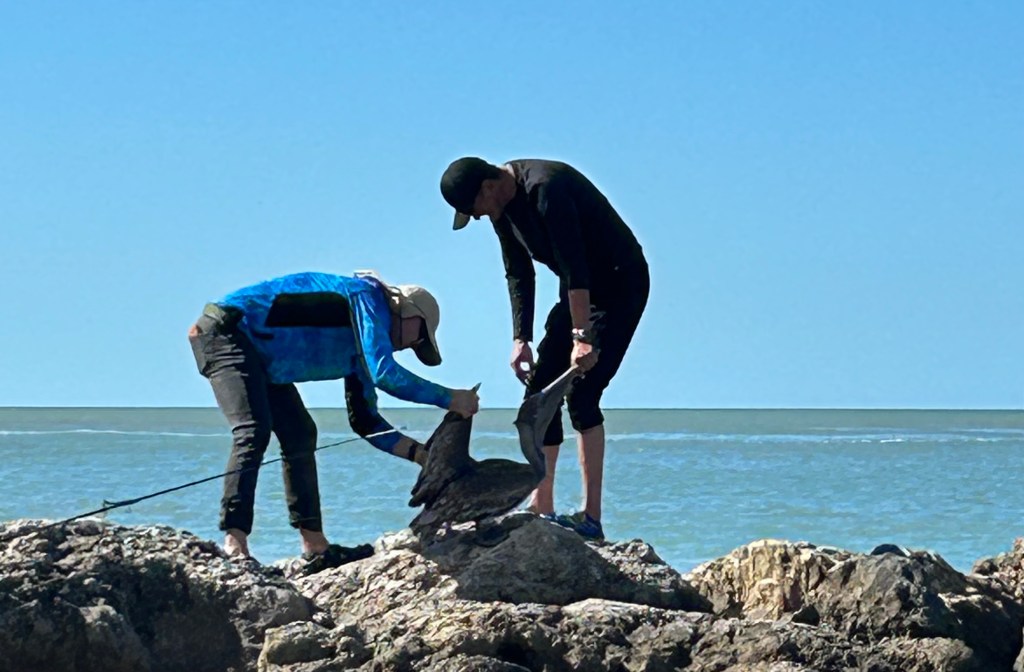
It wasn’t quick; the pelican’s thrashing had only made matters worse. But she kept at it, patiently, and the bird submitted to her care. Once they were satisfied that no strands remained, the man let go and the bird flew off, to applause from the small crowd that had gathered to watch.

The pelican landed in the water just a few yards away and remained there. Was it injured? Periodically, it gave a big flap of its wings without gaining altitude. Maybe the formerly trapped wing was damaged. Perhaps the bird was waterlogged from its captivity in the crevice, or maybe it was just stunned, trying to get its bearings. It really was time for us to turn around, but I couldn’t stop watching.

You know the story has a happy ending, right? Eventually, with a few strong flaps, the pelican lifted out of the water and flew an enormous test-circle, practically buzzing its rescuers as it passed the jetty. They noticed, and pointed, and the beachgoers cheered again.

The story didn’t stop with the rescue, though. As the pelican floated there, gathering strength, the couple was gathering all the old fishing line they could find among the rocks, eventually amassing armloads. It wasn’t their mess, but they cleaned it up anyway.

It wasn’t their mess,
but they cleaned it up anyway.

These days, when so much of the news makes us heartsick (yet unable to look away), what a relief to witness a reminder of the basic goodness of humanity.

This is the point in a blog post where I’d ordinarily launch into a little lesson. I’d unpack the pelican story, musing about our Advent call to be attentive, perhaps, or to help others with the gifts and skills God has given us, or to care for creation, or to leave a place better than we found it. But honestly, I think this story speaks for itself.

More importantly, Eric Clayton has already written that essay, in a beautiful post from Ireland called “The Man Who Untangles Seagulls.” Different coast, different bird, but a similar (amateur) rescue, which led Eric to muse about our call to show up in the moment and respond as best we’re able. Click the image below to read it!
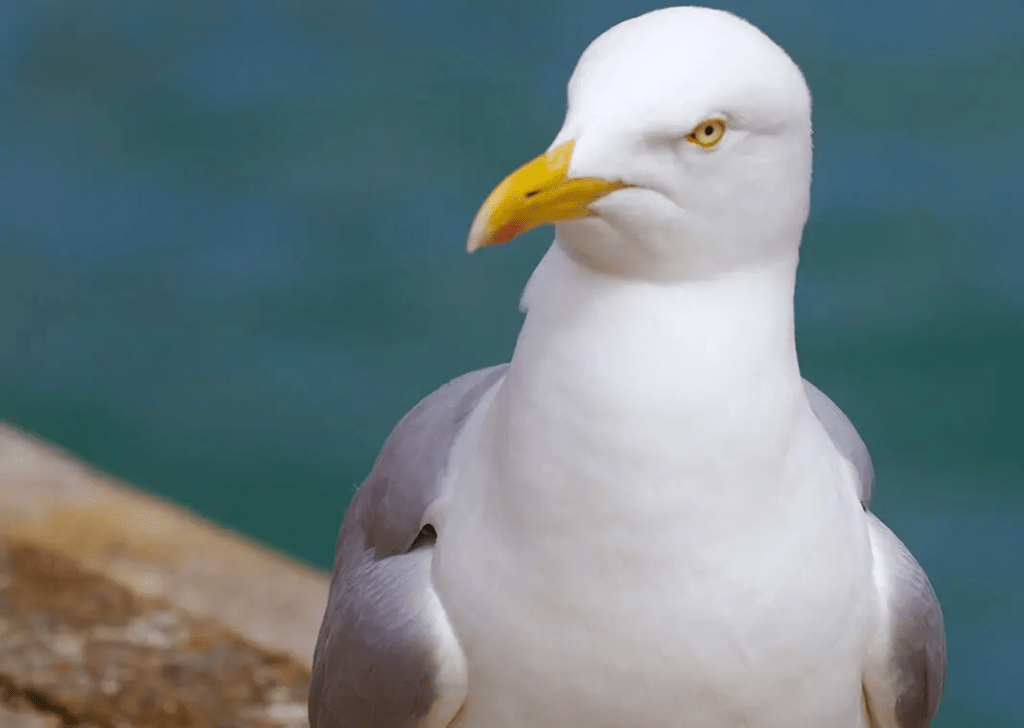
“The Man Who Untangles Seagulls” by Eric Clayton at IgnatianSpirituality.com

May you reap the blessings of attentiveness, this Advent and always!

Travel, Writing

Train Time

When Porter and I decided to take Via Rail across Canada, we had no doubt we’d enjoy ourselves. We love train travel, and the sleeper-car experience was a real “bucket list” item for each of us. I was a little worried about how I’d handle the absence of WIFI on the Canadian, but mostly I was just curious about the outer and inner journeys. Here’s what I discovered . . .

Large Vistas and Small Spaces

Canada is vast. The province of Ontario takes two days to traverse by train, with nothing but evergreens and lakes flying by the window. Manitoba and Saskatchewan come next, all prairies and farmland. Then it’s Alberta, gateway to the Rockies, which are so much bigger than my east coast existence prepared me for. Across Alberta then into British Columbia and down through Washington, we beheld forests, mountains, and even glaciers of enormous proportions. Everything was gorgeous. It was hard to peel my eyes away.

And yet, the snug scale of train life was also a pleasure. Even though we’d packed lightly for the extended trip, we could only bring into our compartment the things we absolutely needed on the train. Comfy clothes, in layers. A few books and crossword puzzles. Toiletries. Travel mugs. The compartment provided enough nooks and hooks for us to have a place for everything. It felt like a small private room in a (gently rocking) retreat house. We could venture over to the dining car, lounge car, and dome car, but that was the extent of our world for four days. I was blissfully content.

In my last blog post, I reminisced about mornings at the Jersey shore before laptops and smart phones, when “I’d rise first, slip out of our room, brew the coffee, head to the deck, pray and/or journal, then get comfortable with whatever novel I was reading. Presently, the sliding door would open and there would be Mom, coffee in one hand, novel in the other.” Mornings on the train were remarkably similar, except I’d take the thermos of coffee I’d prepped the night before to the darkened dome car and pray while watching the train’s headlights illuminate the landscape ahead. Presently, Porter would slide into the seat next to me so we could watch the sun transform the pre-dawn sky together. It was a beautiful reminder of God’s slow and steady work, even in the darkness of our lives.

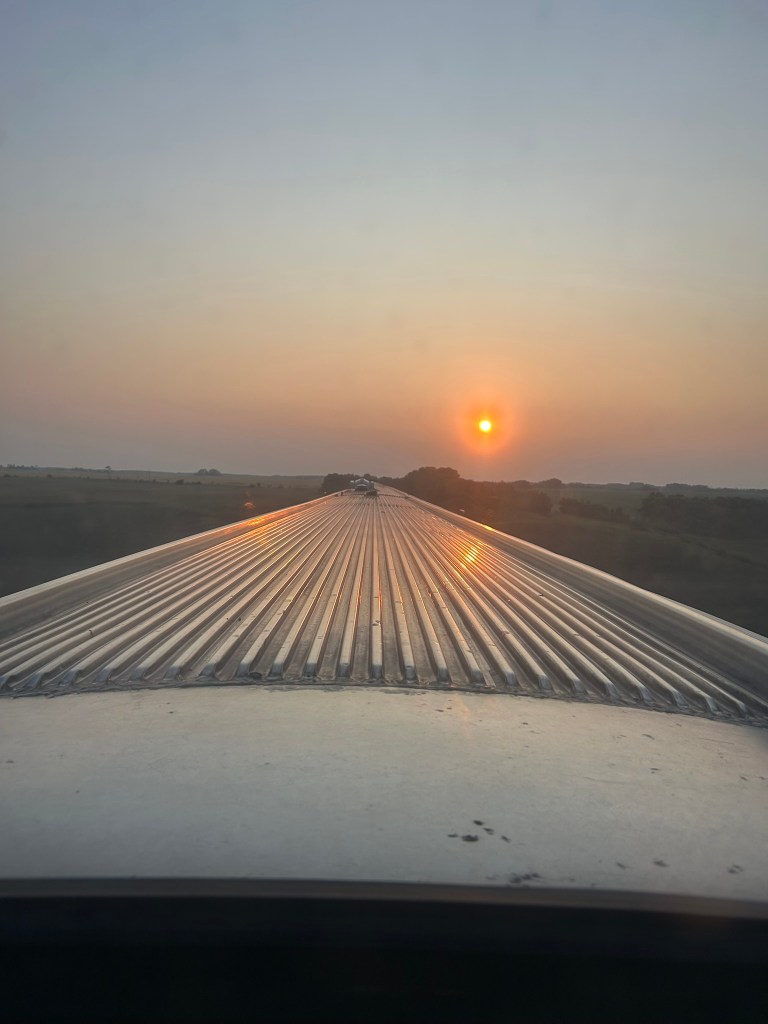
Sunrise out the rear window of the Dome Car
Continue reading “Train Time”
Spirituality, Travel

It’s the People. (And the Dogs)

Seventy-seven miles walked. Nine buses, six ferries, five trains, three flights, two subways, and one tram. What do I remember most from two weeks in Scotland and Ireland? The people. (And their dogs.)

Maybe my introverted self is just more inclined to talk with strangers abroad, or maybe the Scots/Irish are more naturally garrulous and convivial. Either way, on a trip in which gorgeous scenery was a given and meaningful time with pilgrim friends (Iona) and dear family (Omagh) an expected high point, many surprising human and canine encounters linger in my imagination.

Having arrived in Edinburgh at the time of the King’s Garden Party, Porter and I were treated to the sight of many ladies in fancy hats and men in full kilt regalia. At a pub for dinner that night, we struck up a conversation with an older couple at next table. They’d come all the way from the Orkney Islands to have tea at Holyrood Palace with Charles, Camilla, and eight thousand fellow Scots. They were absolutely radiant about the experience, but also about their home island—so far north that it was formerly owned by Norway! Despite the challenges of the man’s thick brogue, Porter and the husband quickly launched into a conversation about gardening, while his wife and I discussed the delights and difficulties of life in such a far-flung place. (I had an easier time, as she was striving to “speak more properly” in the capitol!)

In the port town of Oban, we had dinner in a pub with shared tables, where we met a young couple whose English bulldog, Bluebell, was doing a fine job of keeping the floor crumb-free. (Scotland, you had me at dogs-in-pubs!) Later in the meal, we chatted with a man named Ari who was riding his motorcycle to Ireland—from Finland. Crossing countries by bike and channels by ferry, he was following his bliss with precious little baggage. Though I’d been feeling pretty good about my streamlined packing (no giant suitcase for me this time), I felt a flurry of envy for the freedom he described.

Monty

On the isle of Iona, we took a boat to the tiny isle of Staffa to see nesting puffins and their pufflings. Cuter birds may not exist anywhere! But again, the highlight was a conversation I struck up with boat mates Gerry and Lynn, who were staying on the Isle of Mull with Monty, their three-year-old “flat haired double poodle” (the shaggy offspring of a cockapoo and a golden doodle). Though they’d done a lot of international traveling earlier in life, now they only want to go where they can take their dog. Consequently, they are getting to see some beautiful parts of their own country. (Thank goodness Monty likes boats!)

The next day, we bundled up and took a long walk to one of Iona’s beaches, sharing a picnic lunch while sitting on the damp sand with our backs against a warm rock. Walking back, we passed an English bulldog whose people looked familiar. “Bluebell?” Yes indeed–and her companions Andy and Sara, who were on a day trip from Oban. While we were marveling at running into each other again, approaching from the other direction came Monty, Gerry, and Lynn on a day trip from Mull. What were the odds that we’d simultaneously encounter two dogs whose names we knew—who were staying on two other islands? The magic of Iona knows no bounds!

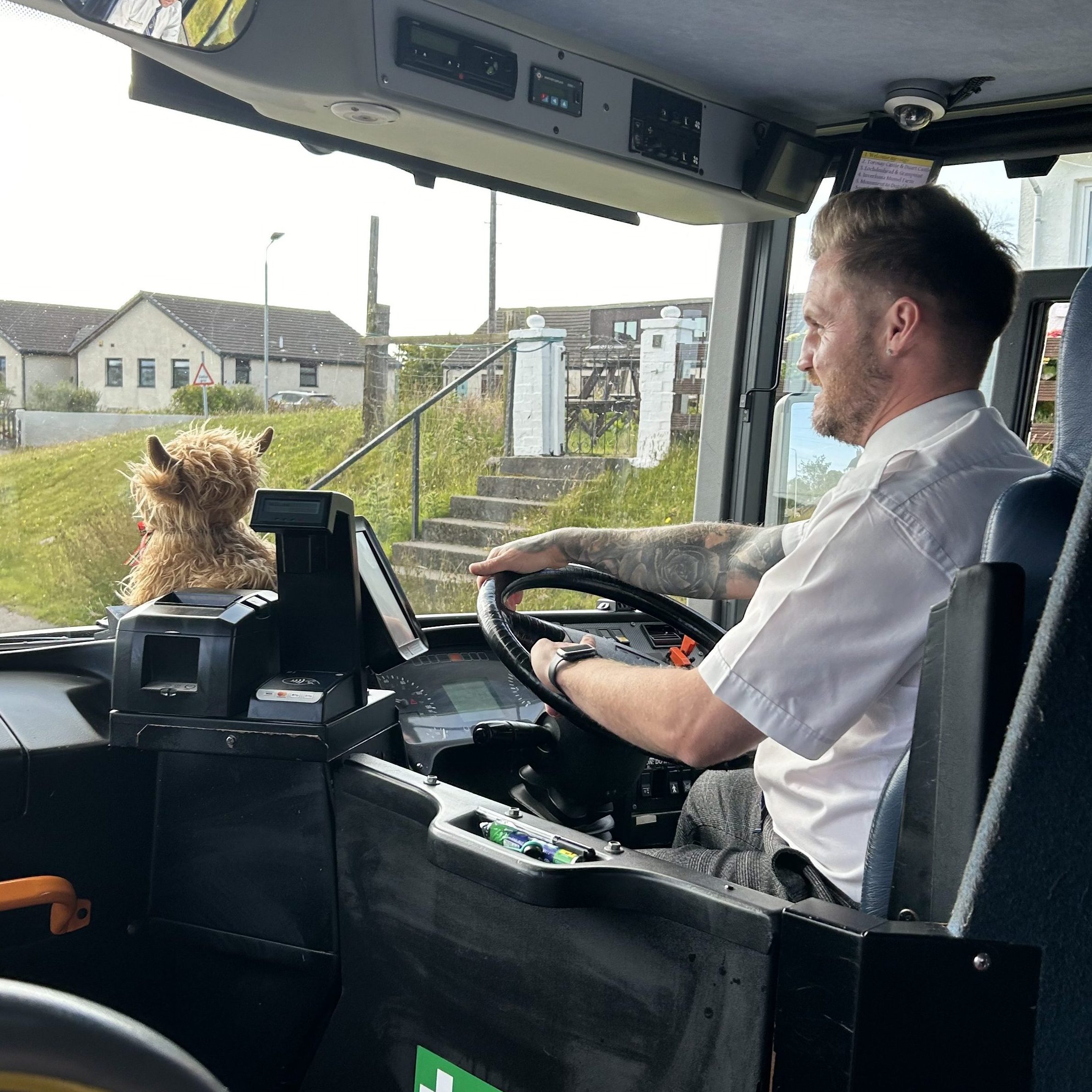
Andrew and his “wee highland coo”

Leaving Iona for Glasgow, we took a quick ferry hop to Mull and then a 75-minute bus ride across its length on a (mostly) one lane road. Our bus driver, Andrew, entertained us the whole way, greeting people out the window, telling us their occupations and bits of their life stories. Passing his own house, he said “Look, there’s me wee dog—and ach, the gate is open!” Shouting at his phone (no hands off the wheel for him), he called his wife to alert her.

Glasgow was our last stop in Scotland. We arrived under the weather, less energized to navigate another new city. On our second night, walking through a quiet neighborhood on our way to an Indian restaurant, we were greeted by a lady wrangling trash cans outside an Episcopal church. Our American accents outed us at once, so she asked how our holiday was going. I mentioned how much we’d been enjoying the people, but confessed that she’d been the first in Glasgow to speak to us. “That’s terrible,” she exclaimed. “You should come in for a cup of tea!” Clearly, she meant it, and had we taken her up on the offer, I’m sure it would have been a fabulous conversation. Just minutes from our dinner reservation, we declined, but were comforted to know that, even in the big city, Scottish folks have open doors and open hearts.

Of course, it’s not just the Scots. Regional cultures vary, but people are people and warmth abounds. Catching a glimpse into the lives of some of God’s other children and discovering fond connections there is one of travel’s great gifts.

How to open myself to such delightful encounters when not protected by travel’s anonymity—now there’s a question. How to be one of those people for those I encounter back home is an even better one.

How might you open yourself to a delightful encounter today?

Puffins
Puffins on Staffa (photo courtesy of Charlie Eisenmann, who got closer)