I am grateful to my friend Alli Bobzien (whom I met during the amazingly generative “Ignatian Creators Summit” offered by the Jesuit Media Lab last summer) for offering me a guest spot on her Substack, The Pondering Heart.
In it, I dive into my long-standing gripe about tomorrow’s Gospel and how I finally got my heart around it.
While you’re on Alli’s site, be sure to poke around and read some of her own beautiful writing. My favorites among recent posts are “The Heart of the Fire” and “The Inkeeper’s Daughter.” The first is a poem and the second a dive into historical/biblical fiction, but both are gorgeous!
When you sing in a church choir and Christmas falls mid-week, you know you’re going to be spending a lot of time in church: Christmas Eve and/or Day (possibly multiple services); then Saturday and/or Sunday; and then—if you’re Catholic—the Solemnity of the Blessed Virgin Mary, Mother of God. That’s right: on New Year’s Eve/Day, we have a holy day of obligation honoring the woman who convinced her son to makemore wine for a party. (And people say the Church doesn’t have a sense of humor.) This pitches us into another weekend, after which even people who’ve had the whole two weeks off are firmly back at work and you’ve been to church like 72 times.
Not that I’m complaining. Really! These liturgies celebrate things that are profound and powerful and—if you’ll pardon the bumper sticker wisdom—the reason for the season. But that’s not the only thing we’re doing in church these days. Christmas, as it turns out, is also a season for funerals.
Sometimes that’s because people go “home for Christmas” (in the words of a Steven Curtis Chapman song that should come with a pack of tissues) or hold on for one last holiday before letting go. Other times, a loved one has died weeks or even months earlier, and family is spread across the country, and this is the best time to bring everyone together.
We had two funerals at St. Vincent’s this week. The first was for the matriarch of a large family, whose husband we buried earlier this year. With a full church and two pews’ worth of grandchildren looking on, her three handsome sons stood at the ambo and wept their way through the eulogy. It was beautiful.
The second was for a woman who had been living in a nursing home for many years, who died two weeks shy of her 100th birthday. She had one mourner: a niece in her eighties. And yet we cut no corners. The five-person bereavement ministry team and other parish staff were there; two of them sat with the niece and found each song in the hymnal for her. We did all the music. Our pastor gave a full-blown homily. It was beautiful.
It’s like eternity in a snow globe.
There is something deeply poignant about a Christmas funeral. It’s like eternity in a snow globe. The light of the paschal candle glows in the twinkle of hundreds of tree lights in the sanctuary. The casket or urn rests just a few steps from the babe in the hay. And above it all looms the crucifix—which at St. Vincent’s is a mural that includes the Blessed Mother reaching for her son, as she does in the manger tableaux below. Birth and death and the promise of new life, all together in that one holy space.
‘Tis the season for curated book lists! Here’s my quirky, second annual contribution, with just two rules: I have to 1) know the author and 2) like the book. (And I can’t just have mentioned it in my Thankful Thursday posts, though there were a lot of great reads in there!)
If you’re shopping online (I’m looking at you, Cyber Monday), I beg of you,get not your books on Amazon. Local independent bookstores need our December dollars! If you don’t have one near you, try Bookshop.org, where you can indicate which local indie your purchase will support, or Barnes & Noble, a bona fide brick-and-mortar chain.
And if you want to gift any of my books for Christmas (including Finding God Along the Way) just email me and I’ll move heaven and earth to get personalized, signed copies to you or your chosen recipients.
Okay, here’s the 2024 edition of Books I Love by People I Love (or at least like and esteem a whole lot), alpha by author:
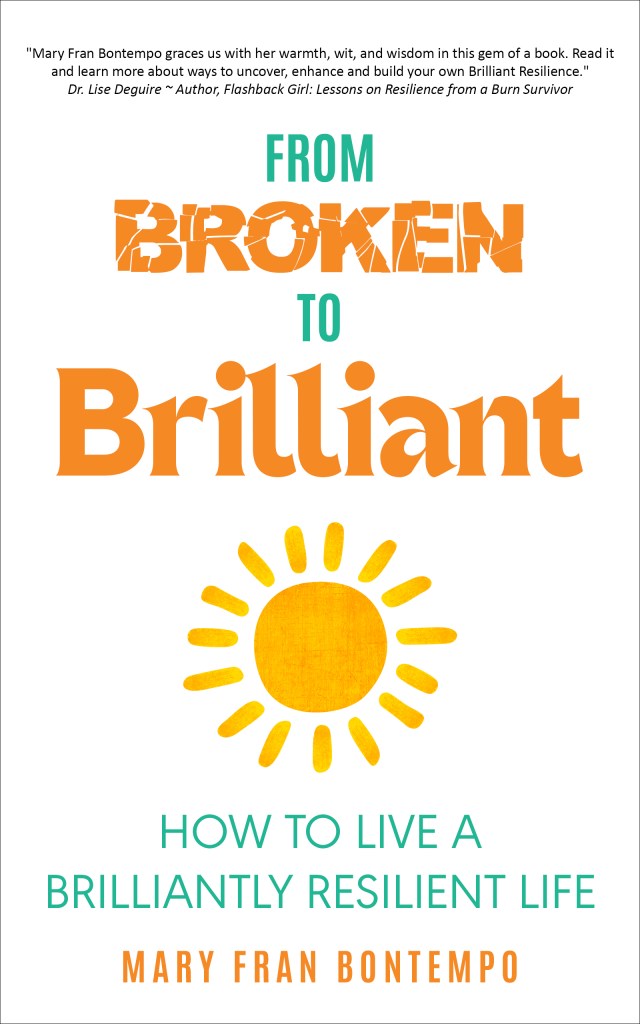
From Broken to Brilliant: How to Live a Brilliantly Resilient Life, by Mary Fran Bontempo When you are racing to respond to one of life’s many crises, Mary Fran Bontempo has your back. This book—published on Kindle today—is a “go bag” of useful strategies: nuggets culled from her own hard-earned experience and the wisdom of more than two dozen podcast guests. Delivered in her characteristic sassy style (she puts the “smart” in “smart ass”), the book also includes practical reflection questions to help you apply each insight to your own life. It’s a master class in getting a grip while remaining endlessly kind to yourself! GIFT THIS TO anyone at whom life has thrown a serious curveball.
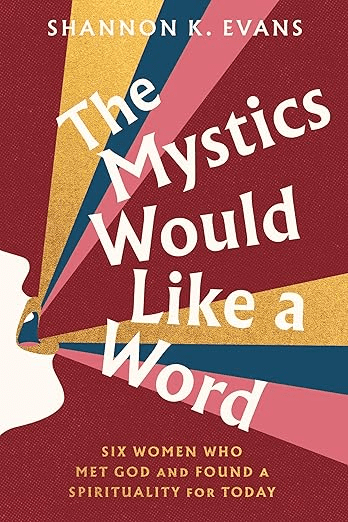
The Mystics Would Like a Word: Six Women Who Met God and Found a Spirituality for Today, by Shannon K. Evans By day, Shannon Evans is the culture and spirituality editor at the National Catholic Reporter; she’s also the author of three books and is one of my Ignatian Creators Summit pals. Here she has taken six mystics whose stories we may only think we know and paired them with searingly honest tales of her own life and our contemporary culture. The result is both riveting and thought-provoking. GIFT THIS TO anyone who likes their spirituality generously seasoned with sass.
Domestic Violence Awareness: Listen for the Whispers of Abuse, by Jennifer Gardella How do you tell the difference between a jerk and an abuser? This is the topic that Dr. Jennifer Gardella tackles in her eye-opening book. Rooted in her own story but determined not to stop there, Jen’s mission is to “empower victims and their support systems to recognize signs of abuse beyond broken bones and bruises, and then learn how to provide support.” GIFT THIS TO anyone who harbors concerns about a loved one but is perplexed about what to do next.
Redeeming Power: Exercising the Gift as God Intended / 12 Lessons for Catholics Who Lead, by Ann Garrido One of the things I often say about Ann Garrido is that she has a keen sense of what needs redeeming (see Redeeming Conflict and Redeeming Administration). In her third book in the series, she addresses the hard reality that leadership confers power, and power can be used hurtfully. As a remedy, Ann gives us a dozen strategies for the healthy and holy use of power, as well as twelve role models to follow. GIFT THIS TO anyone who finds themselves uncomfortably “in charge,” especially in a church setting.
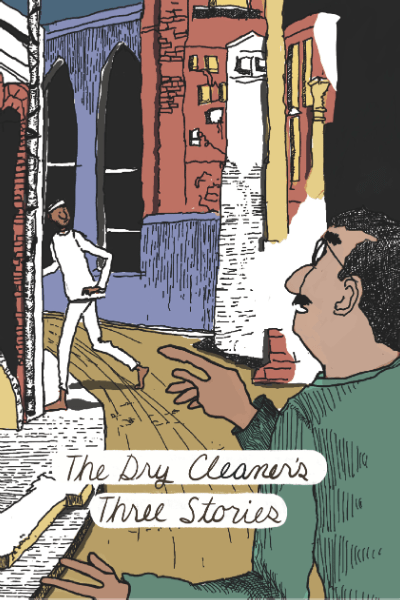
The Dry Cleaner’s Three Stories, by Betsy Hudson I’ve never had a comic book on my list before, and I may never again, but this is too sweet not to share. Betsy’s a fellow pilgrim from the Ignatian Camino. Her delightful little book tells the true story of her husband’s long flight delay spent—quite unexpectedly—in the company of their dry cleaner, Max, and the profound lessons Charlie encountered in the three true stories Max shared. “Because you never know when someone will tell you something that captivates, entertains, and maybe even changes you.” GIFT THIS TO anyone who enjoys a meaningful bit of cross-cultural whimsy.
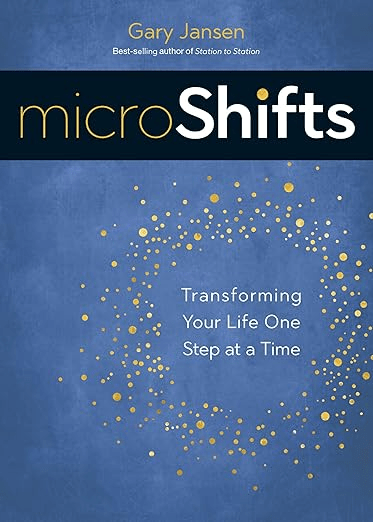
MicroShifts: Transforming Your Life One Step at a Time, by Gary Jansen Gary Jansen is an award-winning author, speaker, and editor (Loyola Press), but I know him best as someone I was fortunate to connect with during the last Ignatian Creators Summit. In this gem of a book, he explores the topic of personal transformation: why it’s so difficult, how we get in our own way, and things we can do to (gradually, sustainably) create the changes we desire. GIFT THIS TO: Anyone who could use a dose of practical inspiration in their stocking.
This Little Light: Lessons in Living from Sister Thea Bowman, by Bro. Mickey McGrath OSFS With his usual flair for storytelling, artist Mickey McGrath illuminates the life of Servant of God Thea Bowman (one of the “Saintly Six” Black Catholics whose cause for canonization is under consideration). Through twelve paintings, he weaves her story of faith and hope with his unfolding personal and artistic growth, giving us all a little more light to see by. GIFT THIS TO anyone who needs to remember, “It doesn’t matter if you’re scared; just keep on steppin’!”
The End of Ending, by Josh Noem Another Ignatian Creators Summit friend, Josh Noem is Editorial Director at Ave Maria Press whose other hats include blogger and novelist. The End of Ending is one of those rare novels that treats religion as a normal part of everyday life (true for so many people, but rarely seen in fiction). When I complemented him on that, Josh said that he wanted the book to be about “the lived experience of confronting despair, grief, injustice—and experiencing something gratuitous on the other side.” GIFT THIS TO fans of belief,beer, baseball or—better yet—all three!
Homework Success for Children with ADHD: A Family-School Intervention Program, by Thomas J. Power, James L. Karustis, and Dina F. Habboushe Okay, you caught me. I have not read this book—because this is not a topic I’ve ever had to think about. But Jim Karustis played a brief but pivotal role in my journey from shy English major to campus ministry-immersed theology major, so I owe him a lot! And apparently this is a very good book and I did actually purchase it, so if anyone would like it please let me know and I’ll pop it in the mail. GIFT THIS TO any educator or parent of young children for whom “homework has become a frustrating battle nobody wins.”
The Missing, by Ben Tanzer The Missing is narrated in the alternating voices of parents whose teenage daughter has vanished. Through this technique, Ben Tanzer deftly weaves the characters’ paths together even as their emotional trajectories are spinning apart. Ben was the publicist for my first two books; I know that he’s a good guy and a great dad. But here’s the writing challenge he set for himself: explore a crisis in which the protagonists make decisions he NEVER would make. I spent a lot of time yelling “Nooooo!” as I read, but ended up applauding Ben’s swell writing chops, and the creative leap required to get inside the heads of characters who keep taking dead wrong turns in their relationship. GIFT THIS TO anyone who’d enjoy a literary deep dive into some truly dark stuff.
I have been enjoying your weekly emails since my friend Rob McChesney brought them to my attention last summer. You have such a deft touch, using small, potent images—a pile of Legos, a burnt pot, a smoke detector—to lead the reader to a moment of spiritual insight. They are like the best kind of daily Mass homilies!
It isn’t often that we get such a clear date stamp on the beginning of a friendship. But since emails are one of the few things I hoard (over 26K in the inbox and counting), I was able to find this gem. I’d been following Eric Clayton’s weekly emails on behalf of the Jesuit Conference (where he is Deputy Director of Communications) since the pandemic summer of 2020, but it wasn’t until the following May that I worked up the nerve to email him, complimenting his writing and sharing my own. Despite obvious demographic differences (he’s a father of young children, for starters), our mutual delight in mining the events of everyday life for spiritual truths led to the discovery of many other shared experiences and enthusiasms.
Eric A. Clayton
Eric is one of the most faithfully prolific writers I know. Those weekly columns keep coming, always using a simple image to unlock a spiritual insight. In 2022, they finally got a name: “Now Discern This.” (You can see them all and sign up here.) He also has a robust presence on Substack, where his “Story Scraps” cover all sorts of topics, including short fiction.
And then there are the books. In 2022, he published Cannonball Moments: Telling Your Story, Deepening Your Faith, about which I said (among other things), “Using the lens of storytelling, Clayton helps each reader mine the riches of their own story, connecting them with the one great story of God as experienced through saints and strangers, grandmothers and toddlers, ordinary life and extraordinary dreams.” This year saw My Life with the Jedi: The Spirituality of Star Wars, which I confess sits on my shelf unread because I feel a compulsion to watch all nine movies first—in order. (If he’d published a book on the spirituality of Star Trek, Battlestar Galactica, or LOTR, I’d have downed it by now.) This week, I preordered his latest, Finding Peace Here and Now: How Ignatian Spirituality Leads Us to Healing and Wholeness, coming in May 2025. Three books in four years; way to go, Eric!
Our mutual delight in mining the events of everyday life for spiritual truths led to the discovery of many other shared enthusiasms.
Eric has been so helpful in linking me to the wider Jesuit world: posting on the Conference website my article about the Ignatian Volunteer Corps; interviewing me on the AMDG Podcast, and inviting me to write for their Advent series for the last three years. (BONUS: click here to sign up for the new series, “Waiting and Wassailing: Daily Advent Meditations on Story and Song,” coming December 1 to an email near you.)
The most life-changing connection, however, was when Eric welcomed me to the Jesuit Media Lab’sIgnatian Creators Summit. During the last two summer gatherings, I’ve formed friendships with so many people who are using their manifold gifts—in writing, art, theater, film, photography, music, podcasting, and more—in the spirit of St. Ignatius, for the greater glory of God. (It was at the first of these Summits that I finally met Eric in person; at the second, I learned what a wicked-competitive card player he is!)
Here’s what Eric had to say about Finding God Along the Way: Filled with warmth, humor and a voracious eye for detail, Finding God Along the Way is Christine Eberle’s invitation to each of us to embark on our own inner pilgrimage. Along the way, Eberle promises to help us discover God in places both surprising and familiar. While we can’t all hop a flight to Spain, we can all journey deeper and deeper into our own selves, into those hidden recesses of our very souls, where God waits with delight. By inviting us into key scenes from her own Ignatian pilgrimage, Eberle masterfully weaves stories that both transport us to the land of St. Ignatius while also keeping us grounded in the spiritual reality of our own present lives. If you’re looking for an adventure into the soul, this is your book.
For a kindred spirit whose talent and productivity are equally matched by his kindness, generosity, and humor, I am truly grateful!
As I prepared to walk the Ignatian Camino—knowing I was planning on writing about it—I tried not to read many other Camino memoirs. I wanted to reach my own insights, free from the risk of parroting someone else’s. I made an exception, however, for Irish Jesuit Brendan McManus’ marvelous work, The Way to Manresa: Discoveries Along the Ignatian Camino.I’m so glad I did!
Brendan McManus, SJ
The book narrates the experience of a priest who had walked the Camino as a young man and set out to do it again after an exhausting stint of suicide-bereavement ministry. His hopes were thwarted when he fell and sustained a serious injury on the second morning of his solo journey. He pressed on (with the approval of a medical center) for several days until pain forced him to abandon the walk. He used public transportation to visit highlights of the Way before returning home, where the search for answers continued.
While it may be hard to imagine getting a whole book out of a pilgrimage cut off at the knees (no pun intended) on Day Two, McManus’ account of the spiritual wrestling match brought on by pain and disappointment makes this a worthwhile read for anyone dealing with an unexpected and unwelcome turn of events.
McManus’ account of the spiritual wrestling match brought on by pain and disappointment makes this a worthwhile read for anyone dealing with an unexpected and unwelcome turn of events.
I later learned that Fr. McManus is a prolific author, and that most of his books have to do with the “other” Camino—the famous one, the Camino de Santiago (Way of St. James). He is currently based at the Manresa Spirituality Center in Dublin, but spends time each summer back in Spain, supporting other pilgrims through the Camino Companions program.
His latest book, co-written with Katherine O’Flynn, FCJ, is called Living the Camino Back Home: Ignatian Tips for Keeping the Camino Spirit Alive. Publication date is December 5, but if you’re free tomorrow afternoon (Friday, November 15, 2:00 Eastern) you can see McManus in conversation during a live book launch event. I just registered (at no cost) and hope you will too!
Brendan McManus could not have been kinder or more encouraging when I reached out to him about my book. Here’s what he said:
Christine has done a wonderful job of distilling the essence of pilgrimage and integrating Ignatian Spirituality into a wonderfully engaging narrative. With a lovely light touch she manages to capture the daily struggles and challenges (bags, beds and blisters!) that make for the essential inner journey that mirrors the outer journey in Ignatian Spain. This book beautifully illustrates Ignatian themes of trust, freedom and listening to the Spirit. A great Ignatian pilgrim read!
For this living witness that “everything has the potential to call forth a deepening of our life in God” (a la Ignatius), I am truly grateful.
The route that Ignatius took from Loyola to Manresa has existed for 502 years now, but the Ignatian Camino in its present form would not exist without the extraordinary commitment of Fr. José Luis Iriberri, Director of the Office of the Ignatian Camino. In addition to organizing and physically leading trips spring through fall each year, he has co-authored (with Chris Lowney) two Camino books: On the Ignatian Way and Guide to the Ignatian Camino. And now, you can see him for yourself—along with many of the places featured in my book—in a 90-minute YouTube documentary that premiered this summer!
Fr. José, on the Way!
A quick word search of my manuscript reveals that I mention him more than 150 times in 187 pages; clearly, he was an integral part of the experience! Here’s an excerpt from Chapter 43: “In Praise of Our Fearless Leader.”
Perhaps the shortest and most accurate thing I can say about José Luis Iriberri, SJ, is that he is a true son of Ignatius. (He even looks like the saint, being of Basque descent and cultivating a bit of an Ignatian beard!) He is intimately familiar with the path Iñigo traversed, pointing out churches where he worshipped, buildings where he conducted business, and hostels where he might have stayed.
It is one thing to know about Ignatius, however, and quite another to know Ignatius and to model one’s life after him. That is the experience of traveling with this man: the sense of being in the company of one of Ignatius’s close companions as he guided us through both the outer and inner landscape of the Camino. He was our spiritual guide, in every sense of the term.
Backpack on, walking stick in hand, he moved like a mountain goat, lightly, over any kind of terrain, knowing every twist and turn of those hundreds of miles—most of which he had marked by hand. But he also knew the contours of our hearts, watching us carefully, listening closely to what we said and didn’t say, reading our faces, and offering sage observations. He knew when to encourage a flagging pilgrim, when to offer a bit of respite, when to break the tension with a droll remark, and when to put his foot down if someone’s ambitions exceeded their abilities. Though he could grow exasperated with our ridiculousness, he was completely attentive and caring the moment someone manifested a genuine need.
José’s helpfulness has continued since our return. When the first draft of my manuscript was complete, I sent it to him for fact-checking. Just a few days later, I received the electronic document back, marked up in red ink in his own hand. He caught many errors—from place names I’d gotten wrong to bits of Spanish history I’d misunderstood—which I gratefully corrected. (He also inserted comments like “Oh I don’t think I said that” and “the walk didn’t really take that long,” which I took under advisement.) He’s even helped with the audiobook: when I discovered a bunch of words in Euskara and Catalan that I wasn’t sure how to pronounce, I sent him a list and he read it into a voice memo for me! The book is so much better for his attentive care, as I was better for his attentive care along the Way.
The book is so much better for his attentive care, as I was better for his attentive care along the Way.
He also shared these kind words: Christine catches the spirit of the pilgrimage, living the full experience in her own body and soul and bringing an open mind to both the obstacles and wonders that pilgrims may encounter along the Way. This book will help you to understand the gifts that you would find walking freely in Spain, following the steps of Saint Ignatius of Loyola, a saint who lived five hundred years ago but experienced a transformation that is most needed in our twenty-first century.
For this walking example of loving God with one’s whole heart, soul, mind, and strength, I am truly grateful.
As I’ve been playing “what-were-we-doing-two-years-ago” all month, so many profound and silly memories have surfaced. Here’s one of the latter, told as part of Chapter Forty, “La Cova.” It takes place on the evening of October 30—the day after what we thought had been our final hike, from Montserrat to Manresa. Enjoy!
At three-thirty that afternoon, Fr. José told us, we were to meet in the garden to walk to Mass at Our Lady of Good Health. We should be sure to wear our boots, he added, and bring our hiking poles. Oh, good grief, I thought. How are we not done with those? And why are we hiking to Mass when there are more chapels than I can count right here in our residence?
The hour’s walk took us through the old town and surrounding commercial district, then onto a rocky path through the fields beyond. I will confess, I was grumpy.
My mood lightened when I discovered that we’d be sharing the road with goats. In the field beside us strode an actual goatherd—wearing sandals, carrying a crook, and accompanied by a frisky dog. (A twenty-first-century goatherd, he was also wearing jeans and a camo baseball cap, but still, it was pretty cool.) Close on his heels were at least fifty goats of varying colors and sizes, each sporting a noisy bell. As we hustled forward, the goats followed, kicking up a cloud of dust behind us until our ways diverged.
The surreal goat encounter banished what was left of my petulance. And, of course, the walk was worth it. Santa Maria de la Salut is a tenth-century hermitage. Preserved in the entryway is a rectangular slab identified (in Catalan, English, and French) as “the stone where Saint Ignatius knelt down on his visits to this sanctuary.”
How is it that a hunk of rock touched by Ignatius’ knees has been preserved for five hundred years? Fr. José explained that the ordinary people of Manresa kept Ignatius’s memory alive, realizing that they had been in the presence of a holy man. According to Tellechea Idígoras’s biography, when the saint’s canonization process was opened in 1594—seventy-two years after his sojourn in Manresa—many testified to the lasting impression Ignatius had made on them or on their parents and grandparents. Perhaps that’s why he continues to feel so present in this place.
As daylight was no longer being saved, the sun had dipped below the horizon already by the time we finished Mass. We started back at a good pace, hoping to reach the paved roads before dark; nevertheless, we had to navigate the treacherous end of the rocky path by flashlight. At last, we reached the bright Burger King and KFC signs on the outskirts of the city—a sharp contrast to the millennium-old hermitage and timeless goatherd. Like many of the towns we visited, Manresa is a place where the past and present coexist.
After dinner, we gathered for our final reflection . . .
In the spring of 2023, the Jesuit Media Lab advertised an eight-week online class for writers of spiritual nonfiction. (Did you even know that was a genre? I didn’t . . . and it’s my genre!) The class would be held in June and July, right smack up against my personally imposed August 1st manuscript deadline. How could I resist?
The teacher was Jonathan Malesic, an award-winning author with a PhD in religious studies; he was the perfect person to lead this (arguably niche) class. Jon is a prolific essayist, writing about the ethical and spiritual challenge of living a good life in America today. He is the author of The End of Burnout: Why Work Drains Us and How to Build Better Lives. In addition to his workshops, he teaches first-year writing at Southern Methodist University.
Jonathan Malesic Photo by Sarah Wall
Each week, he gave us solid content, interesting readings, and short but challenging writing assignments. He critiqued our work but also structured the class so we could shape and encourage one another’s writing. The first chapter of my new book is much tighter and more colorful than it might have been, thanks the workshopping it received there.
At one point, Jon gave me the nicest compliment—and I’ll bet he doesn’t even remember it. We were talking about influences, and I mentioned that I’ve learned to be careful about what I’m reading when writing intensively, because I tend to absorb the tone of whatever I’m taking in. Jon responded, “Well then, you must be reading a lot of poetry.” (Aww. I was reading a lot of Ann Patchett, but I do love rising to the challenge of a word limit!)
One of the unexpected benefits of the spiritual nonfiction class is that it connected me to other writers with similar passions—connections that have continued out in the real world. (You’ll meet one of those people next week.) Several classmates participated in this year’s Ignatian Creators Summit—including Jon himself. What a joy to meet in person!
One of the unexpected benefits of the spiritual nonfiction class is that it connected me to other writers with similar passions—connections that have continued out in the real world.
After learning so much in his class, I was moved by Jon’s endorsement of Finding God Along the Way: Christine Eberle is not only an experienced, funny, and wise spiritual guide. She’s also a great storyteller. In the vivid episodes of this book, she takes readers through stunning Spanish landscapes, hostels, communal meals, and masses and invites us to reflect on our own pilgrimages, including the ones we undertake in our ordinary lives. The rhythm of this book — action, reflection, action, reflection — is the heart of pilgrimage and of Ignatian spirituality itself. Eberle may be sometimes slow of step along the journey she narrates here, but her quick mind and generous heart make her an ideal companion on the Ignatian Camino and the spiritual life it represents.
For the gift of lifelong learning, I am truly grateful.
This morning, I received a WhatsApp message from one of my pilgrim friends, who has returned to Spain with her husband and is spending a few days in Zaragoza. On Bette’s vacation, the city is a beautiful place to explore for a few days between San Sebastian and Barcelona. On my pilgrimage, it was the blessed oasis where Porter and I ground to a halt, nursing our blistered feet and his sudden fever.
A peek at the calendar revealed that I was in Zaragoza exactly two years ago this weekend. What more excuse do I need to share an excerpt of Finding God Along the Way with you? This is from Chapter 25, “Pausing.” It picks up in Tudela, after Fr. José doctored Porter’s and my disastrous feet, shook his head, and gave us directions to the train station.
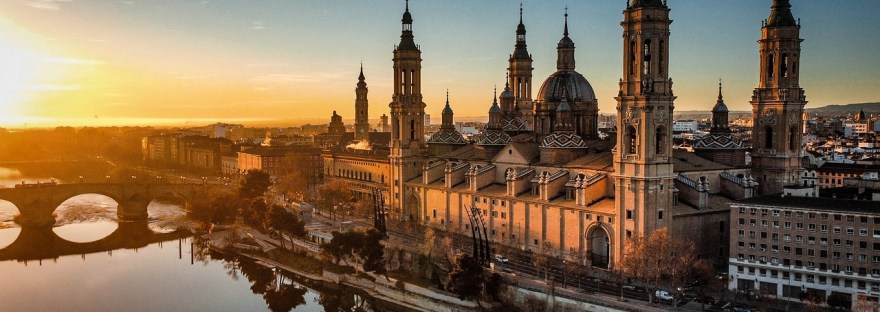
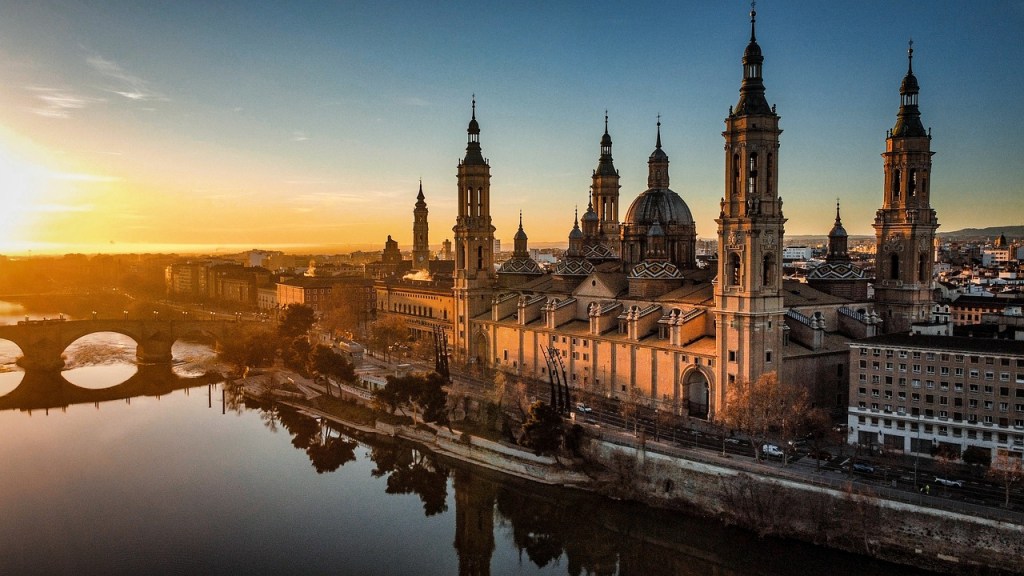
Sunrise over the Basilica of Nuestra Señora del Pilar in Zaragoza
There’s an old tale in which Himalayan sherpas (or, in another version, African tribesmen) are hired by a group of American trekkers to transport their supplies. After a few days of walking fast and far, the locals sit down and refuse to move for several hours—waiting, it’s explained, for their souls to catch up with their bodies. Although I didn’t have the liberty of such on-the-spot refusal along the Camino, I did come to appreciate the power of the pause.
My longest was the three days I spent in the city of Zaragoza. On a Monday morning, Porter and I caught the train from Tudela, ensconced ourselves in a café so I could write for a while, then walked slowly to the Hotel Sauce. Doing our best to approach this wide-open day with wide-open spirits, we lingered wherever we saw something interesting. We stopped in a hardware store for a carabiner to secure the straps of Porter’s old suitcase and visited a department store—El Corte Inglés—to invest in new hiking socks. That brief stroll recalled us to ourselves, reminding us how much we enjoy exploring a new city. It also helped us see beyond our transitory struggles, anchoring us in the surpassing goodness of our life together.
Despite our having a free day on Tuesday, by Wednesday morning my feet were still awful, and Porter was feverish—felled by the slow-moving stomach virus that had been making its way through the group. We would have to linger in Zaragoza for one more day. Our hotel room had a bathtub with a broad ledge at one end, allowing me to indulge in two refreshing pastimes while Porter slept: soaking my feet and perusing the New Yorker magazine I’d optimistically chucked in my suitcase.
Late [the next] afternoon, I made a long, solo visit to the Basilica of Nuestra Señora del Pilar—Our Lady of the Pillar—whose origins were the stuff of legend. When St. James began evangelizing the Iberian peninsula in the first century, the story goes (preaching the Gospel “to the ends of the earth”), he almost despaired of bringing the Christian faith to that pagan land. One day, while he was deep in prayer along the banks of the Ebro River, the Blessed Mother appeared to him atop a rosy pillar, encouraging him not to forsake his mission.
Despite COVID restrictions, visitors still can touch a bit of the titular pillar.
Today, the cavernous interior of the Basilica houses an intimate chapel where a tiny Mary statue sits atop a pillar of pink jasper. Even though the Basilica felt cold and empty, the chapel was warm with the devotion of many visitors; I was lucky to witness a weekly ceremony where children receive a special blessing and get their picture taken with the statue. Pausing in prayer, I felt something shift in me; heading back to the hotel, I realized that I was walking much more easily. Like the apostle James in that same place almost two millennia ago, I felt a renewed hopefulness and a readiness to rejoin my friends on the road the next morning.
Though the three-day break in Zaragoza was a great blessing, pauses did not need to be long to be restorative. On our steepest climbs, when the grade was fierce, I allowed myself to stop for a few deep breaths every ten steps. Count to ten; stop and breathe. Count to ten; stop and breathe. In addition to getting much-needed oxygen to my lungs and leg muscles, this strategy kept hope in view. I knew that in seven . . . five . . . three more steps, I could take a brief, blissful pause, until the terrain grew merciful, and I could press on without stopping.
The most delightful pauses arrived unexpectedly. Occasionally, as we walked through the woods, a clearing would open and—voilà—a café where we could grab a quick cortado and use real restrooms. Fr. José never told us they were coming. This was consistent with his desire to keep us in the present moment, though I suspect he also relished being able offer us a pleasant surprise. Those periodic oases of rest lasted just long enough to refill my well of gratitude before starting out again.
Perhaps my insight here seems obvious. Take a break; do you really need me to tell you this? But maybe you do; maybe, like me, you tend to soldier on. Maybe you never take a sick day (or didn’t, until COVID made bringing your germs to work seem less heroic). Maybe you wouldn’t dream of closing your eyes for five minutes after lunch. Maybe you stare at the Sunday crossword puzzle long after your brain has stopped generating solutions, or routinely accept diminishing returns for your labor in exchange for the ego boost you get from thinking of yourself as a person who “never quits.”
So, in case you do need to hear it, I’ll say it again: There is power in the pause. Whether for a moment or an hour, a day or a week, a well-timed pause can reconnect us to ourselves, giving us fresh energy and perspective. More importantly, the pause can reconnect us to God—inventor of the Sabbath, after all—for whom accomplishment is never everything.
You know who knew this? Jesus. He routinely slipped away from a life of preaching and miracle-working to pause, pray, and recharge. “Come to me, all who labor and find life burdensome, and I will give you rest,” he said—not “and I’ll give you more to do!” Holy pausing is not about taking the easy way out or shirking our share of life’s burdens. It’s about acknowledging our utter dependence on God, who alone provides strength for the journey.
“Wait, you knowPaula D’Arcy?” I’ve loved Paula’s writing for decades; my Camino buddy Jane Lafave might as well have told me she’d been hanging out in Ann Patchett’s kitchen! Jane explained that she’d known the author for many years, since going on a pilgrimage she led to Notre Dame (Paris) as part of her grief ministry.
Paula D’Arcy
The ability to write or speak authentically about loss is hard earned, and Paula D’Arcy paid a terrible entrance price to the world of grief ministers. When she was a young mother, pregnant with her second child, her family was struck by a drunk driver. She awoke in the hospital, alone except for the child in her womb. Her beloved husband and twenty-one-month-old daughter were gone.
That she built a beautiful life in the wake of such tragedy is a testimony to the power of resurrection. I first encountered the story in her 2004 book Sacred Threshold: Crossing the Inner Barrier to a Deeper Love. When my mother died a few years later, I clung to D’Arcy’s next book, When People Grieve. It is full of sanity-saving wisdom and practical advice about the physical, mental, and emotional aftermath of a profound loss. I owe much of my patience with the slow course of grief to her gentle guidance.
D’Arcy’s devastating accident was almost fifty years ago. What defines her life now is not the tragedy, but her consequent commitment to helping others keep the doors of their hearts propped open, even in the midst of grief. She is the founder of the Red Bird Foundation, whose mission is to assist others in the transformation of pain and the restoration of hope.
What defines her life is not the tragedy, but her consequent commitment to helping others keep the doors of their hearts propped open . . .”
I am thrilled to announce that Paula soon will be offering a retreat via Zoom through the SSJ Center for Spirituality in Ocean Grove, NJ. Mark your calendars for Thursday, February 13 from 6-8 p.m. for “Beauty Beyond Loss: Finding Your Way Through the Mystery of Grief and Gratitude.” I just signed up; you can learn more and register here.
Knowing that pilgrimage has been a meaningful part of Paula D’Arcy’s life, I asked my friend Jane if she could reach out to her on my behalf. Paula read my manuscript, then swiftly responded with these lovely words: Finding God Along the Way is equal parts adventure and strong spiritual experience; I felt like I was being given a private retreat as I read along. In this beautifully written book, Eberle encourages readers to risk what it means to step into the unknown each day, putting the Camino experience within every person’s reach.
According to the Talmud, every blade of grass has an angel bending over it, whispering “Grow, grow, grow!” For every angel on earth who whispers hope into the hearts of grieving people, I am truly grateful.




















 Christine Marie Eberle