As I’ve been playing “what-were-we-doing-two-years-ago” all month, so many profound and silly memories have surfaced. Here’s one of the latter, told as part of Chapter Forty, “La Cova.” It takes place on the evening of October 30—the day after what we thought had been our final hike, from Montserrat to Manresa. Enjoy!
At three-thirty that afternoon, Fr. José told us, we were to meet in the garden to walk to Mass at Our Lady of Good Health. We should be sure to wear our boots, he added, and bring our hiking poles. Oh, good grief, I thought. How are we not done with those? And why are we hiking to Mass when there are more chapels than I can count right here in our residence?
The hour’s walk took us through the old town and surrounding commercial district, then onto a rocky path through the fields beyond. I will confess, I was grumpy.
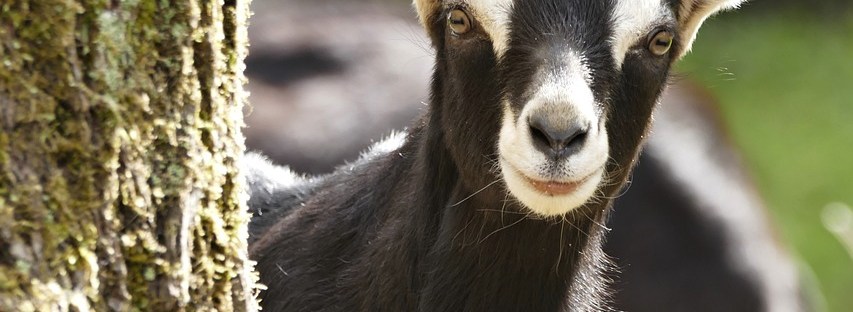
My mood lightened when I discovered that we’d be sharing the road with goats. In the field beside us strode an actual goatherd—wearing sandals, carrying a crook, and accompanied by a frisky dog. (A twenty-first-century goatherd, he was also wearing jeans and a camo baseball cap, but still, it was pretty cool.) Close on his heels were at least fifty goats of varying colors and sizes, each sporting a noisy bell. As we hustled forward, the goats followed, kicking up a cloud of dust behind us until our ways diverged.
The surreal goat encounter banished what was left of my petulance. And, of course, the walk was worth it. Santa Maria de la Salut is a tenth-century hermitage. Preserved in the entryway is a rectangular slab identified (in Catalan, English, and French) as “the stone where Saint Ignatius knelt down on his visits to this sanctuary.”
How is it that a hunk of rock touched by Ignatius’ knees has been preserved for five hundred years? Fr. José explained that the ordinary people of Manresa kept Ignatius’s memory alive, realizing that they had been in the presence of a holy man. According to Tellechea Idígoras’s biography, when the saint’s canonization process was opened in 1594—seventy-two years after his sojourn in Manresa—many testified to the lasting impression Ignatius had made on them or on their parents and grandparents. Perhaps that’s why he continues to feel so present in this place.
As daylight was no longer being saved, the sun had dipped below the horizon already by the time we finished Mass. We started back at a good pace, hoping to reach the paved roads before dark; nevertheless, we had to navigate the treacherous end of the rocky path by flashlight. At last, we reached the bright Burger King and KFC signs on the outskirts of the city—a sharp contrast to the millennium-old hermitage and timeless goatherd. Like many of the towns we visited, Manresa is a place where the past and present coexist.
After dinner, we gathered for our final reflection . . .
This morning, I received a WhatsApp message from one of my pilgrim friends, who has returned to Spain with her husband and is spending a few days in Zaragoza. On Bette’s vacation, the city is a beautiful place to explore for a few days between San Sebastian and Barcelona. On my pilgrimage, it was the blessed oasis where Porter and I ground to a halt, nursing our blistered feet and his sudden fever.
A peek at the calendar revealed that I was in Zaragoza exactly two years ago this weekend. What more excuse do I need to share an excerpt of Finding God Along the Way with you? This is from Chapter 25, “Pausing.” It picks up in Tudela, after Fr. José doctored Porter’s and my disastrous feet, shook his head, and gave us directions to the train station.
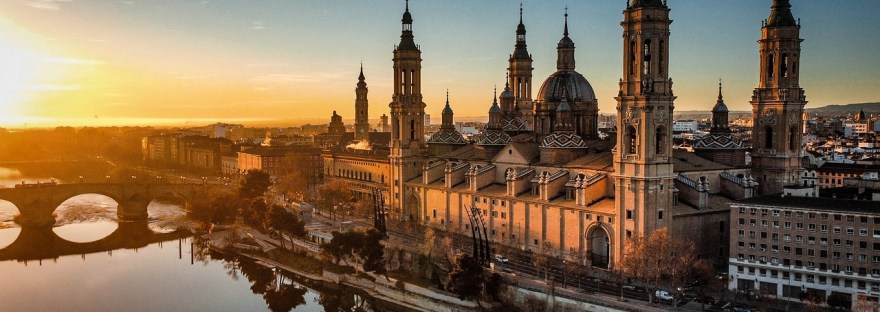
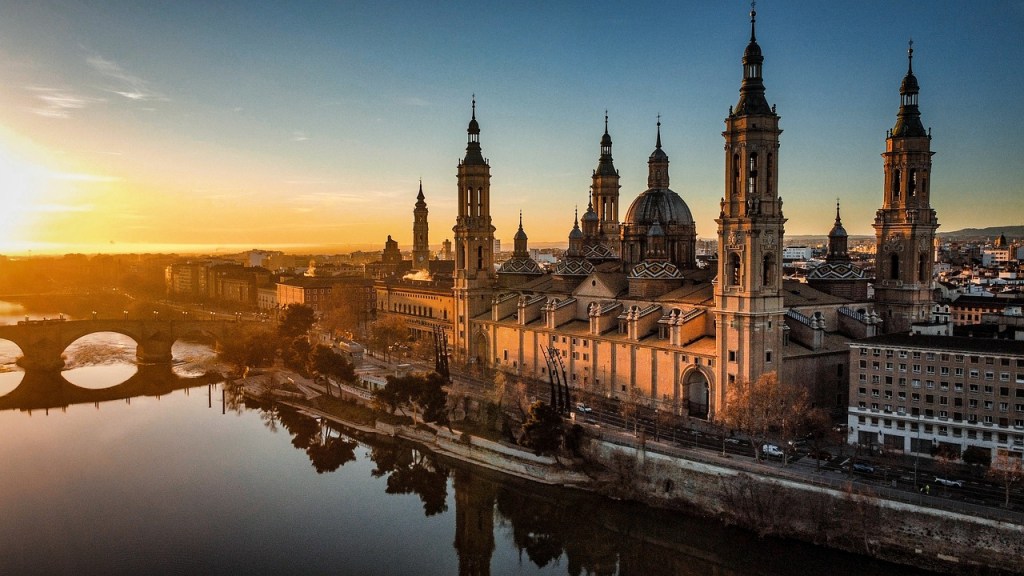
Sunrise over the Basilica of Nuestra Señora del Pilar in Zaragoza
There’s an old tale in which Himalayan sherpas (or, in another version, African tribesmen) are hired by a group of American trekkers to transport their supplies. After a few days of walking fast and far, the locals sit down and refuse to move for several hours—waiting, it’s explained, for their souls to catch up with their bodies. Although I didn’t have the liberty of such on-the-spot refusal along the Camino, I did come to appreciate the power of the pause.
My longest was the three days I spent in the city of Zaragoza. On a Monday morning, Porter and I caught the train from Tudela, ensconced ourselves in a café so I could write for a while, then walked slowly to the Hotel Sauce. Doing our best to approach this wide-open day with wide-open spirits, we lingered wherever we saw something interesting. We stopped in a hardware store for a carabiner to secure the straps of Porter’s old suitcase and visited a department store—El Corte Inglés—to invest in new hiking socks. That brief stroll recalled us to ourselves, reminding us how much we enjoy exploring a new city. It also helped us see beyond our transitory struggles, anchoring us in the surpassing goodness of our life together.
Despite our having a free day on Tuesday, by Wednesday morning my feet were still awful, and Porter was feverish—felled by the slow-moving stomach virus that had been making its way through the group. We would have to linger in Zaragoza for one more day. Our hotel room had a bathtub with a broad ledge at one end, allowing me to indulge in two refreshing pastimes while Porter slept: soaking my feet and perusing the New Yorker magazine I’d optimistically chucked in my suitcase.
Late [the next] afternoon, I made a long, solo visit to the Basilica of Nuestra Señora del Pilar—Our Lady of the Pillar—whose origins were the stuff of legend. When St. James began evangelizing the Iberian peninsula in the first century, the story goes (preaching the Gospel “to the ends of the earth”), he almost despaired of bringing the Christian faith to that pagan land. One day, while he was deep in prayer along the banks of the Ebro River, the Blessed Mother appeared to him atop a rosy pillar, encouraging him not to forsake his mission.
Despite COVID restrictions, visitors still can touch a bit of the titular pillar.
Today, the cavernous interior of the Basilica houses an intimate chapel where a tiny Mary statue sits atop a pillar of pink jasper. Even though the Basilica felt cold and empty, the chapel was warm with the devotion of many visitors; I was lucky to witness a weekly ceremony where children receive a special blessing and get their picture taken with the statue. Pausing in prayer, I felt something shift in me; heading back to the hotel, I realized that I was walking much more easily. Like the apostle James in that same place almost two millennia ago, I felt a renewed hopefulness and a readiness to rejoin my friends on the road the next morning.
Though the three-day break in Zaragoza was a great blessing, pauses did not need to be long to be restorative. On our steepest climbs, when the grade was fierce, I allowed myself to stop for a few deep breaths every ten steps. Count to ten; stop and breathe. Count to ten; stop and breathe. In addition to getting much-needed oxygen to my lungs and leg muscles, this strategy kept hope in view. I knew that in seven . . . five . . . three more steps, I could take a brief, blissful pause, until the terrain grew merciful, and I could press on without stopping.
The most delightful pauses arrived unexpectedly. Occasionally, as we walked through the woods, a clearing would open and—voilà—a café where we could grab a quick cortado and use real restrooms. Fr. José never told us they were coming. This was consistent with his desire to keep us in the present moment, though I suspect he also relished being able offer us a pleasant surprise. Those periodic oases of rest lasted just long enough to refill my well of gratitude before starting out again.
Perhaps my insight here seems obvious. Take a break; do you really need me to tell you this? But maybe you do; maybe, like me, you tend to soldier on. Maybe you never take a sick day (or didn’t, until COVID made bringing your germs to work seem less heroic). Maybe you wouldn’t dream of closing your eyes for five minutes after lunch. Maybe you stare at the Sunday crossword puzzle long after your brain has stopped generating solutions, or routinely accept diminishing returns for your labor in exchange for the ego boost you get from thinking of yourself as a person who “never quits.”
So, in case you do need to hear it, I’ll say it again: There is power in the pause. Whether for a moment or an hour, a day or a week, a well-timed pause can reconnect us to ourselves, giving us fresh energy and perspective. More importantly, the pause can reconnect us to God—inventor of the Sabbath, after all—for whom accomplishment is never everything.
You know who knew this? Jesus. He routinely slipped away from a life of preaching and miracle-working to pause, pray, and recharge. “Come to me, all who labor and find life burdensome, and I will give you rest,” he said—not “and I’ll give you more to do!” Holy pausing is not about taking the easy way out or shirking our share of life’s burdens. It’s about acknowledging our utter dependence on God, who alone provides strength for the journey.
“Wait, you knowPaula D’Arcy?” I’ve loved Paula’s writing for decades; my Camino buddy Jane Lafave might as well have told me she’d been hanging out in Ann Patchett’s kitchen! Jane explained that she’d known the author for many years, since going on a pilgrimage she led to Notre Dame (Paris) as part of her grief ministry.
Paula D’Arcy
The ability to write or speak authentically about loss is hard earned, and Paula D’Arcy paid a terrible entrance price to the world of grief ministers. When she was a young mother, pregnant with her second child, her family was struck by a drunk driver. She awoke in the hospital, alone except for the child in her womb. Her beloved husband and twenty-one-month-old daughter were gone.
That she built a beautiful life in the wake of such tragedy is a testimony to the power of resurrection. I first encountered the story in her 2004 book Sacred Threshold: Crossing the Inner Barrier to a Deeper Love. When my mother died a few years later, I clung to D’Arcy’s next book, When People Grieve. It is full of sanity-saving wisdom and practical advice about the physical, mental, and emotional aftermath of a profound loss. I owe much of my patience with the slow course of grief to her gentle guidance.
D’Arcy’s devastating accident was almost fifty years ago. What defines her life now is not the tragedy, but her consequent commitment to helping others keep the doors of their hearts propped open, even in the midst of grief. She is the founder of the Red Bird Foundation, whose mission is to assist others in the transformation of pain and the restoration of hope.
What defines her life is not the tragedy, but her consequent commitment to helping others keep the doors of their hearts propped open . . .”
I am thrilled to announce that Paula soon will be offering a retreat via Zoom through the SSJ Center for Spirituality in Ocean Grove, NJ. Mark your calendars for Thursday, February 13 from 6-8 p.m. for “Beauty Beyond Loss: Finding Your Way Through the Mystery of Grief and Gratitude.” I just signed up; you can learn more and register here.
Knowing that pilgrimage has been a meaningful part of Paula D’Arcy’s life, I asked my friend Jane if she could reach out to her on my behalf. Paula read my manuscript, then swiftly responded with these lovely words: Finding God Along the Way is equal parts adventure and strong spiritual experience; I felt like I was being given a private retreat as I read along. In this beautifully written book, Eberle encourages readers to risk what it means to step into the unknown each day, putting the Camino experience within every person’s reach.
According to the Talmud, every blade of grass has an angel bending over it, whispering “Grow, grow, grow!” For every angel on earth who whispers hope into the hearts of grieving people, I am truly grateful.
Today marks a big anniversary: On October 5, 2022, at a retreat house in Azpeitia, Spain, my band of pilgrims gathered for our first group meeting with Fr. José Iriberri, the Director of the Ignatian Camino. We had no idea what the next twenty-seven days (or three hundred miles) would hold. In honor of that anniversary, here’s a little excerpt from the beginning of Finding God Along the Way, coming in January from Paraclete Press. Enjoy!
On an October evening in 2022, fifteen pilgrims still trying to remember each other’s names shifted anxiously in a circle of hard plastic chairs, eyes trained on our fearless Jesuit guide. The fluorescent-lit conference room’s unadorned walls gave no hint that we were in the shadow of the tower house of Loyola—the long-envisioned starting point of our grand adventure.
The youngest of us was fifty-five, the oldest seventy-nine. We were ten women and five men, hailing from across the United States as well as Canada, Australia, and Malaysia. The group included couples, widows, singles, and married folks traveling solo. Some were old friends; others knew no one. Although many were part of the Ignatian Volunteer Corps, the rest were drawn simply by their love of Ignatian spirituality. Seventeen days and some two hundred miles later, ten more people would be joining us for the final hundred miles of our journey.
“Introduce yourself briefly and tell us why you’re here,” Fr. José began, “then name your biggest fear about the Camino.” The man knew how to get to a point. A less skilled facilitator might have started with an easier icebreaker, but Fr. José didn’t want us to skim the surface. He wanted us to practice going deep.
Our fears were surprisingly similar. Most of us were worried that we’d packed the wrong things, that our bodies were going to fail us, or that somehow we would fail ourselves by not engaging the experience properly. Betsy—a petite woman with an endearing Southern accent and perfect comic timing—put it best when she confessed to fearing “pilgrim envy.” Her husband, Charlie, was the Ignatian volunteer; what if she turned out to be a remedial pilgrim, not “holy” enough for the Camino to be effective? When more than one head nodded in recognition, Fr. José encouraged us to resist the temptation to compare ourselves to one another, assuring us that, while each person’s experience would be different, God would not be stingy with the divine gifts.
While each person’s experience would be different, God would not be stingy with the divine gifts.
As the meeting drew to a close, Fr. José paused and looked around the circle slowly, letting the anticipation grow, then leaned in and offered one more bit of inspiration. “Pilgrimage can change the world,” he said. “I really believe this. Now, let’s get ready for tomorrow.”
You may remember that I made a month-long pilgrimage in the fall of 2022 in the company of twenty-four remarkable souls inspired by the life of St. Ignatius Loyola. Finding God Along the Way: Wisdom from the Ignatian Camino for Life at Home traces our spiritual adventure from its pre-pandemic conception to the lasting transformations we experienced on the far side. Although the book might inspire future pilgrims, I wrote it for those who will make the journey only in their imagination, as the fruit of this experience should not be reserved for those with the freedom to walk away from their life for a month.
I am so grateful to the good people at Paraclete Press for their enthusiastic embrace of my book and their prayerful approach to every aspect of its production and marketing. By mid-May, I’ll have a cover image; stay tuned.
1736812860
days
hours minutes seconds
until
Pub Date!
Note: We’d originally thought that the book would launch on February 25, and were excited about its being the feast day of Blessed Sebastian de Aparicio, patron saint of travelers and road builders. But we want to have it firmly in people’s hands in time for Lent, so January 14 it is. I can’ wait! (But I shall.)
To ensure that you receive the pre-order announcement for the book, make sure you are signed up for my newsletter (which I send approximately monthly).
Processing…
Success! You're on the list.
Whoops! There was an error and we couldn't process your subscription. Please reload the page and try again.
Pictured here: one of the countless orange arrows marking the Ignatian Way!
In 2014, when my father was near the beginning of what turned out to be his final illness, my brother and I asked each other that question continually. Would Dad be able to keep living alone? Was there any chance we could persuade him to move somewhere without six bedrooms and three flights of stairs? Could we possibly shift our lives and responsibilities to care for him ourselves? What’s going to happen? Over and over we repeated this unanswerable mantra, until life unfolded and we lived our way into the answers. (Which turned out to be, for the specific questions above: no, heck no, and absolutely.)
As I prepare to depart for the Ignatian Camino–the pandemic-deferred pilgrimage I’ve been dreaming about for more than three years now–I find myself echoing the same question. What’s going to happen? My logistics are as ready as they’re ever going to be. My socks are double-layered. My shoes are broken in. My satchel and suitcase are organized. There’s a decent chance I’ve overpacked, but my bag remains dramatically under the weight limit. And, unlike the trip to Peru I joke about in my “Take Nothing for the Journey” retreat, I’m not bringing a single Whitman’s Sampler.
I’ve been focusing on the externals because they are all-consuming, yet I know that, once I set foot out of Loyola Castle, they will be far from all-important. Everything essential will be happening on the inside, in the space that my prayer and my walking create for God. Although I have mental images of what it will be like to stand in the room where Ignatius recovered from his cannonball injury, or to pray in the Cave of Manresa where he developed the Spiritual Exercises, or to walk step after step through the same mountains and vineyards and deserts and villages he saw, the only thing I know for sure is that I will be surprised.
Therefore, as my spiritual director wisely advised, all I can do is strive to be open to the grace that will be meeting me there. And I do know, from that hospice experience, the power of being met by grace.
I’ll return to this blog space after the pilgrimage; in the meanwhile, I hope you’ll follow our journey on the Ignatian Volunteer Corps website, which will be posting whatever photos and ruminations I manage to send from along the way.
For seasoned volunteers and local nonprofits alike, the Ignatian Volunteer Corps is a match made in heaven.
This summer, Catholic Philly ran an article I wrote about IVC’s Philadelphia/South Jersey Chapter; this week, the Jesuits of Canada and the US posted my article about IVC nationwide–including IVC’s new virtual community. Enjoy!
My heart goes out to the people in that upper room in the first chapter of Acts. Once upon a time, they had been capable fishermen, efficient tax collectors, competent homemakers, and women of means. After meeting Jesus and being swept into his company, they’d had a crash course in discipleship, but they were still a ragtag bunch. There were the brothers who had quarreled over who was greater, the woman from whom seven demons had gone out, the gaggle who always needed the parables explained, and that blustery fellow who spent an awful lot of time with his sandal in his mouth. Then tragedy struck, followed by mystery. And now they were expected to be . . . what? His “witnesses to the ends of the earth?” What did that even mean?
Yet on Pentecost day, Scripture says, devout Jews from every nation under heaven heard them speaking in their own tongues of the mighty acts of God. The disciples had spent most of their lives knowing how to do one thing, and then they learned to do something else entirely, and then the Holy Spirit came upon them, and then they changed the world.
If their transformation seems dizzying, it might help to peek back into the upper room. Our mental image of that place may be DaVinci’s table-for-thirteen, but Luke tells us there were actually some one hundred and twenty persons gathered there. What did they do in those ten days between Ascension and Pentecost? Two things we know: they devoted themselves to prayer, and they discerned who had the right gifts for the work ahead, adding Matthias to the Eleven in place of Judas. Although they had no idea what would happen next, they stayed together, they prayed, and they did what they could until the Holy Spirit enabled them to do far more.
That’s a reasonable mandate for us during this Coronavirus crisis. Stay together (at least in mind and heart). Pray. Discern what you can do. Wait for the Holy Spirit.
What has impressed me most about this time of shutdown is how people are learning to do things they never did before: pastors live-streaming Mass in near-empty churches; classroom teachers giving Zoom lessons from their kitchens; reporters broadcasting from their tidied-up dens. Much of this is made possible by technology, of course, enabling the self-quarantined to work from home, video chat with grandchildren, even play board games online with friends. A colleague of mine recently observed that, if this had happened just a decade ago, the entire school year would have been a wash. No graduations, no promotions to the next grade: just one giant do-over.
However, what is intriguing right now not just about the technology. I am so touched by the way people are rummaging around in their hearts and their skill sets, bringing forth whatever is useful for the need at hand. Makers of quilts are churning out masks. Performers are finding new ways of getting their art into the world. Distributors who used to move food from farms to fancy restaurants are packing boxes for hungry families instead. Of course, these pivots could be short-term strategies—designed to maintain an income stream or a sense of purpose—yet I believe that some of these new endeavors actually hold the seeds of future promise.
And it’s not just about what people are doing, of course; it’s also—and more importantly—about the transformation happening within. This season has been profoundly jarring, ripping away so much that we used to take for granted. Perhaps you are on the front lines of the crisis, sacrificing safety at work, peace at home, or financial security. Perhaps you are grieving the loss of someone dear. Or perhaps you are among the lucky ones: riding it out quietly, but still having to let go of plans, assumptions, and certainties. Here you are; here we all are, learning to abide in the unknown.
We are not unlike those early disciples: staying connected; praying in new ways; discerning next steps and waiting for the Holy Spirit to let us out of the room.
In his book The Holy Longing, Ronald Rolheiser describes the tasks required for each stage of the paschal cycle (not only in the Bible, but in the countless dyings and risings of our own lives). According to Rolheiser, the work from Ascension to Pentecost is this: let the past ascend and bless you; receive the spirit for the life you are already living.
We have begun to live into something new, here in the upper room of our quarantine. It is not clear how much the Coronavirus crisis will yet ask of us, but this has gone on far too long to be just a blip on the radar screen, a ridiculous inconvenience we’ll tell stories about someday. Now is the time to settle in, to pay attention, to notice the changes within and without.
How might the Holy Spirit be transforming you?
I was honored to write this reflection as part of the Ignatian Volunteer Corps’ Ascension to Pentecost series, featuring contributions by Fr. Jim Martin, Dan Schutte, and more. If you are not familiar with IVC, check them out: Experience Making a Difference!
Processing…
Success! You're on the list.
Whoops! There was an error and we couldn't process your subscription. Please reload the page and try again.
Last Thursday I had the privilege of facilitating a retreat for members of the Ignatian Volunteer Corps / Baltimore region. IVC volunteers are people age “50 or better” (love it!) who serve 1-2 days a week with a partner agency, using their considerable talents to care for individuals who have slipped through society’s safety net. Their slogan is “Experience Making a Difference,” and I certainly experienced that difference myself in the course of our day together. What a delightful, engaged and engaging group of people, seasoned enough to offer wisdom, yet beautifully open to new questions.
We spent the afternoon working with Part Two of my book Finding God in Ordinary Time. Called Messengers of Grace, Part Two presents surprising encounters with strangers as one of the terrains in which we can spot the presence of God, hidden in plain sight. As you may know, I’ve decided to give faithful blog readers a peek into my book each Sunday in winter Ordinary Time. So with gratitude to the IVC volunteers whom I no longer call strangers, this week I want to share my introduction to Part Two.
Part Two Messengers of Grace
People are beautiful, courageous, and inspiring, but we are also messy, complicated, and fallible.
And yet we are dear to God’s heart. In Genesis—the first book of both the Jewish Torah and the Christian Bible—we learn that all humanity is created in the image and likeness of God. The Qur’an teaches us that God (Allah) is “nearer to man than his jugular vein.” In Catholic Social Teaching, the dignity of each person is the first principle. Quakers affirm that there is “that of God in everyone.”
Ever wonder why so many religious traditions feel the need to point this out?
I love how my friend John puts it: every person we meet contains a revelation of God.
In Matthew 25, Jesus says that whatever we do for “the least of these,” we do for him. Who are these “least”? If we look at Jesus’ list (people who are hungry, thirsty, naked, or ill, those who are strangers or imprisoned), we will see that he clearly identified with those who are most vulnerable.
Sometimes vulnerability is attractive, and sometimes it is repellant, but it is always a place where, if we cock our heads at a certain angle, we can catch the message God wants us to hear.
Who has been a messenger of grace for you? Tell us your story in the “Leave a Reply” section below!
May each of your ordinary days be extraordinarily blessed.








 Christine Marie Eberle