My gosh, did I have fun with this one. Fr. Brendan McManus’ The Way to Manresa helped prepare my heart for pilgrimage, and his newest gem, Living the Camino Back Home, is a filled with good advice for how to sustain one’s pilgrim heart. (Also, he kindly blurbed my book; what a guy!)
We shared stories and insights in a rich hour’s conversation with talented interviewer Eric Clayton. (That hour was preceded by almost half an hour of tech troubles, which may be why we sound so comfortable with one another!)
You can play straight from the image below, or visit the AMDG show notes for more information about the podcast and Fr. McManus’ books. (And while you’re there, you can check out the many other awesome AMDG episodes.) Enjoy!
When I returned from the Ignatian Camino, my challenge was to transform a personal experience of pilgrimage into a book that could touch the hearts of people who might never be able to walk away from their life for a month. Now that Finding God Along the Way is out in the world, a new challenge has arisen: transforming words on a page into living, interactive retreat experiences.
I can’t think of a more hospitable place to begin than the Cranaleith Spiritual Center, where last Saturday I led a morning retreat called “The Long Pilgrimage to Justice.” Moved by a spectrum of concerns, ten souls braved the cold to gather in a sunny room and ground themselves for the work ahead. Together, we considered how the metaphor of pilgrimage could allow us to keep our goal on the horizon while staying deeply present to what is right in front of us. Drawing on wisdom from the Ignatian Camino, we discussed finding our “one thing,” taking the next step, redefining failure, and equipping ourselves spiritually.
My favorite part came near the end. Thoughout the morning, I’d been sharing snippets that speak to me—Scripture verses, songs, poems, quotes, etc. Finally, I read a passage from Chapter Sixteen of my book, “It’s in There,” and invited people to share what they carry in their own “go-bag” of inspiration.
The responses began as slowly as an afternoon snowfall, but each offering encouraged the next until the room was blanketed by consolation. It was such a joy to hear people ask one another, “Wait, who was that author?” “What was the name of that song ?” “Tell me that website again!” Phones came out so folks could look things up; pens came out so we could write them down.
One gentleman shared a reflection from Unfolding Light that captured the spirit of the day. It began: Hope is not anticipation of a certain outcome, but trusting goodness. Though the world around us abounds in hateful rhetoric right now—with even people on “our side” (whichever side that may be) delighting in mean memes and zinging caricatures—it was refreshing to remember how much goodness dwells in people’s hearts and memory banks.
Hope is not anticipation of a certain outcome, but trusting goodness.
Steve Garnaas-Holmes
It made me realize that, just as January is a month in which many of us return to a healthier diet after the excesses of the holiday season, so is this a time to be careful about our mental consumption. What we read, watch, and listen to has a profound effect on our spiritual health. Let’s resolve to choose wisely!
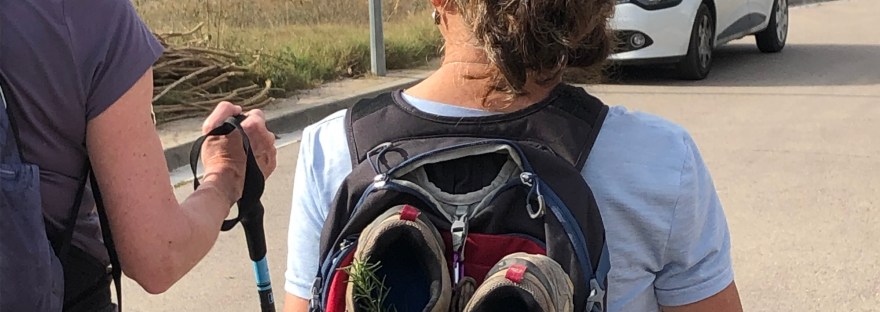
Can you spot the potassium-rich banana in Betsy’s backpack? What’s in your “go-bag” of inspiration?
Excerpt from Chapter Sixteen, “It’s in There”
“I know we’re supposed to be praying during the first two hours of every walk. Does repeatedly taking the name of the Lord in vain count?”
I cracked this joke at the end of a particularly pressured segment of hiking, but I wasn’t actually swearing my way across Spain. The only truth in that snarky remark was the word “repeatedly.” When the pace or terrain overwhelmed my ability to pray deeply (by which I mean conversationally, meditatively, or imaginatively), I took comfort in repeating words and phrases lodged in my memory.
It began during that long ascent to Arantzazu. Knowing that we were going to “visit” the Blessed Mother, I was thrown back to one of my mom’s favorite prayers, the Memorare. As I grew more exhausted by the climb, I resorted to repeating the last sentence like a mantra, in cadence with my steps: O Mother of the Word Incarnate, despise not my petitions, but in your mercy hear and answer me.
Gradually, other words emerged from the deep. Once upon a time, I’d memorized a few prayers in Spanish, so I was able to pass a satisfying hour trying to drag those beloved lines out of the mental vault. Later, I challenged myself to piece together all four verses of Tagore’s “Friends Whom I Knew Not,” which I’d quoted extensively in my book Finding God Abiding. In both cases, something about the combination of meaningful words and mental exercise sustained me for quite a while.
Various Scripture passages joined the parade of words in my head. Walking through the mountains, I recalled the beginning of Psalm 121: “I will lift up my eyes unto the hills, from whence shall come my help.” On another day, I clung to St. Peter’s incredulous exclamation after Jesus asked if he wanted to jump ship like other faint-hearted followers: “Lord, to whom shall we go? You have the words of everlasting life.” Mile after mile, the rhythmic “Lord, to whom shall we go?” reminded me that there was nowhere I’d rather be.
Certain hymns also provided prayerful refuge. Gospel songs such as “Guide My Feet” and “We’ve Come This Far by Faith” encouraged me to press on. The sight of a little dead bird evoked “His Eye is on the Sparrow,” assuring me that I was not alone.Even though such repetitive prayer isn’t ordinarily my style, I’m grateful to have had access to such richness under duress.
In the age of smartphones, the ability to “look anything up” is both a gift and a curse. Though vast amounts of information are there at our fingertips, the convenience discourages committing things to memory. But even if I’d had cell service in the Cantabrian mountains, what would I have done—pulled out my phone and said, “Hey Siri: What’s a good prayer, poem, Scripture, or song for when you’ve climbed higher than you would have thought possible but still have an impossible distance to go?” (Okay, I just tried it, and got a link to “30 Prayers to Give You Peace of Mind When You Need It Most,” but there’s no way I could have flipped through them without dropping my phone or dropping out of the pack!)
Back in the late 80s, a series of Prego spaghetti sauce commercials featured the slogan “It’s in there!” (All the ingredients a home cook could want, right in one convenient jar.) Prego is Italian for “You’re welcome,” so perhaps that’s God’s response as I offer thanks for all the heartening words that dwell in my memory banks and offer themselves as needed. “Prego!”
I am grateful to my friend Alli Bobzien (whom I met during the amazingly generative “Ignatian Creators Summit” offered by the Jesuit Media Lab last summer) for offering me a guest spot on her Substack, The Pondering Heart.
In it, I dive into my long-standing gripe about tomorrow’s Gospel and how I finally got my heart around it.
While you’re on Alli’s site, be sure to poke around and read some of her own beautiful writing. My favorites among recent posts are “The Heart of the Fire” and “The Inkeeper’s Daughter.” The first is a poem and the second a dive into historical/biblical fiction, but both are gorgeous!
My book is in the wild, so you know what that means . . . It’s podcast season! I’m grateful to my friend Mary Fran Bontempo for being first out of the gate with this fun conversation. Click the image below to listen.
Note: Mary Fran’s latest book, From Broken to Brilliant, made my 2024 list of Books I Love by People I Love. Check it out!
Just before Christmas, the Catholic Faith Network interviewed me about my forthcoming book. While I’m always happy to talk about Finding God Along the Way, maintaining “eye contact” with the red dot at the top of my screen as instructed was challenging! How’d I do?
I’m grateful to the good folks at the Jesuit Media Lab for proposing a music-themed take on Advent, for inviting me to submit a reflection, and for making it the first post of the season! (And if you haven’t subscribed yet, I encourage you to. Up next: NPR’s Scott Detrow on “Hark! The Herald Angels Sing.)
I have been enjoying your weekly emails since my friend Rob McChesney brought them to my attention last summer. You have such a deft touch, using small, potent images—a pile of Legos, a burnt pot, a smoke detector—to lead the reader to a moment of spiritual insight. They are like the best kind of daily Mass homilies!
It isn’t often that we get such a clear date stamp on the beginning of a friendship. But since emails are one of the few things I hoard (over 26K in the inbox and counting), I was able to find this gem. I’d been following Eric Clayton’s weekly emails on behalf of the Jesuit Conference (where he is Deputy Director of Communications) since the pandemic summer of 2020, but it wasn’t until the following May that I worked up the nerve to email him, complimenting his writing and sharing my own. Despite obvious demographic differences (he’s a father of young children, for starters), our mutual delight in mining the events of everyday life for spiritual truths led to the discovery of many other shared experiences and enthusiasms.
Eric A. Clayton
Eric is one of the most faithfully prolific writers I know. Those weekly columns keep coming, always using a simple image to unlock a spiritual insight. In 2022, they finally got a name: “Now Discern This.” (You can see them all and sign up here.) He also has a robust presence on Substack, where his “Story Scraps” cover all sorts of topics, including short fiction.
And then there are the books. In 2022, he published Cannonball Moments: Telling Your Story, Deepening Your Faith, about which I said (among other things), “Using the lens of storytelling, Clayton helps each reader mine the riches of their own story, connecting them with the one great story of God as experienced through saints and strangers, grandmothers and toddlers, ordinary life and extraordinary dreams.” This year saw My Life with the Jedi: The Spirituality of Star Wars, which I confess sits on my shelf unread because I feel a compulsion to watch all nine movies first—in order. (If he’d published a book on the spirituality of Star Trek, Battlestar Galactica, or LOTR, I’d have downed it by now.) This week, I preordered his latest, Finding Peace Here and Now: How Ignatian Spirituality Leads Us to Healing and Wholeness, coming in May 2025. Three books in four years; way to go, Eric!
Our mutual delight in mining the events of everyday life for spiritual truths led to the discovery of many other shared enthusiasms.
Eric has been so helpful in linking me to the wider Jesuit world: posting on the Conference website my article about the Ignatian Volunteer Corps; interviewing me on the AMDG Podcast, and inviting me to write for their Advent series for the last three years. (BONUS: click here to sign up for the new series, “Waiting and Wassailing: Daily Advent Meditations on Story and Song,” coming December 1 to an email near you.)
The most life-changing connection, however, was when Eric welcomed me to the Jesuit Media Lab’sIgnatian Creators Summit. During the last two summer gatherings, I’ve formed friendships with so many people who are using their manifold gifts—in writing, art, theater, film, photography, music, podcasting, and more—in the spirit of St. Ignatius, for the greater glory of God. (It was at the first of these Summits that I finally met Eric in person; at the second, I learned what a wicked-competitive card player he is!)
Here’s what Eric had to say about Finding God Along the Way: Filled with warmth, humor and a voracious eye for detail, Finding God Along the Way is Christine Eberle’s invitation to each of us to embark on our own inner pilgrimage. Along the way, Eberle promises to help us discover God in places both surprising and familiar. While we can’t all hop a flight to Spain, we can all journey deeper and deeper into our own selves, into those hidden recesses of our very souls, where God waits with delight. By inviting us into key scenes from her own Ignatian pilgrimage, Eberle masterfully weaves stories that both transport us to the land of St. Ignatius while also keeping us grounded in the spiritual reality of our own present lives. If you’re looking for an adventure into the soul, this is your book.
For a kindred spirit whose talent and productivity are equally matched by his kindness, generosity, and humor, I am truly grateful!
As I prepared to walk the Ignatian Camino—knowing I was planning on writing about it—I tried not to read many other Camino memoirs. I wanted to reach my own insights, free from the risk of parroting someone else’s. I made an exception, however, for Irish Jesuit Brendan McManus’ marvelous work, The Way to Manresa: Discoveries Along the Ignatian Camino.I’m so glad I did!
Brendan McManus, SJ
The book narrates the experience of a priest who had walked the Camino as a young man and set out to do it again after an exhausting stint of suicide-bereavement ministry. His hopes were thwarted when he fell and sustained a serious injury on the second morning of his solo journey. He pressed on (with the approval of a medical center) for several days until pain forced him to abandon the walk. He used public transportation to visit highlights of the Way before returning home, where the search for answers continued.
While it may be hard to imagine getting a whole book out of a pilgrimage cut off at the knees (no pun intended) on Day Two, McManus’ account of the spiritual wrestling match brought on by pain and disappointment makes this a worthwhile read for anyone dealing with an unexpected and unwelcome turn of events.
McManus’ account of the spiritual wrestling match brought on by pain and disappointment makes this a worthwhile read for anyone dealing with an unexpected and unwelcome turn of events.
I later learned that Fr. McManus is a prolific author, and that most of his books have to do with the “other” Camino—the famous one, the Camino de Santiago (Way of St. James). He is currently based at the Manresa Spirituality Center in Dublin, but spends time each summer back in Spain, supporting other pilgrims through the Camino Companions program.
His latest book, co-written with Katherine O’Flynn, FCJ, is called Living the Camino Back Home: Ignatian Tips for Keeping the Camino Spirit Alive. Publication date is December 5, but if you’re free tomorrow afternoon (Friday, November 15, 2:00 Eastern) you can see McManus in conversation during a live book launch event. I just registered (at no cost) and hope you will too!
Brendan McManus could not have been kinder or more encouraging when I reached out to him about my book. Here’s what he said:
Christine has done a wonderful job of distilling the essence of pilgrimage and integrating Ignatian Spirituality into a wonderfully engaging narrative. With a lovely light touch she manages to capture the daily struggles and challenges (bags, beds and blisters!) that make for the essential inner journey that mirrors the outer journey in Ignatian Spain. This book beautifully illustrates Ignatian themes of trust, freedom and listening to the Spirit. A great Ignatian pilgrim read!
For this living witness that “everything has the potential to call forth a deepening of our life in God” (a la Ignatius), I am truly grateful.
The route that Ignatius took from Loyola to Manresa has existed for 502 years now, but the Ignatian Camino in its present form would not exist without the extraordinary commitment of Fr. José Luis Iriberri, Director of the Office of the Ignatian Camino. In addition to organizing and physically leading trips spring through fall each year, he has co-authored (with Chris Lowney) two Camino books: On the Ignatian Way and Guide to the Ignatian Camino. And now, you can see him for yourself—along with many of the places featured in my book—in a 90-minute YouTube documentary that premiered this summer!
Fr. José, on the Way!
A quick word search of my manuscript reveals that I mention him more than 150 times in 187 pages; clearly, he was an integral part of the experience! Here’s an excerpt from Chapter 43: “In Praise of Our Fearless Leader.”
Perhaps the shortest and most accurate thing I can say about José Luis Iriberri, SJ, is that he is a true son of Ignatius. (He even looks like the saint, being of Basque descent and cultivating a bit of an Ignatian beard!) He is intimately familiar with the path Iñigo traversed, pointing out churches where he worshipped, buildings where he conducted business, and hostels where he might have stayed.
It is one thing to know about Ignatius, however, and quite another to know Ignatius and to model one’s life after him. That is the experience of traveling with this man: the sense of being in the company of one of Ignatius’s close companions as he guided us through both the outer and inner landscape of the Camino. He was our spiritual guide, in every sense of the term.
Backpack on, walking stick in hand, he moved like a mountain goat, lightly, over any kind of terrain, knowing every twist and turn of those hundreds of miles—most of which he had marked by hand. But he also knew the contours of our hearts, watching us carefully, listening closely to what we said and didn’t say, reading our faces, and offering sage observations. He knew when to encourage a flagging pilgrim, when to offer a bit of respite, when to break the tension with a droll remark, and when to put his foot down if someone’s ambitions exceeded their abilities. Though he could grow exasperated with our ridiculousness, he was completely attentive and caring the moment someone manifested a genuine need.
José’s helpfulness has continued since our return. When the first draft of my manuscript was complete, I sent it to him for fact-checking. Just a few days later, I received the electronic document back, marked up in red ink in his own hand. He caught many errors—from place names I’d gotten wrong to bits of Spanish history I’d misunderstood—which I gratefully corrected. (He also inserted comments like “Oh I don’t think I said that” and “the walk didn’t really take that long,” which I took under advisement.) He’s even helped with the audiobook: when I discovered a bunch of words in Euskara and Catalan that I wasn’t sure how to pronounce, I sent him a list and he read it into a voice memo for me! The book is so much better for his attentive care, as I was better for his attentive care along the Way.
The book is so much better for his attentive care, as I was better for his attentive care along the Way.
He also shared these kind words: Christine catches the spirit of the pilgrimage, living the full experience in her own body and soul and bringing an open mind to both the obstacles and wonders that pilgrims may encounter along the Way. This book will help you to understand the gifts that you would find walking freely in Spain, following the steps of Saint Ignatius of Loyola, a saint who lived five hundred years ago but experienced a transformation that is most needed in our twenty-first century.
For this walking example of loving God with one’s whole heart, soul, mind, and strength, I am truly grateful.
When I was a sophomore in high school, I attended forensics nationals in NYC and fell in love with the place. I began dreaming of going to Fordham, whose Lincoln Center campus had hosted some of the events. After four years as a communications major in the Big Apple, I figured, I’d snag a job as an editor and pursue my own writing after hours.
All it took to derail that dream was my mother’s discovery that the Fordham campus where I’d be living and studying was in the Bronx. (Cue scary music.) Whatever she was picturing there did not include her only daughter. Mom put her foot down, and I followed a different path.
Two decades later, a Massachusetts gal had a similar dream—and a more accommodating mother. Jen Sawyer is a Fordham alum holding a degree in communication with a concentration in American Catholic studies. After graduation, she deployed her storytelling talents in some fascinating venues, working for “The Martha Stewart Show,” and “Who Wants to Be a Millionaire,” as well as the Cooking Channel and Yahoo. As a freelance writer, she has contributed to “Good Morning America,” Metro, the NY Post, Fordham Magazine, America, and more. She and her husband lived the dream in a tiny apartment in New York before finding a home in New Jersey, where they now live with their 2-year-old daughter, Nora.
Thanks to Jen’s Jesuit education, one question pursued her through the whirlwind of writing, editing, and producing: “Am I doing the most good that I can in my job?” That question led her to combine her skills and passions at Busted Halo, an online platform that presents “a more joyful and meaningful experience of Catholicism” through articles, videos, podcasts, radio, and more. She began as Digital Content Producer; by the time we met in Jonathan Malesic’s spiritual nonfiction class, she was Editor-in-Chief.
One question pursued her through the whirlwind of writing, editing, and producing: “Am I doing the most good that I can in my job?”
As the culminating exercise of the class, we had to pitch an article. I crafted a pitch for Busted Halo, then actually pitched it. Jen and I bounced some ideas around. I wrote the piece. She made it better. In December, BH published “This Advent, Let’s Pray with Our Foremothers in the Faith.” Throughout the process, Jen was a delight to work with. Half a year later, she and I had the joy of participating in the Ignatian Creators Summit together, along with Jon Malesic and several other members of the class.
I so enjoyed getting to know Jen personally in the “temporary alternative space” that the good folks at the Jesuit Media Lab created for us. From taking risks in small-group sharing to swapping stories on the bus ride home from Camden Yards (Let’s go, O’s!), we were at ease in one another’s company. Jen has a great smile. She’s funny, friendly, and fully engaged in the work of helping others connect life and faith in meaningful ways. The world is lucky to have her.
Here’s what she had to say about Finding God Along the Way: Readers don’t have to trek 300 miles across Spain to appreciate the wisdom gleaned from Christine Eberle’s time walking in the footsteps of St. Ignatius of Loyola. With profound insight, vulnerability, and humor, Eberle invites readers to journey alongside her as she reflects on the modern-day relevance of Ignatius’ life and teachings. “Finding God Along the Way” is a must-read for those curious about Ignatian Spirituality and its capability—like pilgrimage—to transform our hearts, our minds, and our perspectives.
For the opportunity to cross paths with the road not taken—and to admire it wholeheartedly yet without regret—I am truly grateful.
















 Christine Marie Eberle