As I’ve been playing “what-were-we-doing-two-years-ago” all month, so many profound and silly memories have surfaced. Here’s one of the latter, told as part of Chapter Forty, “La Cova.” It takes place on the evening of October 30—the day after what we thought had been our final hike, from Montserrat to Manresa. Enjoy!
At three-thirty that afternoon, Fr. José told us, we were to meet in the garden to walk to Mass at Our Lady of Good Health. We should be sure to wear our boots, he added, and bring our hiking poles. Oh, good grief, I thought. How are we not done with those? And why are we hiking to Mass when there are more chapels than I can count right here in our residence?
The hour’s walk took us through the old town and surrounding commercial district, then onto a rocky path through the fields beyond. I will confess, I was grumpy.
My mood lightened when I discovered that we’d be sharing the road with goats. In the field beside us strode an actual goatherd—wearing sandals, carrying a crook, and accompanied by a frisky dog. (A twenty-first-century goatherd, he was also wearing jeans and a camo baseball cap, but still, it was pretty cool.) Close on his heels were at least fifty goats of varying colors and sizes, each sporting a noisy bell. As we hustled forward, the goats followed, kicking up a cloud of dust behind us until our ways diverged.
The surreal goat encounter banished what was left of my petulance. And, of course, the walk was worth it. Santa Maria de la Salut is a tenth-century hermitage. Preserved in the entryway is a rectangular slab identified (in Catalan, English, and French) as “the stone where Saint Ignatius knelt down on his visits to this sanctuary.”
How is it that a hunk of rock touched by Ignatius’ knees has been preserved for five hundred years? Fr. José explained that the ordinary people of Manresa kept Ignatius’s memory alive, realizing that they had been in the presence of a holy man. According to Tellechea Idígoras’s biography, when the saint’s canonization process was opened in 1594—seventy-two years after his sojourn in Manresa—many testified to the lasting impression Ignatius had made on them or on their parents and grandparents. Perhaps that’s why he continues to feel so present in this place.
As daylight was no longer being saved, the sun had dipped below the horizon already by the time we finished Mass. We started back at a good pace, hoping to reach the paved roads before dark; nevertheless, we had to navigate the treacherous end of the rocky path by flashlight. At last, we reached the bright Burger King and KFC signs on the outskirts of the city—a sharp contrast to the millennium-old hermitage and timeless goatherd. Like many of the towns we visited, Manresa is a place where the past and present coexist.
After dinner, we gathered for our final reflection . . .
They’re not even ours. The twin spruce trees with gnarly intertwined branches belong to our up-the-hill neighbor. Given the vagaries of property lines here in coastal Maine, however, they are right outside our dining room window. They’re what I gaze at over every meal, almost close enough to touch. I love these trees. And someone has butchered them.
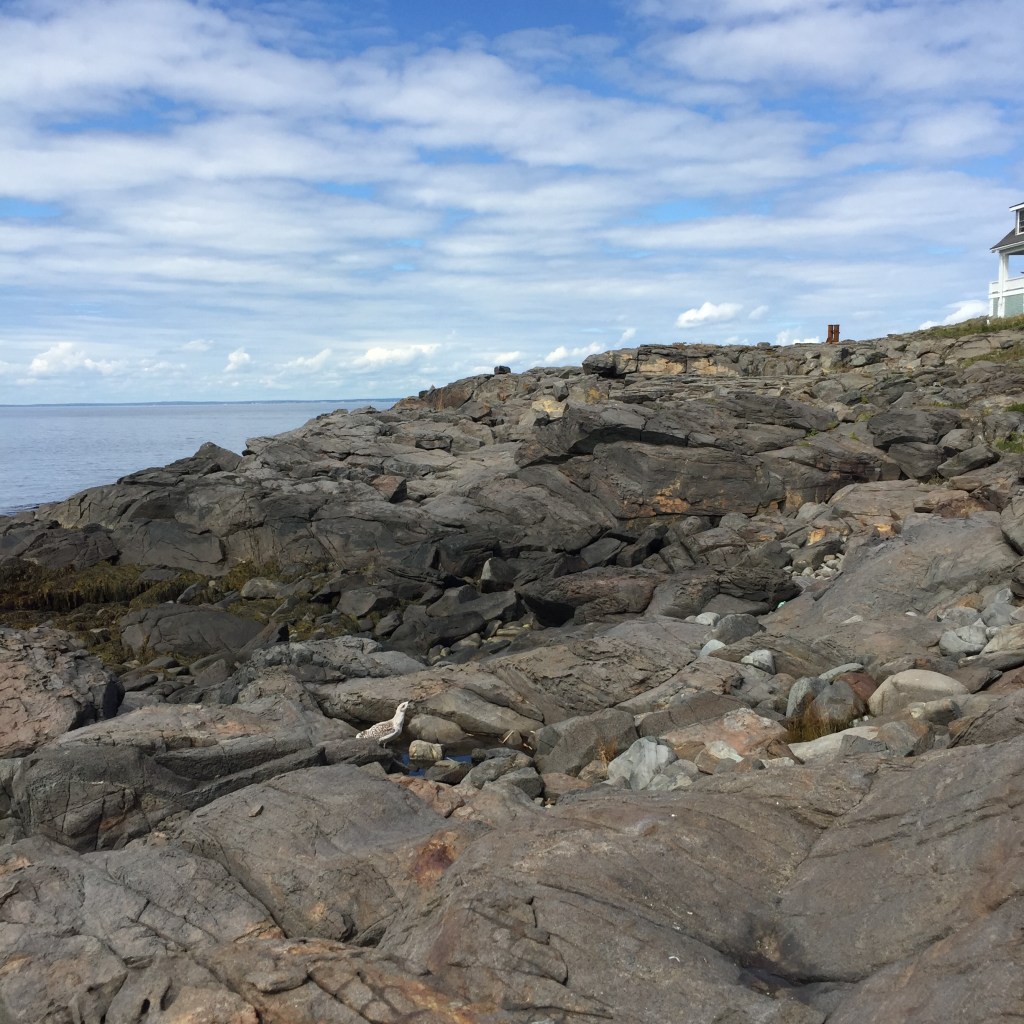
The trail map of Monhegan Island (population 65) clearly identified three walks recommended for day-trippers, so we had chosen the pleasant, 25-minute stroll to Lobster Cove. We sat on a sunny rock and ate our peanut-butter-on-raisin-bread sandwiches (standard picnic fare), watching the sparkling ocean and enjoying a lone seagull who seemed pretty content on a rock of its own. The view was pretty, but we had grown accustomed to longer hikes during these last two weeks in Maine. We decided to walk out along the Cliff Trail a ways, just to see what the vista was like from a bit higher, then return the way we came.
Lobster Cove: Can you spot the seagull?
We would have preferred to stay on the Cliff Trail all the way around the east side of the island, then cut back down the middle to the ferry dock, but again, the map was clear: two sections of the trail ahead were marked in red, identified as “particularly challenging.” The map was also clear about what happened to tourists who overestimated their abilities and got into trouble. No medical service on the island. No guarantee that there would be enough cell signal to call 911. No way for a vehicle or even a boat to reach some of the places a middle-aged woman in sneakers might injure herself. For added drama, the remains of a tugboat wreck dotted the landscape around of us like a rusting cautionary tale.
Which is why we were going to double back. Except . . .
It was so beautiful! Scary, but beautiful. We scrambled up and down rocks, avoided tree roots and swampy bits, and took at least one false turn, but over and over we looked up and discovered a stunning new view of the sea. It had already been hard, so the thought of turning back and retracing our steps was, frankly, a bummer. We didn’t know if the trail ahead was dramatically harder, of if we’d already done the worst of it. And so we pressed on. (I fought rising panic by singing the jaunty rendition of Psalm 23 that was jogging through my head.)
View from the Cliff Trail on Monhegan Island
Porter took the lead—having under his belt both longer legs and more years of scouting. He figured out the safest steps, and gave me a hand when I needed it. This gave me frequent opportunities to soak in the beauty around us, as well as the chance to begin musing about the “harder paths” offered to us in everyday life.
I found myself remembering the two months my father was in home hospice care, when I took FMLA leave and moved in, along with my brother, Stephen, to care for him. It was one of the hardest things I’ve ever done. Every few days, Dad’s abilities dropped off, and the tasks required of us grew more demanding. As on the Cliff Trail, we wondered how much worse it would get, and whether we would hit a point where we couldn’t do it anymore. Yet there was so much beauty.
Even five years later, I have such warm memories of that time-out-of-time: our cousin Mike keeping me company on Wednesday nights when Stephen was back in Baltimore; our cousin Tish sitting with my dad one afternoon so I could take a shower; our uncle Len dragging a vast quantity of recycling to the curb each week as we cleared out the decades of tests, notebooks, and newspaper clippings which the home of two teachers had accumulated. I still savor the way I sat around the fireplace visiting with relatives and friends on weekends, took Stephen’s dog for walks around the old neighborhood in the mornings, and had long, consoling phone calls with distant loved ones at night. And I remember my favorite visit: my friend Liz walking in the door with homemade pizza, an assortment of craft beer, and flowers without a vase—because she figured (rightly) that we already had enough of them.
Those eight weeks were intensely challenging, but I still miss the camaraderie of that special kairos-time.
There is no dramatic ending to my Monhegan story. No one was injured. We didn’t even have any hair-raising near-misses. Eventually, the Cliff Trail intersected with the Burnt Head Trail: a gentle path that led us down an easy slope back into the village, where we shared a blueberry soda (because, Maine) and got back on the Balmy Days II for a ride around the island and return to the mainland.
A few days out, my lingering feeling is great satisfaction with having successfully taken the harder path, mingled with lingering curiosity about life’s harder paths. I keep wondering: when is doing it the hard way worth the beauty and the reward? When is it just too much? When does challenge shade into folly? And how do we know if it’s time to turn around?
I don’t know. But I do know that I want to keep exploring the questions—on foot as well as in prayer. And I know is that getting myself out into nature here in Maine—moving my body in unaccustomed ways and seeing unfamiliar sights—has opened my spirit to fresh metaphors for the spiritual life, and given me a renewed awareness of God’s presence in it all.
The sort of practicing that I did on Monhegan—taking something in the natural world and working the metaphor—will be part of a lovely half-day retreat I’m offering at the Cranaleith Spiritual Center next month. Together, we’ll take a wide-eyed look at the small things in life, and notice the presence of God, hidden in plain sight. The retreat is Sunday, October 6, from 1-4. If you are able to join me, you can register here.
But for now, I invite you to reflect on the harder paths in your own life. What have you tackled that you weren’t sure you could do? Where did you find beauty, or reward? What choice of path lies ahead of you now? How are you being led? Who has your hand? I’d love to hear your stories.
Along whatever path you walk, may your ordinary days be extraordinarily blessed!





 Christine Marie Eberle