Liturgy, Scripture, Spirituality, Writing

Imagining the Gospel: A Reflection on Mark 10

This is the longest lead-time I’ve ever had on an assignment.

At the August 2023 Ignatian Creators Summit, participants volunteered to write imaginative encounters with Gospel texts for the coming liturgical year; the 28th Sunday of Ordinary Time (October 13) fell to me. I began thinking about it immediately, and even posted a mid-point “work in progress” blog (including a homemade sonnet) when Mark 10:17-30 popped up as a daily Mass reading in May.

Here at last is the “final” product. (Scare quotes only because no wrestling with this challenging reading is ever the last word.)

Enjoy!

Book Tour, Spirituality, Travel, Writing

Sneak Peek: How We Began

Today marks a big anniversary: On October 5, 2022, at a retreat house in Azpeitia, Spain, my band of pilgrims gathered for our first group meeting with Fr. José Iriberri, the Director of the Ignatian Camino. We had no idea what the next twenty-seven days (or three hundred miles) would hold. In honor of that anniversary, here’s a little excerpt from the beginning of Finding God Along the Way, coming in January from Paraclete Press. Enjoy!

On an October evening in 2022, fifteen pilgrims still trying to remember each other’s names shifted anxiously in a circle of hard plastic chairs, eyes trained on our fearless Jesuit guide. The fluorescent-lit conference room’s unadorned walls gave no hint that we were in the shadow of the tower house of Loyola—the long-envisioned starting point of our grand adventure.

The youngest of us was fifty-five, the oldest seventy-nine. We were ten women and five men, hailing from across the United States as well as Canada, Australia, and Malaysia. The group included couples, widows, singles, and married folks traveling solo. Some were old friends; others knew no one. Although many were part of the Ignatian Volunteer Corps, the rest were drawn simply by their love of Ignatian spirituality. Seventeen days and some two hundred miles later, ten more people would be joining us for the final hundred miles of our journey.

“Introduce yourself briefly and tell us why you’re here,” Fr. José began, “then name your biggest fear about the Camino.” The man knew how to get to a point. A less skilled facilitator might have started with an easier icebreaker, but Fr. José didn’t want us to skim the surface. He wanted us to practice going deep.

Our fears were surprisingly similar. Most of us were worried that we’d packed the wrong things, that our bodies were going to fail us, or that somehow we would fail ourselves by not engaging the experience properly. Betsy—a petite woman with an endearing Southern accent and perfect comic timing—put it best when she confessed to fearing “pilgrim envy.” Her husband, Charlie, was the Ignatian volunteer; what if she turned out to be a remedial pilgrim, not “holy” enough for the Camino to be effective? When more than one head nodded in recognition, Fr. José encouraged us to resist the temptation to compare ourselves to one another, assuring us that, while each person’s experience would be different, God would not be stingy with the divine gifts.

While each person’s experience would be different, God would not be stingy with the divine gifts.

As the meeting drew to a close, Fr. José paused and looked around the circle slowly, letting the anticipation grow, then leaned in and offered one more bit of inspiration. “Pilgrimage can change the world,” he said. “I really believe this. Now, let’s get ready for tomorrow.”

Spirituality, Writing

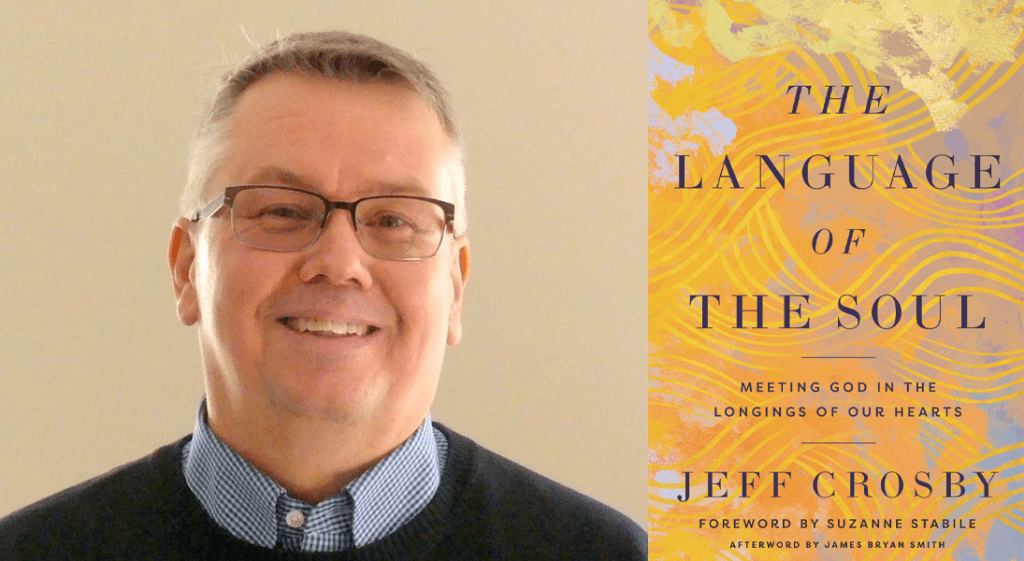
Jeff Crosby

Part of the Thankful Thursday Series

Beginnings are fascinating. Without Jeff Crosby’s introduction, I would not have found Paraclete Press. But the early threads of our connection could have been dropped without either of us noticing.

After Finding God in Ordinary Time came out in 2018, it was selected as a finalist for the Foreword Indies book awards. Jeff—who at the time was Publisher/CEO of InterVarsity Press—bought my book on the strength of its description in the magazine. Then he did two rare and wonderful things: he 1) wrote beautiful reviews on Amazon and Goodreads, and 2) dropped me a note to let me know. (Book lovers: embrace this practice!)

Jeff Crosby and the cover is his book

By the time Finding God Abiding entered the world in 2022, Jeff was serving as president and CEO of ECPA, a trade association of Christian publishers, and working on his own book, The Language of the Soul: Meeting God in the Longings of Our Hearts. I was honored to serve as one of his early readers, and included the book in my 2023 “Books I Love by People I Love.”

In that post, I wrote, “In this cozy book, Jeff explores the concept of saudade—a ‘vague and constant desire for something that does not and possibly cannot exist.’ He muses through ten longings, adding resources for further reading as well as a musical playlist to accompany each one. Gift this to any spiritually minded person who likes to read with pencil in hand.” (As a bonus: now you can download a beautiful, 32-page conversation guide and journal for Jeff’s book on the Broadleaf website.)

Jeff explores the concept of saudade—a ‘vague and constant desire for something that does not and possibly cannot exist.’

When I finished the first draft of Finding God Along the Way last year, Jeff was one of the first people I sent it to for thoughtful feedback, which he provided—then offered to help me find a publisher, should I need assistance. (Here’s where I should point out that Jeff and I have never met in person or even spoken on the phone.  Ours is an entirely epistolary friendship—so old fashioned!)

After several months of fruitless attempts to connect with publishers or agents, I turned to Jeff for advice. He sent me three ideas, of which Paraclete was clearly the strongest, but their website said they weren’t accepting unsolicited manuscripts. Jeff kindly shared my pitch with an editor friend on a Friday afternoon; by Monday morning, she’d asked to see the whole manuscript. Many editorial and marketing team meetings and a lot of discernment ensued, and now I’m part of the Paraclete Press family.  (As is Jeff, by the way; next year they are publishing his new book, World of Wonders: Reading as a Spiritual Discipline. I can’t wait to read it!)

Here’s Jeff’s kind endorsement: A three-cord strand of wonder awaits you in Finding God Along the Way, an inviting book that artfully weaves together Christine Marie Eberle’s pilgrimage along the Ignatian Camino in Spain with history of Ignatius of Loyola and the author’s own deep reflection on what she experienced and learned about herself—and her God—as she made her way. The scriptures she shares and the prompts for our own reflection as readers are icing on the cake. Whether or not you have shared the experience of pilgrimage, you will find much to savor in this book from one who has.

For our mutual delight in seeking just-the-right words to express the ineffable, I am truly grateful.

Spirituality, Travel, Writing

Katie (Haseltine) Mullin

Part of the Thankful Thursday Series

During my pilgrimage, one of the practices that sustained me was the Ignatian daily Examen. Even though Ignatius said the prayer should take no longer than fifteen minutes, on the Camino I sometimes devoted up to an hour, wringing every drop of grace from the previous day. Walking through the steps of gratitude, light, rumination, contrition, and hope each morning helped me view my experience through a spiritual lens instead of getting stuck on the physical level. Therefore, when it came time to seek endorsements, Katie (Haseltine) Mullin was at the top of my list of “ambitious asks.” I didn’t know her personally, but had loved her book, All The Things: A 30-Day Guide to Experiencing God’s Presence in the Prayer of Examen. 

Katie came to the Examen as an outsider—an evangelical Christian who found “breathing room” in a Protestant liturgical church where she began receiving spiritual direction, eventually becoming a spiritual director herself. This renders her writing direct and accessible. She’s not parroting insider terminology as someone who grew up in the Jesuit soup might do. Instead, she serves as a translator—a teacher of “Ignatian for Speakers of Other Spiritualities.” As she approaches the Examen from thirty different starting points, she is beautifully clear: this prayer is not a hurdle to be cleared or a set of boxes to be checked, but a golden opportunity to draw close to the God who loves us by rummaging backwards through our days together. Each chapter includes a personal, practical example of how using a particular angle of approach led her to notice something she might otherwise have missed, and thus to grow in friendship with God.

This prayer is not a hurdle to be cleared or a set of boxes to be checked, but a golden opportunity to draw close to the God who loves us by rummaging backwards through our days together.”

In addition to being a writer and spiritual director, Katie offers a variety of coaching services around both the Enneagram and self-care, all in the service of helping people live the lives they’ve been given with hope and purpose. She also works with the Center for the Formation of Justice and Peace. You can learn more about her many hats here on her website.

Katie had such lovely things to say about my book: “Christine Marie Eberle’s Finding God Along the Way felt like an unexpected, long catch up with your best friend on a Sunday afternoon. I found myself in tears as I read the beginning question, ‘Do you want to take a walk with me?’ and they came often as I read in the pages so many relatable struggles wrapped in countless encouraging words and prayers. As a lover of all things Ignatius, I imagined enjoying this book. Spiritual exercises? Yes, please. The Examen? Of course. What I didn’t count on was having my soul respond with such “serenity” (something the author herself found on the pilgrimage) to reading the familiar language and understanding of how I see God. I also I found myself challenged to pray for others on my daily walks with a deeper commitment and to notice the vulnerable in and around me. You don’t have to walk the Camino (though it remains my top bucket list item!) to go on a meaningful journey with Christine and her friends. St. Ignatius wrote in the First Principle, ‘All the things in this world are gifts from God,’ and Christine’s recollections and reflections on her pilgrimage were an incredible gift to me–one I will look back on and savor for its graces.”

As an unexpected grace, Katie and I decided that two women with a shared enthusiasm for the Examen, Ignatian spirituality, writing, and the Enneagram (we’re both Ones) might also enjoy one another.  At her initiative, we hopped on Zoom and shared a marvelous getting-to-know you hour and have stayed in touch ever since.

For the gifts of serendipitous friendship and mutual delights, I am truly grateful!

Liturgy, Scripture, Spirituality

Do You Not Care?

“Teacher, do you not care that we are perishing?” (Mark 4:38)

These words from today’s Gospel are on my shortlist of saddest lines in Scripture. It’s right up there with Martha’s and Mary’s response when Jesus finally shows up after Lazarus has been in the tomb for four days: “Lord, if you had been here, my brother would not have died.”

In the other accounts of the Storm at Sea, the disciples simply cry out “Lord, save us! We are perishing” (Matthew 8), or “Master, master, we are perishing” (Luke 8). Those sound like the desperate prayers any of us might utter in a crisis. But in Mark, they say “Do you not care that we are perishing?” Ouch. (I suspect that “Do you not care?” was the subtext of the sisters’ words as well—implying that a caring Jesus would have arrived in time to save his friend.)

Mark’s Gospel is shorter and terser than than the other two, so it’s unusual that his account would have more words. It’s also the oldest Gospel, though, so perhaps the other evangelists edited out the apostles’ accusation, finding it unseemly. Yet their question strikes me as perfectly human—and refreshingly honest.

Read more: Do You Not Care?

The feeling that we are going under, or that someone we love is about to slip from our grasp, is indeed terrible. This morning, I’m thinking of the people evacuating Ruidoso, New Mexico ahead of raging wildfires, the couple from my parish racing across the country to be there for their son’s brain surgery, and all the suffering souls in Gaza, Israel, Ukraine, Sudan, and countless other places. The enormity of what people endure is staggering; feeling like God is asleep or indifferent compounds the misery.

Does knowing that even Jesus’ closest friends doubted his care for them offer any consolation? Does belief in their eventual rescue—the storm stilled, Lazarus raised—offer the least bit of solace when we’re in the thick of our own distress? That, my friends, is a question only you can answer for yourself.

What helps me is remembering how many times I’ve reached the other side of a metaphorical storm—emotional, medical, financial, interpersonal—and found my feet on the damp sand of life’s next chapter. Awareness of what God has done nurtures trust in what God may yet do, so I try to begin from a place of gratitude.

One of my favorite Easter hymns is “Sing with All the Saints in Glory,” set to the tune of Beethoven’s “Hymn to Joy.” It contains these marvelous lines:

All around the clouds are breaking,
Soon the storms of time shall cease;
In God’s likeness we awaken,
Knowing everlasting peace.

The song doesn’t minimize suffering, but it does put it in perspective. No storm lasts forever. We will know relief, whether in this world or the world to come.

Whatever storms you are experiencing right now, I invite you to be as honest with God as Martha, Mary, and those soaking-wet disciples were with Jesus. From that place of honesty, may you grasp the outstretched hands of gratitude and hope, waiting to lead you to a place of peace.

Spirituality

Here Comes Valentine’s (Ash Wednes) Day Again!

When this weird overlap of sacred and secular observances happened in 2018, it was the first time in 73 years. But we get a do-over now, and another in 2029, so I guess we should pay attention.

Here, then, is a lightly edited version of my previous post on the topic . . .


Bleeding heart flowers with link to previous blog post

I’m not sure how many people are dismayed by the collision of Catholic and Hallmark holidays. Probably not as many as the Internet would have us believe. But those who would persuade us that this is a conflict are misunderstanding both days, selling us—literally—on an artificial, commercial understanding of love.

Every February, we’re told that we should “say it with flowers,” and the price of roses shoots up. Grocery stores’ seasonal aisles fill—on the day after Christmas—with giant heart-shaped boxes of chocolate.  Jewelry stores run commercials featuring gifts in the the “now I know you love me” price range.

But real love – romantic or otherwise – has never been about that stuff.  Real love is much more akin to the three disciplines of Lent—prayer, fasting, and almsgiving:

Flowers v. Prayer
Whatever the “it” is that needs to be said, I’d rather have the words. Sincere words / meaningful conversation / shared vulnerability—things that don’t wither up and die by next Wednesday. It’s what we need in our personal relationships, romantic or otherwise, and it’s what we need in our relationship with God. Showing up. Saying what we feel. Listening for the response. Being vulnerable before the One we love.  That’s a pretty good description of prayer, and an open invitation to spend a little extra time with God this season.

Candy v. Fasting
I do not understand why chocolate is invested with so much power: THE symbol of Valentine’s Day and THE thing to give up for Lent. Real love is always more about sacrifice than consumption. And by sacrifice I don’t mean “Oh no, I can’t eat that; it’s Lent!”  I mean that we give up stuff for each other all the time. Parents give up sleep for their infants; teachers give up weekends to grade their students’ papers; housemates give up couch time to do the dishes; college students give up whatever when a friend needs a ride or a shoulder or a study partner. That’s the spirit in which we can frame our Lenten sacrifices, too . . . not setting up some sort of Olympic deprivation hurdle for ourselves, but simply asking what we can let go of in order to create more space in our hearts / minds / lives / schedules. This, then, frees us to be more responsive to the needs of those we love and those God loves—which is everyone.

Jewelry v. Almsgiving
TV commercials would have us believe that love is best expressed with a jaw-dropping price tag. We know that’s not true. But real love is generous. Love is open-eyed and openhearted. Love sees the need—the need of the person right in front of us, and the needs of people we will never meet. And love responds—sometimes with money, other times with attention or service or time. Lent invites us to that kind of generosity, and calls it almsgiving.

So as we move into the season of Lent, go ahead and let this divine alignment of Valentine’s Ash Wednesday set the tone.

  • Carve out quality time with the God you love.
  • Give up something that gets in the way of your freedom to love.
  • And let that love overflow with generosity.

Blessings as you go . . .

Christine

Scripture, Spirituality

The Grace of Pajamas

We’ve reached the end of the Christmas season. Today, Luke’s shepherds and angels yield to Matthew’s magi with their exotic gifts. Tomorrow is the Feast of the Baptism of the Lord. On Tuesday, with a sigh of sadness or possibly relief, we return to Ordinary Time.  As we put away our nativity sets, it may be comforting to remember John’s description of the Incarnation, which needs no crèche to hold it:

“And the Word became flesh and made his dwelling among us.”  (John 1:14)

Often, nuances of familiar passages can reveal themselves in unfamiliar translations. Using Bible Gateway, I discovered that the Orthodox Jewish Bible (a 21st century English translation drawing on Yiddish and Hebrew cultural expressions) tells us that “the Dvar Hashem (Word of God) made his sukkah among us.” This is a poignant image for those of us blessed to live in Jewish neighborhoods, where even Catholics know it’s the Feast of Sukkot because of the sukkahs that spring up in nearby yards—or, for the yardless, on decks and balconies.

My favorite translation, however, may be the Message Bible’s chatty paraphrase: “The Word became flesh and blood, and moved into the neighborhood.”

Image by Alisa Dyson from Pixabay

What each of these translations captures in its own way is the startling proximity to which God committed in the Incarnation—experiencing life among and as one of us.  This has me musing about times when I have experienced the goodness of proximity with others, or what I’ve taken to calling The Grace of Pajamas.

Three times during this season, Porter and I have awakened in someone else’s home—with family over Christmas and New Year’s weekends, and now in Boston, at the home of fellow pilgrims from our Ignatian Camino.  As fun as it is to talk on the phone or go out to dinner, there’s nothing quite like sharing space: encountering sleepy relatives or friends over the coffee pot, experiencing their morning routines, cooking together, visiting the local shops that mark their days, accompanying them on their favorite walks or to their beloved place of worship.  There’s a quality of conversation that unfolds over time, an intimacy that grows from the simple sharing of life. 

Such opportunities are as golden as they are rare.  We can’t do it with everyone; a certain threshold of comfort precedes the invitation to pajamas. But these encounters point—as all good and beautiful things do—to an everyday truth.  In Jesus, God has taken on flesh and blood and moved into the neighborhood. God shares life with us not just in the special times, but especially in the ordinary ones.  

The One who made us and loves us and knows us better than we know ourselves promised to be with us always (and thus in all ways). We don’t need to clean up for God. We don’t need to put our face on. We just need to say, Welcome!

In this new year, as you go about the ordinary routines of your days . . . coffee pot, meal prep, dishes, laundry, work, errands, rinse, repeat . . . may you know God’s startling proximity, trust God’s abiding friendship, and experience the grace of those divine pajamas.

Spirituality, Writing

A Stroll in the Orchard

On October 27, I had the great privilege of giving the keynote address at the 5th Annual Friends of the Newman Center dinner at West Chester University, where I served as Associate Director from 1993 – 2004.  Although I spoke from notes, here is (mostly) what I said . . . asides excepted.  Enjoy!

Tonight’s liturgical readings call us to gratitude, which is fitting, because whenever I think about my eleven years here at the Newman Center, gratitude is the first and last and primary thing that I feel. (Also amazement at how I ever managed to work past 10:00 five nights a week for ten academic years, when all my life I have wanted to be in my PJ’s at 9:00—and now often am!)

There are so many memories in this building, but for the sake of time I promised myself that I would stick to things that happened right here in this room. Liturgical things, certainly, like celebrating the Easter Triduum with so many exceptionally well-trained liturgical ministers, and recording our choir CD, Go Make a Difference. I also remember great service events, like schlepping heavy grocery bags filled with donations for our Thanksgiving outreach. And of course there were fundraisers, like the Great Newman Center Garage Sale, and the BINGO nights when Sara Marks and I worked this room on ROLLER BLADES. (That was before this lovely new floor, obviously.)

But my deepest gratitude, when I think of the Newman Center, is for the opportunity to walk with so many students as they grew in their relationship with God. If there’s a better job description, I don’t know what it is.

In the first chapter of my book, I use the analogy of a complicated sunrise. Not the sunrise of a perfectly clear day, when the sun simply pops over the horizon, nor a completely overcast day, when you can’t even tell when it’s up. Complicated sunrises are those days when you can see the sun’s progress only by its dramatic effects on the clouds. Here’s what I wrote:

I love a complicated sunrise for the same reason I love my job in college campus ministry. Just as the sun is rendered more beautiful by its effect on the clouds, God’s glory shines most clearly when it touches the shadowed parts of people’s lives.

A timid student begins to glow in the warmth of a faith community. Foggy lack of direction gives way to the illuminated path of a discovered call. God’s healing power touches broken places—disappointments, abuses, failures, betrayals—and renders hearts stronger than they were before. People in pain discover that the darkness in their lives does not have to stay dark, and when God’s light reaches those troubled crevices, they are transformed from sources of shame into radiant signs of the divine.

Morning arrives in its own way for each one, as clouds give way to light. I am grateful each time I am awake to see it.

One of the things I am most grateful for–and miss the most about this place–is the hunger that Newman students have:  to know about the faith and to grow in friendship with God.  This seems to be true of Newman ministry nationwide. I am 53 years old, and I’ve spent 44 of those years in some kind of educational setting, but West Chester is the only secular school I’ve ever been affiliated with. I went to Catholic school from kindergarten through grad school, and since leaving here I’ve been at Gwynedd Mercy University. Obviously I’m very happy with my own Catholic education (clearly it got me to a good place) and I love where I am now—I so admire the charism of the Sisters of Mercy, their commitment to critical concerns, and the integration of all that into the curriculum and the life of the University. But Newman ministry is special because students at a place like West Chester often find themselves between a rock and a hard place. You go to class and encounter an atheist professor who thinks you’re stupid for being Catholic, and then you head back to your residence hall to deal with the fundamentalist Christian roommate who thinks you’re going to hell for being Catholic!

That’s why it’s so important for there to be a place like this: a safe space where you can be part of community that helps you learn and practice an adult Catholic faith. Not the faith you had when you made your first Communion at age seven or when you were Confirmed at age 12, and not the faith of your parents, but your own, owned, adult Catholic faith. And that is why it is so important that we do this ministry very well.

When I left here and went to Gwynedd Mercy, I knew that the ministry settings were different, but I had no idea how much they would be two totally different jobs . . . that I would go from being, essentially, an associate pastor, to being a college administrator. One of the challenges of being a college administrator was learning to do assessment—a huge task in higher ed. Over and over again I was asked, “How do you know that you’re being effective?” I came kicking and screaming to the world of assessment, once even telling my boss, “Do you know how I’ll know that I did a good job? When I get to heaven and look around and see who else is there!” That’s a joke, of course. But the truth at the center of it is the wisdom contained in that prayer often attributed to St. Oscar Romero but actually written by Bishop Ken Untener: We plant the seeds that will one day grow. We water seeds that have been planted, knowing they hold future promise.

Campus ministry is about planting and watering and weeding and cultivating and fertilizing; it is not about harvesting. The harvest comes later. Much later. Because how holy you feel on the morning after a retreat–or even how well you can articulate your faith on the night before graduation–is not nearly as important as the way you live your life after you leave this place. The difference that we want to make in students’ lives is for the long haul. So how do we know if we’re doing a good job?

Well, one of the answers is, stick around. I’ve been doing this for 25 years, which means that some of my original students are bona fide middle-aged people now.  I find that one of the blessings of Facebook (though we know its evils as well) is how it has enabled me to stay connected to alumni. When I see the careers you have chosen—how many of you are in ministry, or social work, or counseling, or some other helping profession—and I see the kind of people you are choosing as your life partners, and the remarkable children you are raising, and how profoundly you are navigating life’s challenges—I know that this work has borne fruit. And we’re not talking raspberries and strawberries, here, but whole orchards of long-lasting fruit!

Many of the stories in my book were set during my time here, but there’s one in particular that I want to share with you tonight, because it describes an encounter that continues to bear such fruit.   This took place during Project Mexico X, in January of 2005.  (At that point I was already working at Gwynedd Mercy, by the way, but Fr. Sam hadn’t found a successor for me yet, so I got to go to Mexico one last time.)

This is Chapter 18:  Finding God in Forgiveness

Tim was so sick. We were in Mexico City for our annual service-immersion experience—eight college students and two campus ministers—and on the final day, Tim went down hard. Perhaps it was the water, but more likely it was the way he had hurdled the language barrier with the men in our host family by eating every food they dared him to, no matter how spicy or unidentifiable. Twenty-four hours before we were due to fly home, our host grandmother, Inocencia, took Tim to the doctor, who gave him a shot of something and instructions to continue the injections every six hours.

At 2:00 a.m., twelve hours before flight time, Inocencia got up to give Tim his next shot. But we couldn’t find the syringes! We searched frantically, and even woke up Tim’s roommate, Mark, to ask if he had seen them, to no avail. Since Tim was so sick and flight time so close, Inocencia asked her son-in-law Luis to drive her to get more syringes at a twenty-four-hour pharmacy some distance away.

Luis’s car had barely disappeared around the corner when Mark stumbled sleepily into the kitchen. “Is this what you were looking for?” he asked, holding up the missing box. Apparently, he had decided to be helpful and pack the communal suitcase a few hours earlier, and had thrown in everything he thought was ours—including the syringes.

Now the wait began. This was before cell phones. We had no way of contacting Ino and Luis, and they were gone for a very long time. Mark sat at the kitchen table looking just as miserable as Tim. Our students adored this host family, and the realization that his careless mistake had sent these dear people out into the city in the middle of the night weighed on Mark terribly. Finally, the door opened, and as they walked in, Mark guiltily held out the box, braced for their reaction.

I was watching their faces, and what I saw was amazing. There was not even a fleeting trace of annoyance. There was nothing that suggested they were glad we were leaving in eleven hours. There was only laughter, and giving Tim his shot.

By breakfast, Tim was much better, but Mark was still a mess. “I can’t believe I did that,” he said. “They were so good about it. How can I ever repay them?” I told him what I knew to be true: he couldn’t. “Mark, you have just experienced the kind of utter forgiveness that most of us only get from God. All you can do is be grateful, and remember this feeling the next time someone offends you.” Mark is a police officer now, and recently told me he frequently recalls that lesson.

So much human forgiveness is partial, grudging, or conditional. No wonder we have a hard time imagining the fullness of God’s mercy. Isn’t it ironic that the only way to catch a glimpse is to stand in need of it?

This is how our God works. Mark made an innocent mistake—as we all do from time to time. He could have blown it off, and forgotten it entirely. Or it could have lingered as an embarrassing or even shameful memory. But instead—because he was in a place, in a community of faith, where someone could help frame that moment in a spiritual context—it became an enduring lesson.

And not just for himself. As of this morning, according to Amazon’s report, Mark’s story has reached 27 states, including Florida, Texas, California, and Washington.

The Lord has done great things for us. We are filled with joy!

We may never know the impact that our ministry has in people’s lives. But every once in a while, if we’re lucky, we get to take a stroll in the orchard.

Thank you, and God bless this Newman Center community!