
Grief, Liturgy, Scripture, Spirituality

It Was Well with His Soul

During Jeff Draine’s memorial service last Saturday at Wallingford Presbyterian Church, I had the privilege of speaking about his faith. I have written about Jeff here before, in the 2018 blog post “Eat the Peaches” after he was diagnosed with young-onset Alzheimer’s, and in the the long account of our friendship after he died last month. Here’s what I said at his beautiful, joyful memorial.

When Deb first asked me to speak today, the question she posed was this: how would you have known Jeff was a Christian without being told? Well, you might have spotted the Celtic cross he always wore inside his shirt. A perusal of his home bookshelves sure would have given you a clue. You might have known how important this church was to him. And if you knew him long enough, you might also know he was raised as a Methodist preacher’s kid, attended a Lutheran church in Richmond, flirted with Catholicism for a hot minute, and for many years was an active member of an American Baptist church—which he would want me make sure y’all know was not Southern Baptist.

But what if you hadn’t peeked under his shirt, or stood at his bookshelves, or stalked him on Sunday mornings, would you know Jeff was a Christian? Not necessarily. We all know that Jeff could speak at GREAT length about anything that interested him, but he wasn’t a proselytizer, and while he held forth on many topics, his inner life wasn’t one of them. He expressed his faith in deeds more than words. Too often, Christians use the word “Christian” as a sloppy synonym for “kind” or “nice” or “good.” But the truth is, the good deeds that Jeff did in this world—and they were many—could just as easily have stemmed from Jewish or Muslim or Quaker or any number of secular inspirations.

And yet, to know Jeff was to know that the things we admired about him were the putting-into-practice of his deep-seated Christian convictions. And, while every believer has a selective approach to Scripture—our personally curated go-to passages—the thing that really strikes me about Jeff is how passionately—dare I say, literally—he embraced some of the most challenging lines of the Gospels.

For example, in Matthew 25, in the parable of the last judgement, Jesus says, I was hungry and you gave me food, I was thirsty and you gave me something to drink, I was a stranger and you welcomed me, I was naked and you gave me clothing, I was sick and you took care of me, I was in prison and you visited me. When I met Jeff at Freedom House thirty-eight years ago, he was already working on the first four, tending to the needs of our unhoused guests for food, drink, clothing, and above all, welcome. But for the bulk of his professional career, through his research on the intersection of mental illness and incarceration—Jeff laser focused on the final two. And I can tell you that I was sick and in prison and you visited me are the ones that most people who call themselves Christians rarely take literally. It is much easier to ladle soup in a homeless shelter or donate the clothes that don’t fit us any more than to walk into prisons over and over—to spend your life advocating for those the world considers “the least of these.” But that’s what Jeff did.

I also think of the line in the Sermon on the Mount where Jesus says: Do not judge, so that you may not be judged.  Though Jeff certainly could be professionally irritated and politically outraged, he was personally prepared to give just about anyone the benefit of the doubt. He was not given to judgmental rants, nor did he enjoy listening to them; he would rather turn the temperature down than ratchet people up. More than most people I know, Jeff had a keen sense of what was in God’s provenance alone. He was a very smart man who kept an open heart and mind in relation to all that he recognized was unknowable.

My final observation is about Jeff’s equanimity regarding his Alzheimer’s. Although the disease often made him anxious and agitated—especially in the later years—whenever he spoke of what was happening to him, there was never a trace of “poor me” or even “why me?” He recognized his suffering as part of the human condition. He was conscious of the many blessings that still surrounded him, and he wanted, above all else, to be useful. (That’s why he donated that big brain of his to the University of Pennsylvania, so he could keep teaching!) Now, again, one doesn’t have to be a Christian to hold that perspective. And yet . . .

As Pastor Taylor said, Jeff chose every word read and sung today. That includes the passage we just heard from John 21, with these powerful words, “Very truly, I tell you, when you were younger, you used to fasten your own belt and to go wherever you wished. But when you grow old, you will stretch out your hands, and someone else will fasten a belt around you and take you where you do not wish to go.” Jeff knew what was coming. He had no illusions about the hard path ahead. But he held his diminishment in a spiritual context. He understood Alzheimer’s as the particular way he was going to walk with Jesus, all the way to the end of the road. And he gave us that reading today as a gift, a reminder that—even when his mind and body were a mess—it was well with his soul.

Even when his mind and body were a mess,
it was well with his soul.

Jeff had no way of knowing that this memorial would take place on “No Kings Day,” but I think it’s appropriate. Not just because, in his better days, he totally would have been out there protesting. But because of the words he picked to begin this service: The King of Love my Shepherd is, whose goodness faileth never. I nothing lack if I am His, and He is mine forever.

Rest in peace, dear friend.
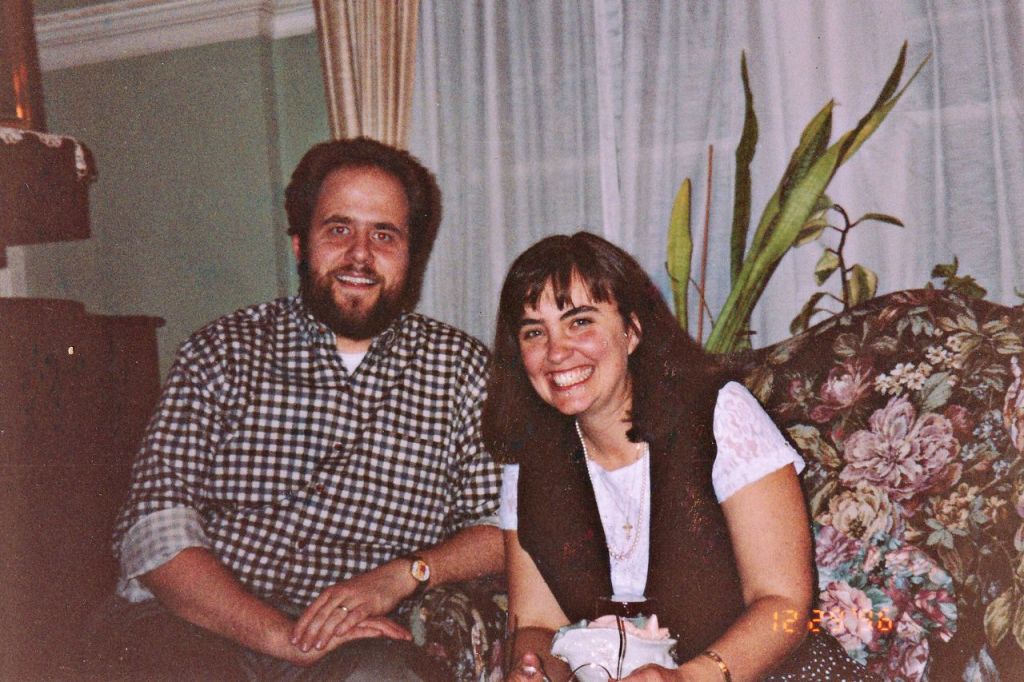
There are so many photos of Jeff and me together at family parties, you might think we were a couple, but really, we were just a couple of introverts!
Scripture, Spirituality, Writing

Fear Locks the door

When the Catholic Preaching Institute asked me to write 300 words “From the Pew” for Pentecost, I knew exactly what I wanted to write about!

You can see the Gospel and the “From the Pulpit” commentary, along with my reflection, here on the St. Charles Borromeo Seminary website. This is what I wrote:

From the Pew: June 8, 2025
Pentecost Sunday (John 20:19-23)

When I was in my thirties, my mother and I had a running disagreement about whether she should lock her screen door at bedtime. “The only person a locked screen door keeps out is a relative with a key!” I would insist—usually after spending way too long trying to get my parents’ attention on a Saturday morning before cell phones. But Mom could not be dissuaded. Although the home was secured by a lock and a German shepherd, flipping that little latch gave her a bit more peace.

One can’t blame the disciples for bolting the door after Jesus’ execution; as his followers, they were understandably terrified. And yet, just as Mom’s screen door was vulnerable to any two-bit burglar with a box cutter, the disciples’ barricade was not going to thwart anyone truly bent on doing them harm. Nor was it an obstacle for Jesus, who appeared in their midst and offered them peace.

But note what Jesus did not offer them: safety.  He didn’t say, “You don’t have anything to be afraid of,” or “Nothing bad will ever happen to you.”  Indeed, he did the opposite: showed them the brutal evidence of his crucifixion, then sent them forth as the Father had sent him. And we know that they went on to suffer for their faith, often meeting violent ends.

The fears that keep me up at night cannot be put to rest by even the strongest lock. Everyone I love will die—unless I beat them to it, which may also be no picnic. Untold hardships await us all. Fortunately, the peace Jesus bestows is not dependent on untroubled circumstances, but on our embrace of his Spirit’s abiding presence.

Fear locks the door, but Jesus walks right in. Will we accept peace on his terms?

Grief, Scripture, Spirituality

What Day Is It?

Every time I walk into church and spot my friend Jamey Moses, I can count on him to ask me the same question: What day is it? No matter if it’s Saturday, Sunday, or a random weekday, I always reply, This is the day the Lord has made!

At Easter Mass yesterday, I sang Psalm 118: This is the day the Lord has made; let us rejoice and be glad! And this morning, like the rest of you, I woke up to the heartbreaking news that Pope Francis has gone home to God.

Not feeling very Eastery anymore, I must confess.

And yet. And yet and yet and yet.

The paschal mystery is no respecter of human or even liturgical calendars. Some people’s hearts are awash in gladness, even on Good Friday—as the vibrant music in our parish during the ecumenical Seven Last Words service demonstrated. For others, the “descent into hell” lasts much longer than three days. As Caedemon’s Call sings in their beautiful Valleys Fill First, “It’s like that long Saturday between Your death and the rising day, when no one wrote a word, wondering is this the end.”

In what now appears prescient, my friend Ann Garrido posted a reflection on Good Friday, recognizing in the crucifixion the aching sorrow of our whole world at this political moment. She suggests that, at least for a time, our best response may be silence, “acknowledging that the Word has been taken from us.” I encourage you to read her whole reflection:

THIS GOOD FRIDAY | Ann Garrido

As I try to get my mind and soul around the reality of a world without Pope Francis, I’m praying with his Easter message from yesterday—literally, Francis’ final word on many subjects.

More importantly, I’m holding onto this seven-word prayer taught to him by his grandmother: “Jesus, make my heart more like yours.”

This is the day the Lord has made. Whatever day it feels like in your soul, may the blessings of Francis’ witness of life and love carry you along.

Retreats, Spirituality

Ode to the Summer Retreat

I’m preparing to give my first week-long retreat, and it’s got my mind wandering down memory lane to the many times I made a summer retreat at the Jesuit Center in Wernersville.

The pack list was simple: Comfortable clothes, in layers. Quiet shoes for inside, and supportive ones for morning miles. Sketch pad with colored pencils. Weathered Bible. Spanish Bible. Perhaps a book of poetry, or another slim inspirational volume. Whatever cross-stitching project I was working on at the time (which I might not have touched since my last retreat). Above all, my journal and good pens—by which I mean inexpensive medium ballpoints. (Blue.)

rocking chair at sunrise

It would take me a couple days to fall into the rhythm of retreat; some years I’d start twitchy, not quite sure what to do. Other times I’d arrive dog tired, entrusting myself to the assurance of Psalm 127: God pours out blessings on the beloved while they slumber. Until I got my bearings, the framework of retreat would carry me along–meals, Mass, spiritual direction–as would the space itself: a rocking chair in the east garden at sunrise; a cozy cushion in the chapel balcony before bed.

Decades later, certain memories remain fresh. Particularly poignant is the first retreat after my mother died. Bent by grief and not sure how to move forward, I sat for hours in my once-favorite garden, where they’d dug up all the irises (and other perennials) but hadn’t quite figured out what to replace them with. I’d brought Mary Oliver’s book Thirst for company, and found deep solace in her poem “Praying,” which spoke to both the garden and my life:

It doesn’t have to be
the blue iris, it could be
weeds in a vacant lot, or a few
small stones; just
pay attention, then patch

a few words together and don’t try
to make them elaborate, this isn’t
a contest but the doorway

into thanks, and a silence in which
another voice may speak.

(Copyright © 2006, Mary Oliver)

By the end of the week, the other voice I was listening for had spoken, bringing me a measure of peace.

Other years found me praying imaginatively with various Scripture passages. Once, I was on Psalm 116 for so long that I rewrote the words to express my gratitude more personally. And I can still remember the brink of the hill where I was standing when struck by the certainty that, like the Samaritan Woman at the Well, I was seen, known, and cherished by God—an awareness that returned to me powerfully along the Ignatian Camino last fall.

We can and should pray anywhere, at any time, just like we can squeeze in conversations with our beloved friends and family on the fly. But in our relationship with God, as in all those other relationships, there is no substitute for quality time. A retreat week creates the environment for us to settle into prayer and the time for that prayer to become expansive. It trains us to listen for the voice of the one who calls us by name, leading us (as today’s Gospel promises) to abundant life.

I know that not everyone has the time, freedom, money, or even desire to escape for a week of retreat. But oh my goodness, if you do . . .

There are still a few spaces left on the guided retreat I’m leading during the last week of June at St. Joseph Villa, which overlooks beautiful Shinnecock Bay in Hampton Bays, Long Island. Each morning, I will open the day with material for reflection around the themes of Finding God in Ordinary Time. Each afternoon, those who wish may gather for some gentle conversation about what’s been happening in prayer. For the rest of the day, including meals, we’ll enjoy the gift of shared silence. The retreat runs from the afternoon of Sunday, June 25 to the morning of Saturday, July 1, and the cost is $560 (which includes a private room and all meals). Click the link above for more information or to register.

Whatever your summer holds, I hope it finds you somewhere you can listen to the voice of the One who sees, knows, and cherishes you.

Christine

Scripture, Spirituality

On Fire, but Not Consumed

There the angel of the LORD appeared to Moses as fire flaming out of a bush. When he looked, although the bush was on fire, it was not being consumed. (Exodus 3:2)

What a remarkable sight: a bush on fire, but not consumed. “I must turn aside to look,” Moses thinks, asking “Why does the bush not burn up?”

On fire, but not consumed. Have you ever experienced this?

Continue reading “On Fire, but Not Consumed”