Writing

Books I Love by People I Love (2025)

‘Tis the season . . . for curated book lists! Here’s my quirky annual contribution, with just two rules: I have to 1) genuinely like the book and 2) know the author personally (enough to have had a conversation).

If you’re shopping online (I’m looking at you, Cyber Monday), I beg of you, GET NOT YOUR BOOKS FROM AMAZON. Local independent bookstores need our December dollars! If you don’t have one near you, try Bookshop.org, where you can indicate which local indie your purchase will support, or Barnes & Noble, a bona fide brick-and-mortar chain.

And if you want to gift any of my books for Christmas, just email me and I’ll move heaven and earth to get personalized, signed copies to you or your chosen recipients.

Enough said. Here’s the 2025 edition of Books I Love by People I Love:

Lilli de Jong: A Novel, by Janet Benton
Janet is a Philadelphia-based writing coach. Her debut novel, set among Quakers in Germantown in the late 1800’s, follows the travails of an unwed mother forced to make her way in the world in the face of heartbreaking poverty and prejudice. GIFT THIS TO anyone who enjoys a compelling, immersive read.

If I Loved You, I Would Tell You This,
Short Stories by Robin Black
Robin is a local author I met years ago when Lynn Rosen hosted a discussion of Robin’s novel Life Drawing (which I also recommend). Wanting to read more, I discovered her marvelous book of short stories. Fun fact: last year, I ran into Robin at an Authors Guild happy hour and fan-girled her so hard it might have freaked her out a bit. GIFT THIS TO anyone who needs their exquisite writing in small doses.

Finding Peace Here & Now: How Ignatian Spirituality Leads Us to Healing and Wholeness, by Eric A. Clayton
The fun and prolific Eric Clayton released his third book this year, and I got to review it for the National Catholic Reporter. It’s not enough to wring our hands and pray for peace, Eric insists. “If peace is what we desire, then we need to practice it.” A generous writer, Eric provides many helpful suggestions for how to practice peace within ourselves so that we can extend it to others. GIFT THIS TO anyone who doesn’t like what today’s political climate is doing to their blood pressure.
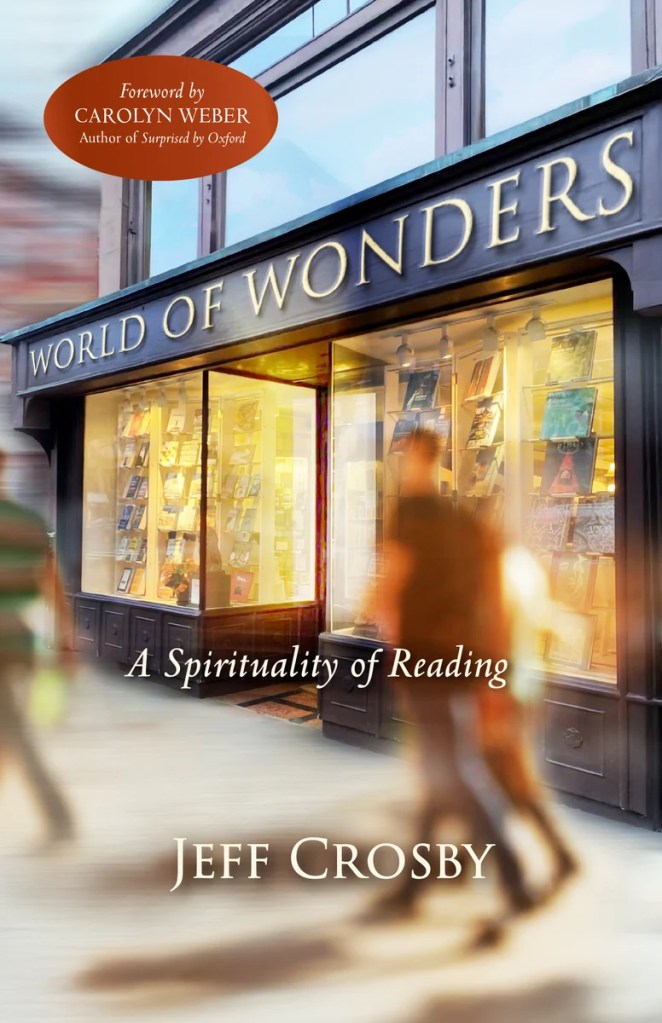
World of Wonders: A Spirituality of Reading, by Jeff Crosby
Jeff (with whom I’ve enjoyed an epistolary friendship for several years) has written an intriguing memoir chronicling the intersection of his faith and his reading, including the evolution of his relationship with Scripture, poetry, and fiction. He identifies literature that has nourished him in various seasons of life, and provides carefully curated lists of works he has found helpful and we might too. GIFT THIS TO anyone who’d like 174 MORE book recommendations (I’m not even kidding) to enrich their spiritual life.

Common Ground: How the Crisis of the Earth is Saving Us from Our Illusion of Separation, by Eileen Flanagan
Eileen is a good friend, and I’ve had the privilege of reading parts of this book in draft form ever since we went to the When Words Count retreat together in 2017. Common Ground takes readers on a journey to places where environmental disasters are being exacerbated by corporate interests and dishonesty. Yet this is not a “doom and gloom” book; Eileen interviews climate activists, spiritual leaders, and ordinary, warm-hearted citizens, all working together to banish our “illusion of separation” from one another and from the earth that gives us life. GIFT THIS TO anyone who wants to be better equipped to talk persuasively about the crisis facing our planet.

Together Through Reflection: Themes for Those Who Lead and Serve in Catholic Organizations, by Bridget Deegan-Krause
For decades, Bridget has worked to equip mission-focused leaders for service. Designed as a resource for faith-based leaders to use with their teams, this accessible guide offers practical direction for producing an effective and prayerful reflection experience. (Now, there’s a book I wish I’d had during my years in campus ministry!) GIFT THIS TO anyone who works for a Catholic institution—especially if they are in a leadership role.

The Soul Also Keeps the Score: A Trauma-Informed Companion to the Spiritual Exercises of Saint Ignatius, by Robert W. McChesney, SJ
Convinced by decades of work with traumatized individuals that a siloed approach to care undermines holistic recovery, my friend Rob brings spiritual and psychological insights to the table and insists that they have a conversation.  The Soul Also Keeps the Score is part color commentary on the life and legacy of soul-wounded swashbuckler-turned-saint Ignatius of Loyola, part deep dive into cutting-edge research in trauma studies. In it, Rob navigates the turbulent waters among disciplines in the service of that most Ignatian of goals: to help souls. GIFT THIS TO anyone frustrated by the divide between psychology and religion. Bonus: Rob and I have begun offering retreats together; we’ll be at Cranaleith (Philadelphia) in January and Bellarmine (Chicago) in March!
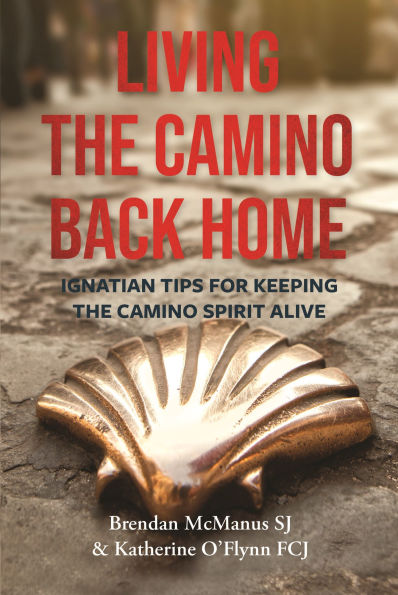
Living the Camino Back Home: Ignatian Tips for Keeping the Camino Spirit Alive, by Brendan McManus, SJ
I first encountered Brendan through his wonderful book about the Ignatian Camino called The Way to Manresa, later discovering that most of his books have to do with the Camino de Santiago (Way of St. James). Based in Dublin, he spends time in Spain each summer, supporting pilgrims through the Camino Companions program. This little gem of a book provides valuable insight on how to sustain the transformative effects of a pilgrimage in everyday life. GIFT THIS TO anyone who returned from a pilgrimage asking, “Now what?”
Jesus Before God: The Prayer Life of the Historical Jesus, by Hal Taussig
In the late 90’s, I had the amazing experience of taking a few of Hal’s graduate classes at Chestnut Hill College. A Methodist minister and Scripture scholar, Hal opened the Bible for me like no one before or since. This imaginative portrait of Jesus at prayer is a palate-cleanser of a book, readying us for a fresh encounter with God. (Note: it may be out of print, but gently-used copies abound!) GIFT THIS TO anyone who’s intrigued by the notion of a “historical” Jesus.

That’s it for this year, friends. For more ideas, check out 2024 and 2023.

Scripture, Spirituality, Writing

Fear Locks the door

When the Catholic Preaching Institute asked me to write 300 words “From the Pew” for Pentecost, I knew exactly what I wanted to write about!

You can see the Gospel and the “From the Pulpit” commentary, along with my reflection, here on the St. Charles Borromeo Seminary website. This is what I wrote:

From the Pew: June 8, 2025
Pentecost Sunday (John 20:19-23)

When I was in my thirties, my mother and I had a running disagreement about whether she should lock her screen door at bedtime. “The only person a locked screen door keeps out is a relative with a key!” I would insist—usually after spending way too long trying to get my parents’ attention on a Saturday morning before cell phones. But Mom could not be dissuaded. Although the home was secured by a lock and a German shepherd, flipping that little latch gave her a bit more peace.

One can’t blame the disciples for bolting the door after Jesus’ execution; as his followers, they were understandably terrified. And yet, just as Mom’s screen door was vulnerable to any two-bit burglar with a box cutter, the disciples’ barricade was not going to thwart anyone truly bent on doing them harm. Nor was it an obstacle for Jesus, who appeared in their midst and offered them peace.

But note what Jesus did not offer them: safety.  He didn’t say, “You don’t have anything to be afraid of,” or “Nothing bad will ever happen to you.”  Indeed, he did the opposite: showed them the brutal evidence of his crucifixion, then sent them forth as the Father had sent him. And we know that they went on to suffer for their faith, often meeting violent ends.

The fears that keep me up at night cannot be put to rest by even the strongest lock. Everyone I love will die—unless I beat them to it, which may also be no picnic. Untold hardships await us all. Fortunately, the peace Jesus bestows is not dependent on untroubled circumstances, but on our embrace of his Spirit’s abiding presence.

Fear locks the door, but Jesus walks right in. Will we accept peace on his terms?

Picture of a Goat
Liturgy, Retreats, Scripture, Spirituality

Prodigal Mic Drop

The most pointed insight I ever gained into the Prodigal Son story (Luke 15:11-32) came during a retreat skit performed by a group of West Chester University Newman Center students.

I remember no context—only that they’d been put into groups and assigned parables to act out. (BTW I can’t believe I made them do this. I skipped my own college orientation because I heard there were skits!)

Truly, I remember nothing about the enactment of the Prodigal Son until right after the guy playing the older brother—scandalized by the fatted calf’s having been killed to celebrate his rascally sibling’s return—turned on his father, saying, “You never gave me so much as a kid goat to celebrate with my friends.” Christopher Jowett, the tall, ponytailed dude who was playing the father (and who surely wouldn’t mind my quoting him without permission here, because it was awesome), spun around and thundered:

“YOU NEVER ASKED ME FOR A KID GOAT!”

I’m sure the skit went on from there, but I was done. Mic drop done. Convicted done.

Here’s what I grasped, in an instant. The younger boy’s departure had been a dagger in the heart, sure. “Give me the share of your estate that should come to me” was was just a polite way of saying, “I (literally) can’t wait for you to die.” But the older one’s reaction to his brother’s reappearance? That was a knife in the back.

The one who had seemed to serve faithfully by his side was actually in it for the reward? The one about whom he could say “you are with me always, and everything I have is yours” wanted more? The one who had borne witness to the depths of his grief still did not know him well enough to share his heart’s rejoicing?

This was a stranger.

The one who had borne witness to the depths of his grief still did not know him well enough to share his heart’s rejoicing.

Over the course of our lives, we may all vacillate along the continuum from the younger brother’s “dissolute living” to the elder brother’s life of “dutiful service,” with readers of this blog probably mostly avoiding the more dissolute end. We can’t be on our high horses about that, though, because it only means that’s not where our temptation lies.

That’s not where our temptation lies.

Our temptation—should you recognize yourself among the “older brother” types—is to serve dutifully but resentfully. Keeping careful records. Believing all the things that go right in our lives are because of our hard work and responsibility. Not recognizing the four hundred things a day that go right because of happenstance, privilege, or mercy.

Each time we fail to share God’s parental distress over every lost and suffering soul, or wholeheartedly celebrate each return to grace, we are the older brother.

I suspect there’s something there to convict us all, so I’ll end simply with this beautiful poem by Rumi, which I first encountered in Marilyn Lacey RSM’s marvelous book This Flowing Toward Me: A Story of God Arriving in Strangers. May we all recognize God’s flowing toward us today.

For sixty years I have been forgetful,
every minute, but not for a second
has this flowing toward me stopped or slowed.
I deserve nothing. Today I recognize
that I am the guest the mystics talk about.
I play this living music for my host.
Everything today is for the host.

Book Tour, Pilgrimage, Retreats, Spirituality, Writing

It’s In There

When I returned from the Ignatian Camino, my challenge was to transform a personal experience of pilgrimage into a book that could touch the hearts of people who might never be able to walk away from their life for a month. Now that Finding God Along the Way is out in the world, a new challenge has arisen: transforming words on a page into living, interactive retreat experiences.

I can’t think of a more hospitable place to begin than the Cranaleith Spiritual Center, where last Saturday I led a morning retreat called “The Long Pilgrimage to Justice.” Moved by a spectrum of concerns, ten souls braved the cold to gather in a sunny room and ground themselves for the work ahead. Together, we considered how the metaphor of pilgrimage could allow us to keep our goal on the horizon while staying deeply present to what is right in front of us. Drawing on wisdom from the Ignatian Camino, we discussed finding our “one thing,” taking the next step, redefining failure, and equipping ourselves spiritually.

My favorite part came near the end. Thoughout the morning, I’d been sharing snippets that speak to me—Scripture verses, songs, poems, quotes, etc. Finally, I read a passage from Chapter Sixteen of my book, “It’s in There,” and invited people to share what they carry in their own “go-bag” of inspiration.

The responses began as slowly as an afternoon snowfall, but each offering encouraged the next until the room was blanketed by consolation. It was such a joy to hear people ask one another, “Wait, who was that author?” “What was the name of that song ?” “Tell me that website again!” Phones came out so folks could look things up; pens came out so we could write them down.

One gentleman shared a reflection from Unfolding Light that captured the spirit of the day. It began: Hope is not anticipation of a certain outcome, but trusting goodness. Though the world around us abounds in hateful rhetoric right now—with even people on “our side” (whichever side that may be) delighting in mean memes and zinging caricatures—it was refreshing to remember how much goodness dwells in people’s hearts and memory banks.

Hope is not anticipation of a certain outcome, but trusting goodness.

Steve Garnaas-Holmes

It made me realize that, just as January is a month in which many of us return to a healthier diet after the excesses of the holiday season, so is this a time to be careful about our mental consumption. What we read, watch, and listen to has a profound effect on our spiritual health. Let’s resolve to choose wisely!

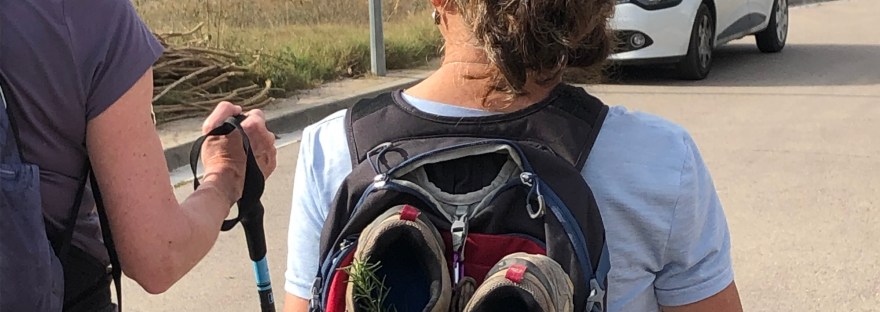
Can you spot the potassium-rich banana in Betsy’s backpack?
What’s in your “go-bag” of inspiration?

Excerpt from Chapter Sixteen, “It’s in There”

“I know we’re supposed to be praying during the first two hours of every walk. Does repeatedly taking the name of the Lord in vain count?”

I cracked this joke at the end of a particularly pressured segment of hiking, but I wasn’t actually swearing my way across Spain. The only truth in that snarky remark was the word “repeatedly.” When the pace or terrain overwhelmed my ability to pray deeply (by which I mean conversationally, meditatively, or imaginatively), I took comfort in repeating words and phrases lodged in my memory.

It began during that long ascent to Arantzazu. Knowing that we were going to “visit” the Blessed Mother, I was thrown back to one of my mom’s favorite prayers, the Memorare. As I grew more exhausted by the climb, I resorted to repeating the last sentence like a mantra, in cadence with my steps: O Mother of the Word Incarnate, despise not my petitions, but in your mercy hear and answer me.

Gradually, other words emerged from the deep. Once upon a time, I’d memorized a few prayers in Spanish, so I was able to pass a satisfying hour trying to drag those beloved lines out of the mental vault. Later, I challenged myself to piece together all four verses of Tagore’s “Friends Whom I Knew Not,” which I’d quoted extensively in my book Finding God Abiding. In both cases, something about the combination of meaningful words and mental exercise sustained me for quite a while.

Various Scripture passages joined the parade of words in my head. Walking through the mountains, I recalled the beginning of Psalm 121: “I will lift up my eyes unto the hills, from whence shall come my help.” On another day, I clung to St. Peter’s incredulous exclamation after Jesus asked if he wanted to jump ship like other faint-hearted followers: “Lord, to whom shall we go? You have the words of everlasting life.” Mile after mile, the rhythmic “Lord, to whom shall we go?” reminded me that there was nowhere I’d rather be.

Certain hymns also provided prayerful refuge. Gospel songs such as “Guide My Feet” and “We’ve Come This Far by Faith” encouraged me to press on. The sight of a little dead bird evoked “His Eye is on the Sparrow,” assuring me that I was not alone. Even though such repetitive prayer isn’t ordinarily my style, I’m grateful to have had access to such richness under duress.

In the age of smartphones, the ability to “look anything up” is both a gift and a curse. Though vast amounts of information are there at our fingertips, the convenience discourages committing things to memory. But even if I’d had cell service in the Cantabrian mountains, what would I have done—pulled out my phone and said, “Hey Siri: What’s a good prayer, poem, Scripture, or song for when you’ve climbed higher than you would have thought possible but still have an impossible distance to go?” (Okay, I just tried it, and got a link to “30 Prayers to Give You Peace of Mind When You Need It Most,” but there’s no way I could have flipped through them without dropping my phone or dropping out of the pack!)

Back in the late 80s, a series of Prego spaghetti sauce commercials featured the slogan “It’s in there!” (All the ingredients a home cook could want, right in one convenient jar.) Prego is Italian for “You’re welcome,” so perhaps that’s God’s response as I offer thanks for all the heartening words that dwell in my memory banks and offer themselves as needed. “Prego!”

Liturgy, Scripture, Spirituality, Writing

Imagining the Gospel: A Reflection on Mark 10

This is the longest lead-time I’ve ever had on an assignment.

At the August 2023 Ignatian Creators Summit, participants volunteered to write imaginative encounters with Gospel texts for the coming liturgical year; the 28th Sunday of Ordinary Time (October 13) fell to me. I began thinking about it immediately, and even posted a mid-point “work in progress” blog (including a homemade sonnet) when Mark 10:17-30 popped up as a daily Mass reading in May.

Here at last is the “final” product. (Scare quotes only because no wrestling with this challenging reading is ever the last word.)

Enjoy!

a pile of open books
Liturgy, Scripture, Spirituality, Writing

Lost in Translation

I really ought to get over it. The “new” translation of the New American Bible hasn’t been new since I was in college (1986), and it’s been in liturgical use for more than two decades now. But, every once in a while, something about the revised edition hits my ear badly and sets my head shaking again. This was one of those days.

In today’s Gospel, Jesus is on his way to heal the dying daughter of synagogue leader Jairus when they are halted by an afflicted woman who (literally) reaches out for a cure by touching the tassel of Jesus’ cloak. The ensuing conversation delays the trip to Jairus’ house long enough for people to arrive with news that the child has died. Turning to the stricken father, Jesus says . . .

“Do not be afraid; just have faith.”

Seriously?

I suspect it’s the word “just” that bugs me. Such a dismissive little word. Like the “Just Say No” anti-drug campaign of the 80’s, or Nike’s “Just Do It” commercials, the reality is so much harder than the word “just” implies. In the old (1970) New American Bible—the version engraved on my heart—Jesus says: “Fear is useless; what is needed is trust.” That has always moved me. “Fear is useless” sounds so much stronger than “Do not be afraid.”

I remember, in grad school, learning about the continuum of approaches to biblical translation. On one end is literal translation–as close as possible to word-for-word. On the other is paraphrase–rendering the ancient languages in chatty, accessible prose. In the middle is something called dynamic equivalence, which aims to convey the meaning of the original as fluently as possible in the new language. As I understand it, this was the intent of the 1970 NAB, but it was perceived as having gone too far. The 1986 version is more literal, but to me it feels like they’ve sucked the poetry out of all my favorite texts.

I’m on this today not to lobby for the old translation—clearly, that ship has sailed—but because of a realization that hit me as I was fussing about it.

Last week, I reviewed the suggested copyedits for my new book, including the insertion of translation acronyms after every Scripture citation. In addition to the New American Bible Revised Edition (NABRE), I’ve use the New Revised Standard Version Catholic Edition (NRSVCE), the King James and New King James Versions (KJV & NKJV), and even something called the Complete Jewish Bible (CJB). What is wrong with me? I wondered as I went through the text. Why can’t I just pick a translation and stick with it? (Hah! Once again, “just” is harder than it sounds.) This morning, I realized why: it’s because the translation in my head doesn’t exist anymore, so I’m forever searching for the one that comes closest.

The next time a line of Scripture catches your attention, I highly recommend visiting Bible Gateway, where you can see it in over sixty English translations. (But not the 1970 NAB; for that, you have to haunt used bookshops like I do!) Perhaps you’ll discover a nuance you hadn’t grasped, or a phrasing that speaks to your present circumstances. The most important thing is that you let the Word “dwell in you richly” (to cite many translations of Colossians 3:16), remaining close to your heart where it can make a difference in how you approach the world.

As for me, I’m just going to keep muttering “fear is useless” . . .

Liturgy, Scripture, Spirituality

Do You Not Care?

“Teacher, do you not care that we are perishing?” (Mark 4:38)

These words from today’s Gospel are on my shortlist of saddest lines in Scripture. It’s right up there with Martha’s and Mary’s response when Jesus finally shows up after Lazarus has been in the tomb for four days: “Lord, if you had been here, my brother would not have died.”

In the other accounts of the Storm at Sea, the disciples simply cry out “Lord, save us! We are perishing” (Matthew 8), or “Master, master, we are perishing” (Luke 8). Those sound like the desperate prayers any of us might utter in a crisis. But in Mark, they say “Do you not care that we are perishing?” Ouch. (I suspect that “Do you not care?” was the subtext of the sisters’ words as well—implying that a caring Jesus would have arrived in time to save his friend.)

Mark’s Gospel is shorter and terser than than the other two, so it’s unusual that his account would have more words. It’s also the oldest Gospel, though, so perhaps the other evangelists edited out the apostles’ accusation, finding it unseemly. Yet their question strikes me as perfectly human—and refreshingly honest.

Read more: Do You Not Care?

The feeling that we are going under, or that someone we love is about to slip from our grasp, is indeed terrible. This morning, I’m thinking of the people evacuating Ruidoso, New Mexico ahead of raging wildfires, the couple from my parish racing across the country to be there for their son’s brain surgery, and all the suffering souls in Gaza, Israel, Ukraine, Sudan, and countless other places. The enormity of what people endure is staggering; feeling like God is asleep or indifferent compounds the misery.

Does knowing that even Jesus’ closest friends doubted his care for them offer any consolation? Does belief in their eventual rescue—the storm stilled, Lazarus raised—offer the least bit of solace when we’re in the thick of our own distress? That, my friends, is a question only you can answer for yourself.

What helps me is remembering how many times I’ve reached the other side of a metaphorical storm—emotional, medical, financial, interpersonal—and found my feet on the damp sand of life’s next chapter. Awareness of what God has done nurtures trust in what God may yet do, so I try to begin from a place of gratitude.

One of my favorite Easter hymns is “Sing with All the Saints in Glory,” set to the tune of Beethoven’s “Hymn to Joy.” It contains these marvelous lines:

All around the clouds are breaking,
Soon the storms of time shall cease;
In God’s likeness we awaken,
Knowing everlasting peace.

The song doesn’t minimize suffering, but it does put it in perspective. No storm lasts forever. We will know relief, whether in this world or the world to come.

Whatever storms you are experiencing right now, I invite you to be as honest with God as Martha, Mary, and those soaking-wet disciples were with Jesus. From that place of honesty, may you grasp the outstretched hands of gratitude and hope, waiting to lead you to a place of peace.

Scripture, Spirituality, Writing

What Happened Next?

What treasures from my chest would I not shove
if Jesus looked at
me with that much love?

For months now, I’ve been playing around with the story of the Rich Man in Mark (which you can read here) as an assignment for the Jesuit Media Lab’s Imagining the Gospel series. It’s the Gospel for the 28th Sunday in Ordinary Time (October 13), so I have months left to muse on it. But when I began my morning with Pray As You Go, I discovered that it is also the Gospel for today—Monday of the 8th Week of Ordinary Time. So it felt right to share with you my thoughts in progress.

Although poetry is not my medium, something about this passage kept pulling me in that direction—specifically, the discipline and economy demanded by a sonnet. Perhaps Jesus’ invitation to pare down the rich man’s possessions made me want to do the same with my words?

I’m not saying it’s a good sonnet; mostly, it feels like a high school English assignment—compressing my thoughts into fourteen lines of iambic pentameter. But the ending couplet that began this post has stayed with me:

What treasures from my chest would I not shove
if Jesus looked at
me with that much love?

The story begins with the rich man running up to Jesus, ostensibly seeking guidance but quick to say he’s kept all the Commandments from his youth. (Oy. Brag much?) We know how it ends: after Jesus tells him he’s only lacking one thing (go, sell all you have, give to the poor, and come follow me), the man goes away sad, for his possessions are many. But sometimes we forget the middle, the pivot-point: “Jesus, looking at him, loved him.”

Why did Jesus love him? I don’t think it was his spiritual resume. (Oh, you’ve kept all the Commandments?) Perhaps he was touched by the man’s earnestness or even his anxiety—that someone who’d followed all the rules would still have such deep unease about the path to salvation.

On the other hand, maybe asking “why” Jesus loved him is not the right question. Maybe that spontaneous, compassionate regard is the nature of the beholder, not the merit of the beheld. Maybe to be looked at by Jesus is to be loved by him.

So, what happened next? Was that love transformative? Did the rich man go away sad because he knew he wouldn’t be able to tear himself away from all those possessions—or because he knew how much work lay ahead of him?

I hope it was the latter, but the pressing question today is simply this: Can we allow ourselves to stand in that divine gaze long enough to be transformed by the knowledge of how deeply we are loved?


“What Happened Next?” (with apologies to Shakespeare)

As on a journey they were setting out,
I bet the muttered epithets were rife
When some rich guy delayed them with a shout:
What must I do to gain eternal life?

Our Lord, so patient, listed out the Ten
Commandments. Oh, I’ve kept them from my youth!
“You have but only one thing lacking, then:
Sell all and give, then come and follow Truth.”

Poor foolish burdened ass, you well may say—
Too tied to “stuff” for generous reply.
But I suspect that, as he walked away,
Sheer magnitude of work’s what made him sigh.

What treasures from my chest would I not shove
If Jesus looked at me with that much love?


And here’s the final version, if you’re curious.

Scripture, Spirituality

The Grace of Pajamas

We’ve reached the end of the Christmas season. Today, Luke’s shepherds and angels yield to Matthew’s magi with their exotic gifts. Tomorrow is the Feast of the Baptism of the Lord. On Tuesday, with a sigh of sadness or possibly relief, we return to Ordinary Time.  As we put away our nativity sets, it may be comforting to remember John’s description of the Incarnation, which needs no crèche to hold it:

“And the Word became flesh and made his dwelling among us.”  (John 1:14)

Often, nuances of familiar passages can reveal themselves in unfamiliar translations. Using Bible Gateway, I discovered that the Orthodox Jewish Bible (a 21st century English translation drawing on Yiddish and Hebrew cultural expressions) tells us that “the Dvar Hashem (Word of God) made his sukkah among us.” This is a poignant image for those of us blessed to live in Jewish neighborhoods, where even Catholics know it’s the Feast of Sukkot because of the sukkahs that spring up in nearby yards—or, for the yardless, on decks and balconies.

My favorite translation, however, may be the Message Bible’s chatty paraphrase: “The Word became flesh and blood, and moved into the neighborhood.”

Image by Alisa Dyson from Pixabay

What each of these translations captures in its own way is the startling proximity to which God committed in the Incarnation—experiencing life among and as one of us.  This has me musing about times when I have experienced the goodness of proximity with others, or what I’ve taken to calling The Grace of Pajamas.

Three times during this season, Porter and I have awakened in someone else’s home—with family over Christmas and New Year’s weekends, and now in Boston, at the home of fellow pilgrims from our Ignatian Camino.  As fun as it is to talk on the phone or go out to dinner, there’s nothing quite like sharing space: encountering sleepy relatives or friends over the coffee pot, experiencing their morning routines, cooking together, visiting the local shops that mark their days, accompanying them on their favorite walks or to their beloved place of worship.  There’s a quality of conversation that unfolds over time, an intimacy that grows from the simple sharing of life. 

Such opportunities are as golden as they are rare.  We can’t do it with everyone; a certain threshold of comfort precedes the invitation to pajamas. But these encounters point—as all good and beautiful things do—to an everyday truth.  In Jesus, God has taken on flesh and blood and moved into the neighborhood. God shares life with us not just in the special times, but especially in the ordinary ones.  

The One who made us and loves us and knows us better than we know ourselves promised to be with us always (and thus in all ways). We don’t need to clean up for God. We don’t need to put our face on. We just need to say, Welcome!

In this new year, as you go about the ordinary routines of your days . . . coffee pot, meal prep, dishes, laundry, work, errands, rinse, repeat . . . may you know God’s startling proximity, trust God’s abiding friendship, and experience the grace of those divine pajamas.