Uncategorized

The Littlest Angel

My reflection for the Jesuit Media Lab’s “Waiting and Wassailing” series dropped yesterday. I chose Bing Crosby’s “The Littlest Angel,” a song that never fails to bring a sappy tear to my eye. Click here to read/listen and explore the rest of the series. (You can also sign up to receive a song and reflection a day in your inbox, now through Christmas Eve.)

Wishing all the blessings of Advent, especially to those who find themselves in the darkness of grief this year . . .

Christine

Image by Inn from Pixabay
Uncategorized

#BucketList

“Have one of my books reviewed in America Magazine” was something I didn’t even know was on the professional bucket list until it became a possibility.

Several months ago, a friend who occasionally writes for America asked them if she could contribute a review of Finding God Along the Way, only to learn that it had been assigned already—to a stranger! (By which I mean, one of their regular contributors, with whom I happen to be unfamiliar.)

Cue the nail-biting. What would someone who didn’t already know me—who didn’t already like me—have to say about my writing? I’ve seen even bestselling books by well-known authors get taken down a notch by America reviewers. Would this one feel compelled to toss in a few critical observations just to prove her own writerly bona fides?

And when would it appear? I eagerly checked January’s issue (publication month) and February’s (which included IVC’s impressive annual Impact Report—a logical connection). Perhaps it would appear in March, when I was giving so many pilgrimage-themed Lent retreats? When April and May slid by as well, I stopped thinking about it. Maybe the fact that my book was assigned a reviewer was no guarantee said review would appear in print.

Then out of the blue on Friday morning, a text from Lexa Hall, my wonderful marketing contact at Paraclete Press: Did you see the review? Check your email!

Was I thrilled or crushed? Click the image below to read for yourself!

Recognizing Our Lives as Pilgrimages: A Review by Kristy Savage

Uncategorized

Heat Was in the Very Sod

I’m grateful to the good folks at the Jesuit Media Lab for proposing a music-themed take on Advent, for inviting me to submit a reflection, and for making it the first post of the season! (And if you haven’t subscribed yet, I encourage you to. Up next: NPR’s Scott Detrow on “Hark! The Herald Angels Sing.)

Uncategorized

The Parable of the Basset Hound

Conclusion of the Thankful Thursday Series

Two Sundays ago, I had the privilege of preaching at First Presbyterian Church of Haddonfield, NJ. It was Consecration Sunday, when members submit their tithing pledges for the year ahead. Pastor Marvin Lindsay had invited me to preach on gratitude and/or generosity, and said I could choose my own readings. (What a treat!)

I selected Proverbs 3:1-10 (“Trust in the Lord all your heart…”) and Mark 6:45-52 (Jesus walks on water), and titled my sermon “The Parable of the Basset Hound” after my of my nephew-dogs, Hank. Here’s the pivot point of the lesson:

“I am sure that every person in this room is grateful for God’s many blessings in our lives. But the question is: Does our gratitude for what God did yesterday inspire trust for what God will do tomorrow, or do we just panic all over again like a pack of church-going Basset Hounds?” 

To hear the backstory—and the rest of what I had to say—you can listen to a podcast of the sermon, or watch the whole service here (readings begin at 20:25).

I remain ever-grateful to those who follow my writing. May Thanksgiving find your heart overflowing with gratitude!

Christine

Hank, unimpressed by his new fame

Uncategorized

David W. Burns

Part of the Thankful Thursday Series

There’s an almost thirty-year gap in the story of my friendship with Dave Burns. I have clear (ish) memories of our time together as undergrads at Saint Joe’s: arguing in honors seminars, collaborating on SEARCH retreats, that sort of thing. When the Challenger exploded, Dave and his girlfriend (now wife) Kate and I watched the coverage together in Xavier Hall. There’s a fun cap-and-gown picture of us in front of the student center in 1987, and then . . . I was forty-nine, walking into church for my father’s funeral, trying to figure out who that vaguely familiar middle-aged man was, smiling at me kindly from a back pew.

Cultivating the “Man of Mystery” look!

Since I reconnected with Dave ten years ago, our shared passion for writing has helped us make up for lost time.  He sent me an unpublished draft of a fun romp in which his protagonist was a fast-talking, wise-cracking, self-deprecating Gorgon (yup—snakes for hair, paralyzing death-gaze). Then he confessed to having also written a six volume post-apocalyptic series with some surprisingly Biblical turns. I asked for the manuscripts one at a time, and thoroughly enjoyed the ride.

Dave’s writing chops garnered some attention in 2019 when his excellent short story “Night Surf” won a Writer’s Digest grand prize. (You can read the story and an interview about it here.) And in 2022, he entered a Pitch Week competition at When Words Count—the writers’ retreat in Vermont that opened the door to my first published book—and swept all the categories, winning the top prize with that little Gorgon tale, now out in the world as Heart of Stone: Book One of The Medusa Chronicles. (Keep writing, Dave; we want to know what’s next for Kyra!)

Besides being a prolific writer, Dave is a New Jersey trial attorney. What do world-building in a fantasy novel and making a persuasive case to a jury have in common? They both rely on his gift for storytelling. In the Writer’s Digest interview, he says that’s the aspect of trial work he enjoys most: “having the opportunity to tell what I hope is a true story to a jury and then letting them weigh in on what they think of it.”

I haven’t seen Dave in the courtroom, but as a fan of his fiction, I believe that the truth at the core of each of his stories is what makes them so good. His characters wrestle with eternal, relatable themes of meaning and purpose, even when they’re battling mythological assassins or defending a citadel from vampire attacks.

His characters wrestle with eternal, relatable themes of meaning and purpose, even when they’re battling mythological assassins or defending a citadel from vampire attacks.”

Dave was one of the early readers for Finding God Along the Way, and I can picture exactly where I was when he called to tell me he had finished reading itI was giving a retreat in Hampton Bays NY, out for a long walk after dinner when my cell phone rang. “I remember finishing the last Lord of the Rings book as a kid,” Dave said, “and bursting into tears because I knew it was over and there wouldn’t be any more. Not since then have I been so sorry to reach the end of a book!”

Here’s what he had to say in writing: “Do you want to go for a walk with me?” With this deceptively simple question, author Christine M. Eberle launches us on a journey that is both physical and spiritual as she recounts her month-long, 300-mile trek through northern Spain with a group of fellow pilgrims to visit the key sites in the life of Ignatius of Loyola. In Finding God Along the Way: Wisdom from the Ignatian Camino for Life at Home, Eberle shares the perils and pitfalls of each stage of her travels, as well as the moments of sublime grace and beauty she encountered, while recreating each wild and wide vista of the Ignatian Camino trail—from the formidable heights of its mountains to the fragrant vineyards and arid deserts of its lowlands.

With her trademark tongue-in-cheek wit and relentless honesty, Eberle crafts both an entertaining and accessible memoir and a guidebook for meditating life’s most important questions. At turns harrowing and joyous, this is a book that lets the reader inhabit each step of an uplifting and transformative odyssey few will get to experience firsthand. By the time the author reaches the pinnacle of her journey and arrives at the monastery at Montserrat, the reader will feel an undeniable sense of accomplishment and triumph.

For new iterations of old friendships, I am truly grateful.

Uncategorized

Ann Garrido

Part of the Thankful Thursdays Series

I can’t remember when I first heard Ann Garrido’s name, but it may have been when an Ave Maria Press catalog landed on my desk, advertising a little book called Redeeming Administration: Twelve Spiritual Habits for Catholic Leaders. I ordered it at once and benefitted immediately from Ann’s fluent integration of prayer and practice, delivered in bite-sized, memorable concepts. My takeaways included things like (and here I paraphrase): The administrator’s job is to create an environment where everyone on the staff can thrive and Do what only you can do . . . in the service of which, make sure everyone knows how to change the toner in the copier!

Ann Garrido: Educator, Writer, Preacher, Podcaster, and more!

When I was on the planning team for a gathering of campus ministers from Catholic colleges and universities, I jumped at the chance to invite Ann to speak and discovered that she is even more delightful in person. And get this cool day job: she’s an Associate Professor of Homiletics at the Aquinas Institute of Theology in St. Louis.  No wonder she speaks as well as she writes! 

Since then, I’ve come to love some of Ann’s other books. As a campus minister, I often used her Redeeming Conflict in student leadership workshops. I still try to practice its principles, such as maintaining an awareness of the difference between intent and impact as well as approaching potential conflicts with curiosity and a presumption of goodwill.  But my favorite is Preaching to the Choir, a collection of forty selections of her preaching with the Aquinas Institute community. Not only are her reflections powerful, but they illustrate the potency of breaking open the Word in a setting where we know and are known by the congregation. (Ann also has contributed to Catholic Women Preach, so you experience her there.)

Ann’s reflections illustrate the potency of breaking open the Word in a setting where we know and are known by the congregation.”

From reading Ann’s monthly newsletter, I know that—in addition to her teaching, writing, and postcasting work—she maintains a busy travel schedule, giving talks and workshops across the county.  For my campus ministry peeps, here’s an exciting virtual event coming October 3: a CCMA symposium on “Embracing the Spirituality of Administration.” Check it out!

Ann has been a gracious mentor of my writing career for many years. I remember a long conversation when I was working on my first book, in which she talked me through some of the nuances of the publishing industry. I’ve circled back to her for advice and endorsements several times since then, and she has been beautifully responsive.

Here’s what she had to say about Finding God Along the Way: “Although I have never walked the Ignatian Camino, I feel as if I have reaped the benefits of doing so by reading Eberle’s spiritual travelogue of her pilgrimage. The questions she asks at the end of each reflection remind me that life is a pilgrimage and that whether I travel through Spain or my own backyard, it is the same God who is leading the way.”

For Ann Garrido’s commitment to excellent preaching in the Church, and her encouragement of my own efforts to connect spirituality, Scripture, and everyday life, I am truly grateful.

Uncategorized

Let’s Not Burn It Down

In the spring of first grade, I was pulled out of class one day to attend First Communion practice. A second-grader was absent, which would throw off the pew location of every girl behind her in line. (The boys were on the other side of the aisle). To avoid that, the good (IHM) sisters chose me as a seat-filler.

I remember only two things about that day. The second always makes me smile: how momentarily thrilled my mother was when I told her all about it over milk and cookies that afternoon. Had the sisters recognized how spiritually precocious I was, and decided I should skip a grade, sacramentally? (Oh, Mom . . . I love how you loved me.)

The first is something I still recall at almost every Mass, more than half a century later. The line the children were memorizing that day was “May the Lord accept the sacrifice at your hands, for the praise and glory of His name, for our good and the good of all His holy Church.”

I’m guessing most Catholics rarely think about that line (beyond, perhaps, slaloming around the male language for God). It riveted me, however—because I misunderstood it. At six years old, my sense of “Church” was limited to the physical edifice—the wonder of marble and stone that was St. Alice’s in Upper Darby. That day, and for the next few years, I believed we prayed “for the good of all His holy Church” so that the building would not burn down. (Whether this caused or was caused by my childhood terror of fire, I do not know.)

I found myself thinking about that misunderstanding during Mass yesterday morning in light of a conversation I’d had with my friend Eileen Flanagan on Saturday night about risk factors for political violence. (Sorry, that was an abrupt pivot; I should have warned you to fasten your seatbelt!)

My parish is relatively homogenous, politically; maybe your is, too (if you have a parish). Or maybe you worship in a place that is more representative of our nation: well-meaning people passionately committed to opposing parties. The divide across that aisle can feel cavernous. I remember a time when people could hotly debate political topics over appetizers then enjoy a convivial dinner together. No more. We may avoid the subjects that divide us, but more likely we avoid the people.

And this is where the good of all God’s holy Church comes in. There’s more than one way to burn a thing down.

So, back to those risk factors. Apparently there are three: 1) a recent history of election-related violence, 2) scapegoating / blaming / fear mongering on the part of one or both sides and 3) mistrust of election results. While there’s nothing we can do about our appalling recent history (attempts at both insurrection and assassination, with threats to poll workers in between), there is plenty we can do about numbers two and three.

Scapegoating / Blaming / Fear Mongering
Let me say this clearly: we can not control how other people speak. We can only control how we speak—to and about other people. Scripture is full of good advice in this regard. “Let everyone be quick to listen, slow to speak, slow to anger; for your anger does not produce God’s righteousness” (James 1:19-20). Or this: “Should anyone ask you the reason for this hope of yours, be ever-ready to reply, but speak gently and respectfully” (1 Peter 3:15-16).

This weekend, I had a gentle, respectful email exchange with someone whose partisan convictions differ sharply from my own, which made me realize how rarely I have any conversation at all with people “on the other side.” I was grateful for the relationship-preserving graciousness. When such opportunities arise, we should remember that “flamethrower” language never convinces anyone of anything. Even when we are speaking to those in total agreement, colorful demonizing is entertaining, but does not contribute to the building up of the common good.

As Scripture says, “Those who guard mouth and tongue guard themselves from trouble” (Proverbs 21:23). This doesn’t mean we shouldn’t speak about important topics—far from it. But we need to be deeply mindful of how we speak.

Not Trusting Election Results.
On this, I’ll be briefer. If you are are skeptical about election integrity, come watch the sausage be made. As a poll worker, I see firsthand the care with which each voter and vote is handled, and the extensive training we go through, twice a year, to ensure it. Of course, this does not eliminate systemic threats, like rules that make it harder for every person to vote and the electoral college system that makes it harder for every vote to count. But if you are skeptical about the process itself, please know that—before, during, and after election day, on the ground, district by district—more than half a million of your fellow citizens are hard at work preserving your right to cast your ballot. Be kind to them!

. . . be ever-ready to reply, but speak gently and respectfully.”

A commitment to civil discourse is vital for the good of “all God’s holy Church” . . . or whatever body you call home. These communities—vital to our well-being—are going to be around long after this election, this presidency, this decade. Peacemaking begins at home.

Let’s not burn it down.

Uncategorized

Pilgrimage is Life: Camino Stories

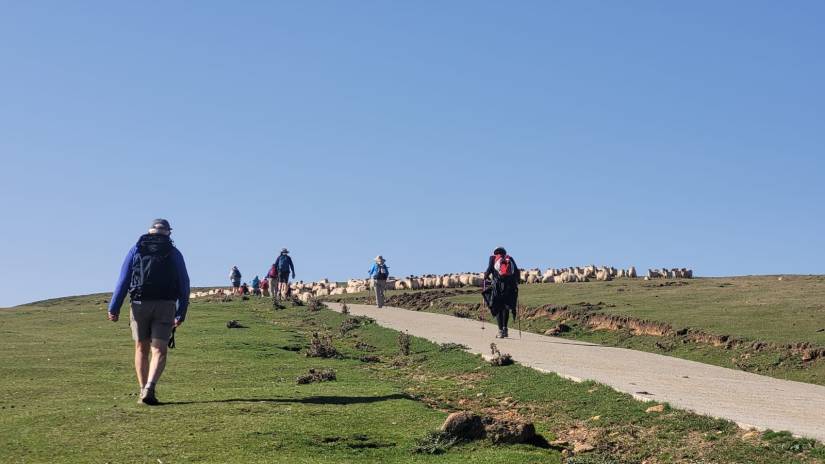
In April, I had the privilege of being a panelist on a webinar co-sponsored by Le Moyne College and the Ignatian Volunteer Corps. Click here for an engaging conversation facilitated by John Green (IVC’s VP for Partnership Engagement) with me, Jim Casey (one of my Ignatian Camino buddies) and his wife Evelyn Cannon (with whom Jim has made many pilgrimages along the Camino de Santiago).

Enjoy!