As I’ve been playing “what-were-we-doing-two-years-ago” all month, so many profound and silly memories have surfaced. Here’s one of the latter, told as part of Chapter Forty, “La Cova.” It takes place on the evening of October 30—the day after what we thought had been our final hike, from Montserrat to Manresa. Enjoy!
At three-thirty that afternoon, Fr. José told us, we were to meet in the garden to walk to Mass at Our Lady of Good Health. We should be sure to wear our boots, he added, and bring our hiking poles. Oh, good grief, I thought. How are we not done with those? And why are we hiking to Mass when there are more chapels than I can count right here in our residence?
The hour’s walk took us through the old town and surrounding commercial district, then onto a rocky path through the fields beyond. I will confess, I was grumpy.
My mood lightened when I discovered that we’d be sharing the road with goats. In the field beside us strode an actual goatherd—wearing sandals, carrying a crook, and accompanied by a frisky dog. (A twenty-first-century goatherd, he was also wearing jeans and a camo baseball cap, but still, it was pretty cool.) Close on his heels were at least fifty goats of varying colors and sizes, each sporting a noisy bell. As we hustled forward, the goats followed, kicking up a cloud of dust behind us until our ways diverged.
The surreal goat encounter banished what was left of my petulance. And, of course, the walk was worth it. Santa Maria de la Salut is a tenth-century hermitage. Preserved in the entryway is a rectangular slab identified (in Catalan, English, and French) as “the stone where Saint Ignatius knelt down on his visits to this sanctuary.”
How is it that a hunk of rock touched by Ignatius’ knees has been preserved for five hundred years? Fr. José explained that the ordinary people of Manresa kept Ignatius’s memory alive, realizing that they had been in the presence of a holy man. According to Tellechea Idígoras’s biography, when the saint’s canonization process was opened in 1594—seventy-two years after his sojourn in Manresa—many testified to the lasting impression Ignatius had made on them or on their parents and grandparents. Perhaps that’s why he continues to feel so present in this place.
As daylight was no longer being saved, the sun had dipped below the horizon already by the time we finished Mass. We started back at a good pace, hoping to reach the paved roads before dark; nevertheless, we had to navigate the treacherous end of the rocky path by flashlight. At last, we reached the bright Burger King and KFC signs on the outskirts of the city—a sharp contrast to the millennium-old hermitage and timeless goatherd. Like many of the towns we visited, Manresa is a place where the past and present coexist.
After dinner, we gathered for our final reflection . . .
In the spring of 2023, the Jesuit Media Lab advertised an eight-week online class for writers of spiritual nonfiction. (Did you even know that was a genre? I didn’t . . . and it’s my genre!) The class would be held in June and July, right smack up against my personally imposed August 1st manuscript deadline. How could I resist?
The teacher was Jonathan Malesic, an award-winning author with a PhD in religious studies; he was the perfect person to lead this (arguably niche) class. Jon is a prolific essayist, writing about the ethical and spiritual challenge of living a good life in America today. He is the author of The End of Burnout: Why Work Drains Us and How to Build Better Lives. In addition to his workshops, he teaches first-year writing at Southern Methodist University.
Jonathan Malesic Photo by Sarah Wall
Each week, he gave us solid content, interesting readings, and short but challenging writing assignments. He critiqued our work but also structured the class so we could shape and encourage one another’s writing. The first chapter of my new book is much tighter and more colorful than it might have been, thanks the workshopping it received there.
At one point, Jon gave me the nicest compliment—and I’ll bet he doesn’t even remember it. We were talking about influences, and I mentioned that I’ve learned to be careful about what I’m reading when writing intensively, because I tend to absorb the tone of whatever I’m taking in. Jon responded, “Well then, you must be reading a lot of poetry.” (Aww. I was reading a lot of Ann Patchett, but I do love rising to the challenge of a word limit!)
One of the unexpected benefits of the spiritual nonfiction class is that it connected me to other writers with similar passions—connections that have continued out in the real world. (You’ll meet one of those people next week.) Several classmates participated in this year’s Ignatian Creators Summit—including Jon himself. What a joy to meet in person!
One of the unexpected benefits of the spiritual nonfiction class is that it connected me to other writers with similar passions—connections that have continued out in the real world.
After learning so much in his class, I was moved by Jon’s endorsement of Finding God Along the Way: Christine Eberle is not only an experienced, funny, and wise spiritual guide. She’s also a great storyteller. In the vivid episodes of this book, she takes readers through stunning Spanish landscapes, hostels, communal meals, and masses and invites us to reflect on our own pilgrimages, including the ones we undertake in our ordinary lives. The rhythm of this book — action, reflection, action, reflection — is the heart of pilgrimage and of Ignatian spirituality itself. Eberle may be sometimes slow of step along the journey she narrates here, but her quick mind and generous heart make her an ideal companion on the Ignatian Camino and the spiritual life it represents.
For the gift of lifelong learning, I am truly grateful.
This morning, I received a WhatsApp message from one of my pilgrim friends, who has returned to Spain with her husband and is spending a few days in Zaragoza. On Bette’s vacation, the city is a beautiful place to explore for a few days between San Sebastian and Barcelona. On my pilgrimage, it was the blessed oasis where Porter and I ground to a halt, nursing our blistered feet and his sudden fever.
A peek at the calendar revealed that I was in Zaragoza exactly two years ago this weekend. What more excuse do I need to share an excerpt of Finding God Along the Way with you? This is from Chapter 25, “Pausing.” It picks up in Tudela, after Fr. José doctored Porter’s and my disastrous feet, shook his head, and gave us directions to the train station.
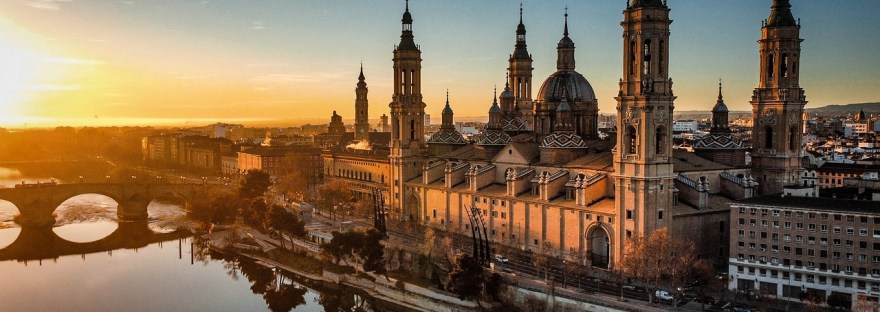
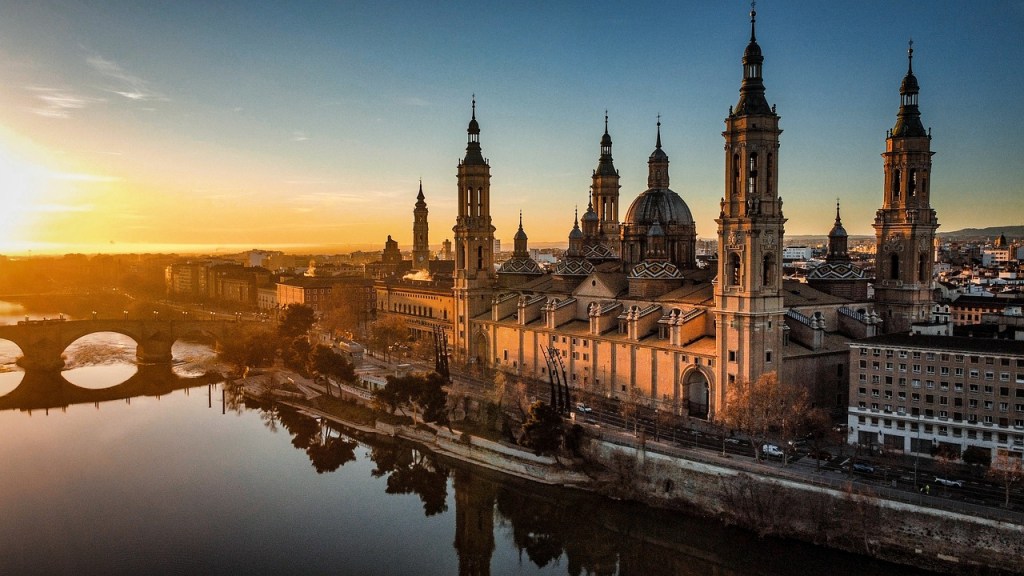
Sunrise over the Basilica of Nuestra Señora del Pilar in Zaragoza
There’s an old tale in which Himalayan sherpas (or, in another version, African tribesmen) are hired by a group of American trekkers to transport their supplies. After a few days of walking fast and far, the locals sit down and refuse to move for several hours—waiting, it’s explained, for their souls to catch up with their bodies. Although I didn’t have the liberty of such on-the-spot refusal along the Camino, I did come to appreciate the power of the pause.
My longest was the three days I spent in the city of Zaragoza. On a Monday morning, Porter and I caught the train from Tudela, ensconced ourselves in a café so I could write for a while, then walked slowly to the Hotel Sauce. Doing our best to approach this wide-open day with wide-open spirits, we lingered wherever we saw something interesting. We stopped in a hardware store for a carabiner to secure the straps of Porter’s old suitcase and visited a department store—El Corte Inglés—to invest in new hiking socks. That brief stroll recalled us to ourselves, reminding us how much we enjoy exploring a new city. It also helped us see beyond our transitory struggles, anchoring us in the surpassing goodness of our life together.
Despite our having a free day on Tuesday, by Wednesday morning my feet were still awful, and Porter was feverish—felled by the slow-moving stomach virus that had been making its way through the group. We would have to linger in Zaragoza for one more day. Our hotel room had a bathtub with a broad ledge at one end, allowing me to indulge in two refreshing pastimes while Porter slept: soaking my feet and perusing the New Yorker magazine I’d optimistically chucked in my suitcase.
Late [the next] afternoon, I made a long, solo visit to the Basilica of Nuestra Señora del Pilar—Our Lady of the Pillar—whose origins were the stuff of legend. When St. James began evangelizing the Iberian peninsula in the first century, the story goes (preaching the Gospel “to the ends of the earth”), he almost despaired of bringing the Christian faith to that pagan land. One day, while he was deep in prayer along the banks of the Ebro River, the Blessed Mother appeared to him atop a rosy pillar, encouraging him not to forsake his mission.
Despite COVID restrictions, visitors still can touch a bit of the titular pillar.
Today, the cavernous interior of the Basilica houses an intimate chapel where a tiny Mary statue sits atop a pillar of pink jasper. Even though the Basilica felt cold and empty, the chapel was warm with the devotion of many visitors; I was lucky to witness a weekly ceremony where children receive a special blessing and get their picture taken with the statue. Pausing in prayer, I felt something shift in me; heading back to the hotel, I realized that I was walking much more easily. Like the apostle James in that same place almost two millennia ago, I felt a renewed hopefulness and a readiness to rejoin my friends on the road the next morning.
Though the three-day break in Zaragoza was a great blessing, pauses did not need to be long to be restorative. On our steepest climbs, when the grade was fierce, I allowed myself to stop for a few deep breaths every ten steps. Count to ten; stop and breathe. Count to ten; stop and breathe. In addition to getting much-needed oxygen to my lungs and leg muscles, this strategy kept hope in view. I knew that in seven . . . five . . . three more steps, I could take a brief, blissful pause, until the terrain grew merciful, and I could press on without stopping.
The most delightful pauses arrived unexpectedly. Occasionally, as we walked through the woods, a clearing would open and—voilà—a café where we could grab a quick cortado and use real restrooms. Fr. José never told us they were coming. This was consistent with his desire to keep us in the present moment, though I suspect he also relished being able offer us a pleasant surprise. Those periodic oases of rest lasted just long enough to refill my well of gratitude before starting out again.
Perhaps my insight here seems obvious. Take a break; do you really need me to tell you this? But maybe you do; maybe, like me, you tend to soldier on. Maybe you never take a sick day (or didn’t, until COVID made bringing your germs to work seem less heroic). Maybe you wouldn’t dream of closing your eyes for five minutes after lunch. Maybe you stare at the Sunday crossword puzzle long after your brain has stopped generating solutions, or routinely accept diminishing returns for your labor in exchange for the ego boost you get from thinking of yourself as a person who “never quits.”
So, in case you do need to hear it, I’ll say it again: There is power in the pause. Whether for a moment or an hour, a day or a week, a well-timed pause can reconnect us to ourselves, giving us fresh energy and perspective. More importantly, the pause can reconnect us to God—inventor of the Sabbath, after all—for whom accomplishment is never everything.
You know who knew this? Jesus. He routinely slipped away from a life of preaching and miracle-working to pause, pray, and recharge. “Come to me, all who labor and find life burdensome, and I will give you rest,” he said—not “and I’ll give you more to do!” Holy pausing is not about taking the easy way out or shirking our share of life’s burdens. It’s about acknowledging our utter dependence on God, who alone provides strength for the journey.
“Wait, you knowPaula D’Arcy?” I’ve loved Paula’s writing for decades; my Camino buddy Jane Lafave might as well have told me she’d been hanging out in Ann Patchett’s kitchen! Jane explained that she’d known the author for many years, since going on a pilgrimage she led to Notre Dame (Paris) as part of her grief ministry.
Paula D’Arcy
The ability to write or speak authentically about loss is hard earned, and Paula D’Arcy paid a terrible entrance price to the world of grief ministers. When she was a young mother, pregnant with her second child, her family was struck by a drunk driver. She awoke in the hospital, alone except for the child in her womb. Her beloved husband and twenty-one-month-old daughter were gone.
That she built a beautiful life in the wake of such tragedy is a testimony to the power of resurrection. I first encountered the story in her 2004 book Sacred Threshold: Crossing the Inner Barrier to a Deeper Love. When my mother died a few years later, I clung to D’Arcy’s next book, When People Grieve. It is full of sanity-saving wisdom and practical advice about the physical, mental, and emotional aftermath of a profound loss. I owe much of my patience with the slow course of grief to her gentle guidance.
D’Arcy’s devastating accident was almost fifty years ago. What defines her life now is not the tragedy, but her consequent commitment to helping others keep the doors of their hearts propped open, even in the midst of grief. She is the founder of the Red Bird Foundation, whose mission is to assist others in the transformation of pain and the restoration of hope.
What defines her life is not the tragedy, but her consequent commitment to helping others keep the doors of their hearts propped open . . .”
I am thrilled to announce that Paula soon will be offering a retreat via Zoom through the SSJ Center for Spirituality in Ocean Grove, NJ. Mark your calendars for Thursday, February 13 from 6-8 p.m. for “Beauty Beyond Loss: Finding Your Way Through the Mystery of Grief and Gratitude.” I just signed up; you can learn more and register here.
Knowing that pilgrimage has been a meaningful part of Paula D’Arcy’s life, I asked my friend Jane if she could reach out to her on my behalf. Paula read my manuscript, then swiftly responded with these lovely words: Finding God Along the Way is equal parts adventure and strong spiritual experience; I felt like I was being given a private retreat as I read along. In this beautifully written book, Eberle encourages readers to risk what it means to step into the unknown each day, putting the Camino experience within every person’s reach.
According to the Talmud, every blade of grass has an angel bending over it, whispering “Grow, grow, grow!” For every angel on earth who whispers hope into the hearts of grieving people, I am truly grateful.
This is the longest lead-time I’ve ever had on an assignment.
At the August 2023 Ignatian Creators Summit, participants volunteered to write imaginative encounters with Gospel texts for the coming liturgical year; the 28th Sunday of Ordinary Time (October 13) fell to me. I began thinking about it immediately, and even posted a mid-point “work in progress” blog (including a homemade sonnet) when Mark 10:17-30 popped up as a daily Mass reading in May.
Here at last is the “final” product. (Scare quotes only because no wrestling with this challenging reading is ever the last word.)
Today marks a big anniversary: On October 5, 2022, at a retreat house in Azpeitia, Spain, my band of pilgrims gathered for our first group meeting with Fr. José Iriberri, the Director of the Ignatian Camino. We had no idea what the next twenty-seven days (or three hundred miles) would hold. In honor of that anniversary, here’s a little excerpt from the beginning of Finding God Along the Way, coming in January from Paraclete Press. Enjoy!
On an October evening in 2022, fifteen pilgrims still trying to remember each other’s names shifted anxiously in a circle of hard plastic chairs, eyes trained on our fearless Jesuit guide. The fluorescent-lit conference room’s unadorned walls gave no hint that we were in the shadow of the tower house of Loyola—the long-envisioned starting point of our grand adventure.
The youngest of us was fifty-five, the oldest seventy-nine. We were ten women and five men, hailing from across the United States as well as Canada, Australia, and Malaysia. The group included couples, widows, singles, and married folks traveling solo. Some were old friends; others knew no one. Although many were part of the Ignatian Volunteer Corps, the rest were drawn simply by their love of Ignatian spirituality. Seventeen days and some two hundred miles later, ten more people would be joining us for the final hundred miles of our journey.
“Introduce yourself briefly and tell us why you’re here,” Fr. José began, “then name your biggest fear about the Camino.” The man knew how to get to a point. A less skilled facilitator might have started with an easier icebreaker, but Fr. José didn’t want us to skim the surface. He wanted us to practice going deep.
Our fears were surprisingly similar. Most of us were worried that we’d packed the wrong things, that our bodies were going to fail us, or that somehow we would fail ourselves by not engaging the experience properly. Betsy—a petite woman with an endearing Southern accent and perfect comic timing—put it best when she confessed to fearing “pilgrim envy.” Her husband, Charlie, was the Ignatian volunteer; what if she turned out to be a remedial pilgrim, not “holy” enough for the Camino to be effective? When more than one head nodded in recognition, Fr. José encouraged us to resist the temptation to compare ourselves to one another, assuring us that, while each person’s experience would be different, God would not be stingy with the divine gifts.
While each person’s experience would be different, God would not be stingy with the divine gifts.
As the meeting drew to a close, Fr. José paused and looked around the circle slowly, letting the anticipation grow, then leaned in and offered one more bit of inspiration. “Pilgrimage can change the world,” he said. “I really believe this. Now, let’s get ready for tomorrow.”
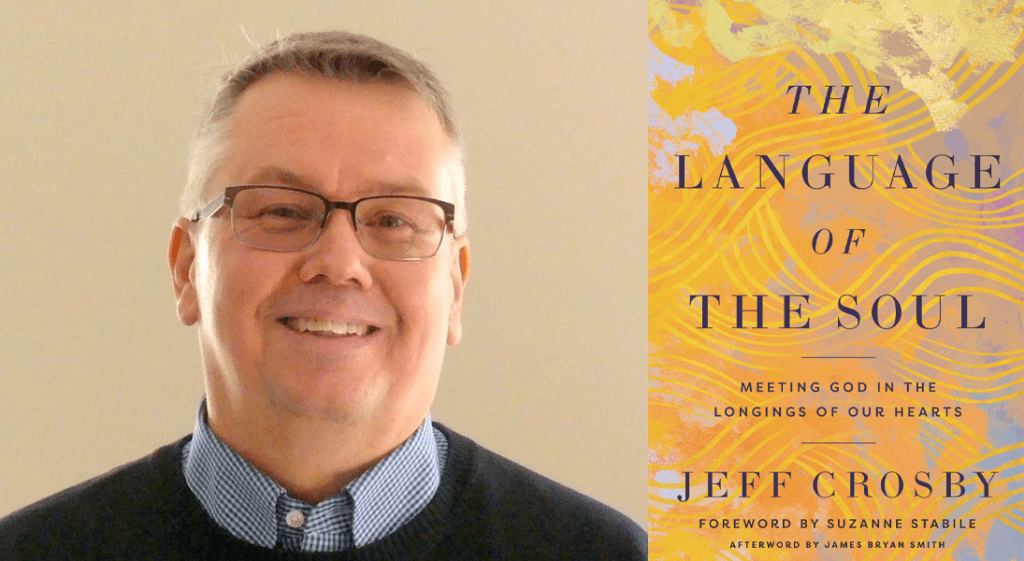
Beginnings are fascinating. Without Jeff Crosby’s introduction, I would not have found Paraclete Press. But the early threads of our connection could have been dropped without either of us noticing.
After Finding God in Ordinary Time came out in 2018, it was selected as a finalist for the Foreword Indiesbook awards. Jeff—who at the time was Publisher/CEO of InterVarsity Press—bought my book on the strength of its description in the magazine. Then he did two rare and wonderful things: he 1) wrote beautiful reviews on Amazon and Goodreads, and 2) dropped me a note to let me know. (Book lovers: embrace this practice!)
In that post, I wrote, “In this cozy book, Jeff explores the concept of saudade—a ‘vague and constant desire for something that does not and possibly cannot exist.’ He muses through ten longings, adding resources for further reading as well as a musical playlist to accompany each one. Gift this to any spiritually minded person who likes to read with pencil in hand.” (As a bonus: now you can download a beautiful, 32-page conversation guide and journal for Jeff’s book on the Broadleaf website.)
Jeff explores the concept of saudade—a ‘vague and constant desire for something that does not and possibly cannot exist.’
When I finished the first draft of Finding God Along the Way last year, Jeff was one of the first people I sent it to for thoughtful feedback, which he provided—then offered to help me find a publisher, should I need assistance. (Here’s where I should point out that Jeff and I have never met in person or even spoken on the phone. Ours is an entirely epistolary friendship—so old fashioned!)
After several months of fruitless attempts to connect with publishers or agents, I turned to Jeff for advice. He sent me three ideas, of which Paraclete was clearly the strongest, but their website said they weren’t accepting unsolicited manuscripts. Jeff kindly shared my pitch with an editor friend on a Friday afternoon; by Monday morning, she’d asked to see the whole manuscript. Many editorial and marketing team meetings and a lot of discernment ensued, and now I’m part of the Paraclete Press family. (As is Jeff, by the way; next year they are publishing his new book, World of Wonders: Reading as a Spiritual Discipline. I can’t wait to read it!)
Here’s Jeff’s kind endorsement: A three-cord strand of wonder awaits you in Finding God Along the Way, an inviting book that artfully weaves together Christine Marie Eberle’s pilgrimage along the Ignatian Camino in Spain with history of Ignatius of Loyola and the author’s own deep reflection on what she experienced and learned about herself—and her God—as she made her way. The scriptures she shares and the prompts for our own reflection as readers are icing on the cake. Whether or not you have shared the experience of pilgrimage, you will find much to savor in this book from one who has.
For our mutual delight in seeking just-the-right words to express the ineffable, I am truly grateful.
I met Cameron in the summer of 2023 at my first Ignatian Creators Summit (a truly cool undertaking of the Jesuit Media Lab). I was a nervous newcomer, but she quickly put me at ease with her welcoming spirit, quirky sense of humor, and undergraduate major even less practical than my own: Russian Literature!
Cameron Bellm: Attention and Astonishment
In classic Ignatian fashion, Cameron describes herself as a contemplative in action. She’s a writer and speaker based in Seattle, where she and her husband are raising two cutie-pie little boys. In 2020, she had the internet version of fifteen-minutes-of-fame when her Prayer for a Pandemic went viral. (Just for fun, Google that and see how many places it was shared!) Here’s the beautiful original and a 2022 follow-up, which contains my favorite line: “Above all, as we gaze upon our frayed social fabric / may we who have spare threads set to weaving.”
As we gaze upon our frayed social fabric, may we who have spare threads set to weaving.”
Formed by both Ignatian spirituality and Catholic Social Teaching, Cameron has written several devotionals over the years. She is now hard at work wrapping up the manuscript of a book that will be published by Eerdmans in 2025: The Sacrament of Paying Attention: Contemplative Practices for Restoring Sacred Human Communion. She publishes a short weekly missive on Substack called “Attention and Astonishment,” which always includes thought-provoking nuggets. (The title is a shout-out to a line from “Sometimes” by Mary Oliver):
Instructions for living a life: Pay attention. Be astonished. Tell about it.
Indeed, Cameron’s attention to—and ability to be astonished by—both the big and little things in life is one of her many endearing / enduring qualities.
Here’s what she said about Finding God Along the Way: “What a delight it is to journey along the Ignatian Camino with Christine Eberle as our wise and thoughtful guide! Scripture, story, and Ignatian principles are woven together in a meditative and inspiring guide not only for those making a literal pilgrimage, but for all of us who lace up our shoes each morning to walk through the holy and challenging terrain of our own lives.”
For people you can see once a year for forty-eight hours yet still rejoice like Elizabeth greeting Mary the next time you meet, I am truly grateful!
“Great stories are all the same beneath the splendid array of differences that makes each one unique. The answers (whom to kill, whom to marry, how to cope) are specific to the place, the time, the characters, and the circumstances. But the questions (Who am I? What is my life about? What is my legacy?) that necessitate those answers are universal to the human condition.”
For years, I’ve been quoting this snippet from Elizabeth Grace Matthew during my retreat / keynote called “The Stories that Form Us”—explaining that I encountered it in an America magazine review of the Sex and the City reboot, of all things. After encouraging people to brainstorm their favorite childhood books or current television series on streaming loops, I ask, “What questions—universal to the human condition—do they address?”
Elizabeth Grace Matthew
A few years ago, at a grade-school faculty retreat not far from my home, a teacher rushed up to me after the session. “Liz Matthew is a friend of mine! Do you want to meet her? I think you’d really like each other!”
It had never occurred to me that a writer I’d read in the Jesuit Review (note reverent tone) would be a mom who lived one town over from me—friendly and funny and fond of our local coffee shop. We met there and hit it off at once, chatting about writing and editing and creative-life balance, right to the outer limit of her childcare.
Several times since then, I’ve found myself sufficiently struck by the quality of writing in an America article to flip back to the beginning and see who wrote it, only to discover Liz’s name again. (You can check out her articles here.) In addition to writing for many other publications, this mother of four boys is busy working on a book about Little Women and feminism. Sign me up!
It had never occurred to me that a writer I’d read in the Jesuit Review would be a mom who lived one town over from me—friendly and funny and fond of our local coffee shop.
While juggling all that, she made time to read my manuscript and had this to say: “With humor and insight, Christine Eberle invites us to tag along from afar on her Ignatian Camino. At first glance, this is a book about how extraordinary circumstances super-charged one woman’s spiritual growth. Dig deeper, and it’s really about how ordinary life can also reveal our own opportunities to grow with God. Eberle gives us the context and the questions to better understand our own journeys, and where to look for those opportunities, through the evocative lens of Ignatian spirituality.”
For the serendipity that precedes the exclamation “How have we never met?” and the delight of discussing shared passions, I am truly thankful!
During my pilgrimage, one of the practices that sustained me was the Ignatian daily Examen. Even though Ignatius said the prayer should take no longer than fifteen minutes, on the Camino I sometimes devoted up to an hour, wringing every drop of grace from the previous day. Walking through the steps of gratitude, light, rumination, contrition, and hope each morning helped me view my experience through a spiritual lens instead of getting stuck on the physical level. Therefore, when it came time to seek endorsements, Katie (Haseltine) Mullin was at the top of my list of “ambitious asks.” I didn’t know her personally, but had loved her book, All The Things: A 30-Day Guide to Experiencing God’s Presence in the Prayer of Examen.
Katie came to the Examen as an outsider—an evangelical Christian who found “breathing room” in a Protestant liturgical church where she began receiving spiritual direction, eventually becoming a spiritual director herself. This renders her writing direct and accessible. She’s not parroting insider terminology as someone who grew up in the Jesuit soup might do. Instead, she serves as a translator—a teacher of “Ignatian for Speakers of Other Spiritualities.” As she approaches the Examen from thirty different starting points, she is beautifully clear: this prayer is not a hurdle to be cleared or a set of boxes to be checked, but a golden opportunity to draw close to the God who loves us by rummaging backwards through our days together. Each chapter includes a personal, practical example of how using a particular angle of approach led her to notice something she might otherwise have missed, and thus to grow in friendship with God.
This prayer is not a hurdle to be cleared or a set of boxes to be checked, but a golden opportunity to draw close to the God who loves us by rummaging backwards through our days together.”
In addition to being a writer and spiritual director, Katie offers a variety of coaching services around both the Enneagram and self-care, all in the service of helping people live the lives they’ve been given with hope and purpose. She also works with the Center for the Formation of Justice and Peace. You can learn more about her many hats here on her website.
Katie had such lovely things to say about my book: “Christine Marie Eberle’s Finding God Along the Way felt like an unexpected, long catch up with your best friend on a Sunday afternoon. I found myself in tears as I read the beginning question, ‘Do you want to take a walk with me?’ and they came often as I read in the pages so many relatable struggles wrapped in countless encouraging words and prayers. As a lover of all things Ignatius, I imagined enjoying this book. Spiritual exercises? Yes, please. The Examen? Of course. What I didn’t count on was having my soul respond with such “serenity” (something the author herself found on the pilgrimage) to reading the familiar language and understanding of how I see God. I also I found myself challenged to pray for others on my daily walks with a deeper commitment and to notice the vulnerable in and around me. You don’t have to walk the Camino (though it remains my top bucket list item!) to go on a meaningful journey with Christine and her friends. St. Ignatius wrote in the First Principle, ‘All the things in this world are gifts from God,’ and Christine’s recollections and reflections on her pilgrimage were an incredible gift to me–one I will look back on and savor for its graces.”
As an unexpected grace, Katie and I decided that two women with a shared enthusiasm for the Examen, Ignatian spirituality, writing, and the Enneagram (we’re both Ones) might also enjoy one another. At her initiative, we hopped on Zoom and shared a marvelous getting-to-know you hour and have stayed in touch ever since.
For the gifts of serendipitous friendship and mutual delights, I am truly grateful!












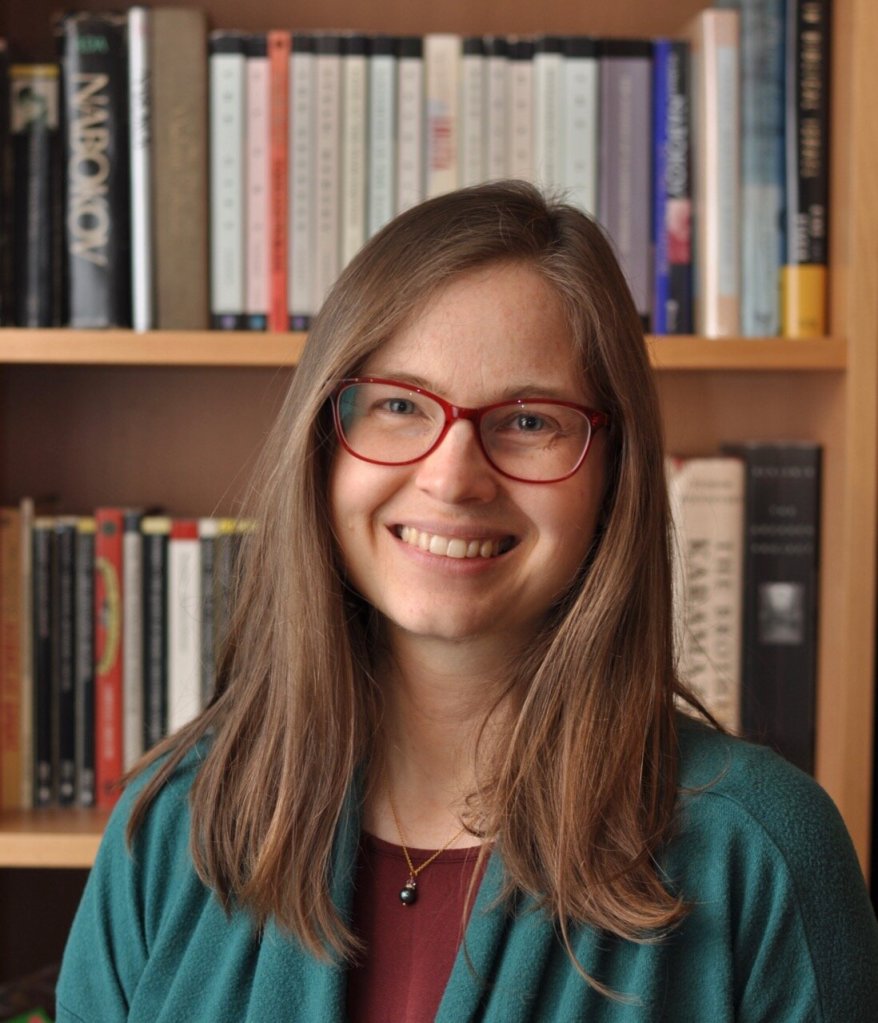




 Christine Marie Eberle