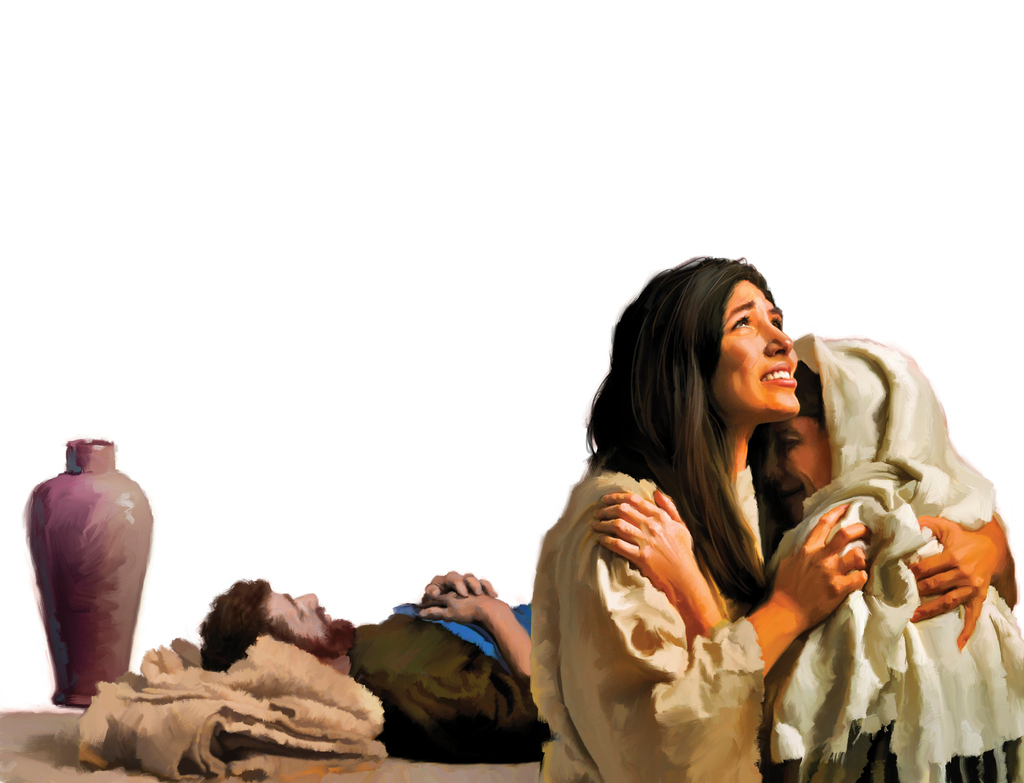
Mary and Martha, grieving the death of their brother Lazarus (Image courtesy of GoodSalt.com)
This weekend, we hear the second-most-famous story about Martha and Mary in the Scriptures. The death and raising of Lazarus is a pivotal point in the events leading up to Holy Week—one of the key “signs” shared by John in his Gospel. But for the grieving sisters, time would have flowed differently.
I’m grateful for the chace to write about about this for the Catholic Preaching Institute’s “From the Pew” reflection. If you are (or have ever been) stuck in the raw space between grief and hope, this one’s for you!
I watched a lot of baseball last month. (To be clear: I watched a lot of baseball for me.) After the Phillies were eliminated in post-season play, I embraced those scrappy Toronto Blue Jays and followed them all the way to the heartbreaking eleventh inning of game seven of the World Series.
A curious thing happens to me when I’m watching baseball. I don’t exactly forget which team I’m rooting for, but occasionally I do cheer at the wrong time. Sometimes, when the “other” side pulls off a spectacularly good play or “my” side makes an egregious error, I respond in a way that causes my husband to shoot me a baffled look.
I could blame it on the change of uniforms from home to away, or on my divided attention. But maybe it’s something more human. The player diving into a stolen base with a quarter inch to spare deserves my admiration, just as the player running backwards to catch the ball but losing it in the lights deserves my sympathy. In that moment of relief or disappointment, the categories of “us and them” dissolve. I’m happy for the guy; I’m sorry for the other guy, even if I’m not “supposed” to be.
In Fr. Greg Boyle’s new book, Cherished Belonging, the Jesuit founder of Homeboy Industries says that God’s dream for the world would be to replace “Us VS. Them” with “Nobody VS. Anybody.” Perhaps that’s what Saint Paul was getting at when he encouraged us to “rejoice with those who rejoice, weep with those who weep” (Romans 12:15).
No Us and Them, just Us. This is, indeed, God’s dream come true.
Fr. Greg Boyle, SJ
In these polarizing times, it is so easy to demonize the “other side” (whichever side of whatever thing that happens to be for us). But can we also recognize goodness or sorrow, even in people whose views and actions we abhor? Can we acknowledge flaws and blind spots, even in people pursuing causes dear to our hearts? Can we forget—just for a moment—who we’re supposed to be rooting for, and simply be humans together?
Nobody VS. Anybody is a tall order. Most days, I’m not there; I’m too angry at politicians and corporations who put job security and profits ahead of human decency, and who gin up enemies for people to fear in order to keep us pitted against one another. That’s why I’m grateful to baseball: for providing the occasional moments of obliviousness that allow me to glimpse how God’s dream might be possible.
During Jeff Draine’s memorial service last Saturday at Wallingford Presbyterian Church, I had the privilege of speaking about his faith. I have written about Jeff here before, in the 2018 blog post “Eat the Peaches” after he was diagnosed with young-onset Alzheimer’s, and in the the long account of our friendship after he died last month. Here’s what I said at his beautiful, joyful memorial.
When Deb first asked me to speak today, the question she posed was this: how would you have known Jeff was a Christian without being told? Well, you might have spotted the Celtic cross he always wore inside his shirt. A perusal of his home bookshelves sure would have given you a clue. You might have known how important this church was to him. And if you knew him long enough, you might also know he was raised as a Methodist preacher’s kid, attended a Lutheran church in Richmond, flirted with Catholicism for a hot minute, and for many years was an active member of an American Baptist church—which he would want me make sure y’all know was not Southern Baptist.
But what if you hadn’t peeked under his shirt, or stood at his bookshelves, or stalked him on Sunday mornings, would you know Jeff was a Christian? Not necessarily. We all know that Jeff could speak at GREAT length about anything that interested him, but he wasn’t a proselytizer, and while he held forth on many topics, his inner life wasn’t one of them. He expressed his faith in deeds more than words. Too often, Christians use the word “Christian” as a sloppy synonym for “kind” or “nice” or “good.” But the truth is, the good deeds that Jeff did in this world—and they were many—could just as easily have stemmed from Jewish or Muslim or Quaker or any number of secular inspirations.
And yet, to know Jeff was to know that the things we admired about him were the putting-into-practice of his deep-seated Christian convictions. And, while every believer has a selective approach to Scripture—our personally curated go-to passages—the thing that really strikes me about Jeff is how passionately—dare I say, literally—he embraced some of the most challenging lines of the Gospels.
For example, in Matthew 25, in the parable of the last judgement, Jesus says, I was hungry and you gave me food, I was thirsty and you gave me something to drink, I was a stranger and you welcomed me, I was naked and you gave me clothing, I was sick and you took care of me, I was in prison and you visited me. When I met Jeff at Freedom House thirty-eight years ago, he was already working on the first four, tending to the needs of our unhoused guests for food, drink, clothing, and above all, welcome. But for the bulk of his professional career, through his research on the intersection of mental illness and incarceration—Jeff laser focused on the final two. And I can tell you that I was sick and in prison and you visited me are the ones that most people who call themselves Christians rarely take literally. It is much easier to ladle soup in a homeless shelter or donate the clothes that don’t fit us any more than to walk into prisons over and over—to spend your life advocating for those the world considers “the least of these.” But that’s what Jeff did.
I also think of the line in the Sermon on the Mount where Jesus says: Do not judge, so that you may not be judged. Though Jeff certainly could be professionally irritated and politically outraged, he was personally prepared to give just about anyone the benefit of the doubt. He was not given to judgmental rants, nor did he enjoy listening to them; he would rather turn the temperature down than ratchet people up. More than most people I know, Jeff had a keen sense of what was in God’s provenance alone. He was a very smart man who kept an open heart and mind in relation to all that he recognized was unknowable.
My final observation is about Jeff’s equanimity regarding his Alzheimer’s. Although the disease often made him anxious and agitated—especially in the later years—whenever he spoke of what was happening to him, there was never a trace of “poor me” or even “why me?” He recognized his suffering as part of the human condition. He was conscious of the many blessings that still surrounded him, and he wanted, above all else, to be useful. (That’s why he donated that big brain of his to the University of Pennsylvania, so he could keep teaching!) Now, again, one doesn’t have to be a Christian to hold that perspective. And yet . . .
As Pastor Taylor said, Jeff chose every word read and sung today. That includes the passage we just heard from John 21, with these powerful words, “Very truly, I tell you, when you were younger, you used to fasten your own belt and to go wherever you wished. But when you grow old, you will stretch out your hands, and someone else will fasten a belt around you and take you where you do not wish to go.” Jeff knew what was coming. He had no illusions about the hard path ahead. But he held his diminishment in a spiritual context. He understood Alzheimer’s as the particular way he was going to walk with Jesus, all the way to the end of the road. And he gave us that reading today as a gift, a reminder that—even when his mind and body were a mess—it was well with his soul.
Even when his mind and body were a mess, it was well with his soul.
Jeff had no way of knowing that this memorial would take place on “No Kings Day,” but I think it’s appropriate. Not just because, in his better days, he totally would have been out there protesting. But because of the words he picked to begin this service: The King of Love my Shepherd is, whose goodness faileth never. I nothing lack if I am His, and He is mine forever.
Rest in peace, dear friend.
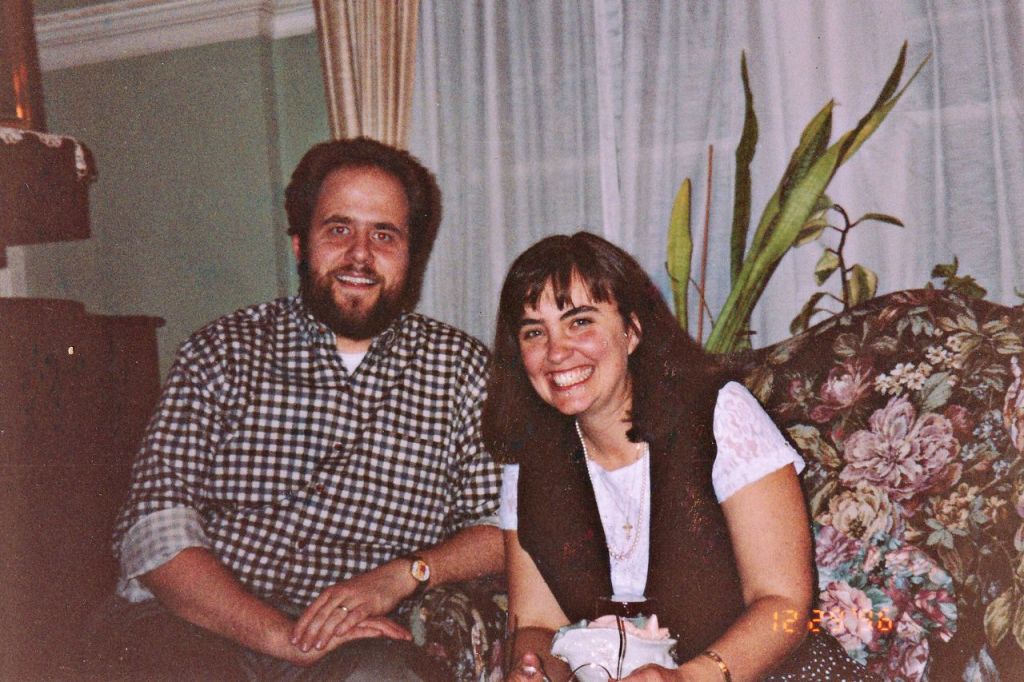
There are so many photos of Jeff and me together at family parties, you might think we were a couple, but really, we were just a couple of introverts!
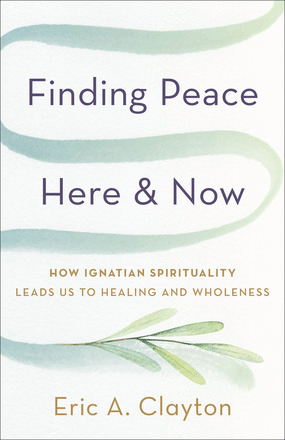
I’m delighted to share that my review of Eric Clayton’s new book, Finding Peace Here and Now, has appeared in the National Catholic Reporter.
It is not enough to wring our hands and pray for peace, Clayton insists: “If peace is what we desire, then we need to practice it.”
How, then, does one practice peace? What are the repetitive, foundational movements that precede mastery — the spiritual equivalents of piano scales or basketball set shots? (Can I get two points for using a sports metaphor here?)
Whether we aspire to be peacemakers on the national or global stage, or (more likely) prefer the intimate theater of family, parish or neighborhood, we must first discover the way to peace in our own hearts. Clayton’s subtitle reveals his roadmap: How Ignatian Spirituality Leads Us to Healing and Wholeness.
From the Pew: June 8, 2025 Pentecost Sunday (John 20:19-23)
When I was in my thirties, my mother and I had a running disagreement about whether she should lock her screen door at bedtime. “The only person a locked screen door keeps out is a relative with a key!” I would insist—usually after spending way too long trying to get my parents’ attention on a Saturday morning before cell phones. But Mom could not be dissuaded. Although the home was secured by a lock and a German shepherd, flipping that little latch gave her a bit more peace.
One can’t blame the disciples for bolting the door after Jesus’ execution; as his followers, they were understandably terrified. And yet, just as Mom’s screen door was vulnerable to any two-bit burglar with a box cutter, the disciples’ barricade was not going to thwart anyone truly bent on doing them harm. Nor was it an obstacle for Jesus, who appeared in their midst and offered them peace.
But note what Jesus did not offer them: safety. He didn’t say, “You don’t have anything to be afraid of,” or “Nothing bad will ever happen to you.” Indeed, he did the opposite: showed them the brutal evidence of his crucifixion, then sent them forth as the Father had sent him. And we know that they went on to suffer for their faith, often meeting violent ends.
The fears that keep me up at night cannot be put to rest by even the strongest lock. Everyone I love will die—unless I beat them to it, which may also be no picnic. Untold hardships await us all. Fortunately, the peace Jesus bestows is not dependent on untroubled circumstances, but on our embrace of his Spirit’s abiding presence.
Fear locks the door, but Jesus walks right in. Will we accept peace on his terms?
Every time I walk into church and spot my friend Jamey Moses, I can count on him to ask me the same question: What day is it? No matter if it’s Saturday, Sunday, or a random weekday, I always reply, This is the day the Lord has made!
At Easter Mass yesterday, I sang Psalm 118: This is the day the Lord has made; let us rejoice and be glad! And this morning, like the rest of you, I woke up to the heartbreaking news that Pope Francis has gone home to God.
Not feeling very Eastery anymore, I must confess.
And yet. And yet and yet and yet.
The paschal mystery is no respecter of human or even liturgical calendars. Some people’s hearts are awash in gladness, even on Good Friday—as the vibrant music in our parish during the ecumenical Seven Last Words service demonstrated. For others, the “descent into hell” lasts much longer than three days. As Caedemon’s Call sings in their beautiful Valleys Fill First, “It’s like that long Saturday between Your death and the rising day, when no one wrote a word, wondering is this the end.”
In what now appears prescient, my friend Ann Garrido posted a reflection on Good Friday, recognizing in the crucifixion the aching sorrow of our whole world at this political moment. She suggests that, at least for a time, our best response may be silence, “acknowledging that the Word has been taken from us.” I encourage you to read her whole reflection:
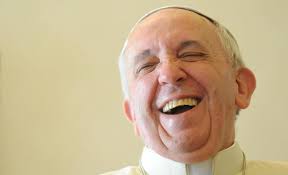
As I try to get my mind and soul around the reality of a world without Pope Francis, I’m praying with his Easter message from yesterday—literally, Francis’ final word on many subjects.
More importantly, I’m holding onto this seven-word prayer taught to him by his grandmother: “Jesus, make my heart more like yours.”
This is the day the Lord has made. Whatever day it feels like in your soul, may the blessings of Francis’ witness of life and love carry you along.
The most pointed insight I ever gained into the Prodigal Son story (Luke 15:11-32) came during a retreat skit performed by a group of West Chester University Newman Center students.
I remember no context—only that they’d been put into groups and assigned parables to act out. (BTW I can’t believe I made them do this. I skipped my own college orientation because I heard there were skits!)
Truly, I remember nothing about the enactment of the Prodigal Son until right after the guy playing the older brother—scandalized by the fatted calf’s having been killed to celebrate his rascally sibling’s return—turned on his father, saying, “You never gave me so much as a kid goat to celebrate with my friends.” Christopher Jowett, the tall, ponytailed dude who was playing the father (and who surely wouldn’t mind my quoting him without permission here, because it was awesome), spun around and thundered:
“YOU NEVER ASKED ME FOR A KID GOAT!”
I’m sure the skit went on from there, but I was done. Mic drop done. Convicted done.
Here’s what I grasped, in an instant. The younger boy’s departure had been a dagger in the heart, sure. “Give me the share of your estate that should come to me” was was just a polite way of saying, “I (literally) can’t wait for you to die.” But the older one’s reaction to his brother’s reappearance? That was a knife in the back.
The one who had seemed to serve faithfully by his side was actually in it for the reward? The one about whom he could say “you are with me always, and everything I have is yours” wanted more? The one who had borne witness to the depths of his grief still did not know him well enough to share his heart’s rejoicing?
This was a stranger.
The one who had borne witness to the depths of his grief still did not know him well enough to share his heart’s rejoicing.
Over the course of our lives, we may all vacillate along the continuum from the younger brother’s “dissolute living” to the elder brother’s life of “dutiful service,” with readers of this blog probably mostly avoiding the more dissolute end. We can’t be on our high horses about that, though, because it only means that’s not where our temptation lies.
That’s not where our temptation lies.
Our temptation—should you recognize yourself among the “older brother” types—is to serve dutifully but resentfully. Keeping careful records. Believing all the things that go right in our lives are because of our hard work and responsibility. Not recognizing the four hundred things a day that go right because of happenstance, privilege, or mercy.
Each time we fail to share God’s parental distress over every lost and suffering soul, or wholeheartedly celebrate each return to grace, we are the older brother.
I suspect there’s something there to convict us all, so I’ll end simply with this beautiful poem by Rumi, which I first encountered in Marilyn Lacey RSM’s marvelous book This Flowing Toward Me: A Story of God Arriving in Strangers. May we all recognize God’s flowing toward us today.
For sixty years I have been forgetful, every minute, but not for a second has this flowing toward me stopped or slowed. I deserve nothing. Today I recognize that I am the guest the mystics talk about. I play this living music for my host. Everything today is for the host.
I am grateful to my friend Alli Bobzien (whom I met during the amazingly generative “Ignatian Creators Summit” offered by the Jesuit Media Lab last summer) for offering me a guest spot on her Substack, The Pondering Heart.
In it, I dive into my long-standing gripe about tomorrow’s Gospel and how I finally got my heart around it.
While you’re on Alli’s site, be sure to poke around and read some of her own beautiful writing. My favorites among recent posts are “The Heart of the Fire” and “The Inkeeper’s Daughter.” The first is a poem and the second a dive into historical/biblical fiction, but both are gorgeous!
This is the longest lead-time I’ve ever had on an assignment.
At the August 2023 Ignatian Creators Summit, participants volunteered to write imaginative encounters with Gospel texts for the coming liturgical year; the 28th Sunday of Ordinary Time (October 13) fell to me. I began thinking about it immediately, and even posted a mid-point “work in progress” blog (including a homemade sonnet) when Mark 10:17-30 popped up as a daily Mass reading in May.
Here at last is the “final” product. (Scare quotes only because no wrestling with this challenging reading is ever the last word.)
I met Cameron in the summer of 2023 at my first Ignatian Creators Summit (a truly cool undertaking of the Jesuit Media Lab). I was a nervous newcomer, but she quickly put me at ease with her welcoming spirit, quirky sense of humor, and undergraduate major even less practical than my own: Russian Literature!
Cameron Bellm: Attention and Astonishment
In classic Ignatian fashion, Cameron describes herself as a contemplative in action. She’s a writer and speaker based in Seattle, where she and her husband are raising two cutie-pie little boys. In 2020, she had the internet version of fifteen-minutes-of-fame when her Prayer for a Pandemic went viral. (Just for fun, Google that and see how many places it was shared!) Here’s the beautiful original and a 2022 follow-up, which contains my favorite line: “Above all, as we gaze upon our frayed social fabric / may we who have spare threads set to weaving.”
As we gaze upon our frayed social fabric, may we who have spare threads set to weaving.”
Formed by both Ignatian spirituality and Catholic Social Teaching, Cameron has written several devotionals over the years. She is now hard at work wrapping up the manuscript of a book that will be published by Eerdmans in 2025: The Sacrament of Paying Attention: Contemplative Practices for Restoring Sacred Human Communion. She publishes a short weekly missive on Substack called “Attention and Astonishment,” which always includes thought-provoking nuggets. (The title is a shout-out to a line from “Sometimes” by Mary Oliver):
Instructions for living a life: Pay attention. Be astonished. Tell about it.
Indeed, Cameron’s attention to—and ability to be astonished by—both the big and little things in life is one of her many endearing / enduring qualities.
Here’s what she said about Finding God Along the Way: “What a delight it is to journey along the Ignatian Camino with Christine Eberle as our wise and thoughtful guide! Scripture, story, and Ignatian principles are woven together in a meditative and inspiring guide not only for those making a literal pilgrimage, but for all of us who lace up our shoes each morning to walk through the holy and challenging terrain of our own lives.”
For people you can see once a year for forty-eight hours yet still rejoice like Elizabeth greeting Mary the next time you meet, I am truly grateful!













 Christine Marie Eberle