

Grief, Liturgy, Scripture, Spirituality

It Was Well with His Soul

During Jeff Draine’s memorial service last Saturday at Wallingford Presbyterian Church, I had the privilege of speaking about his faith. I have written about Jeff here before, in the 2018 blog post “Eat the Peaches” after he was diagnosed with young-onset Alzheimer’s, and in the the long account of our friendship after he died last month. Here’s what I said at his beautiful, joyful memorial.

When Deb first asked me to speak today, the question she posed was this: how would you have known Jeff was a Christian without being told? Well, you might have spotted the Celtic cross he always wore inside his shirt. A perusal of his home bookshelves sure would have given you a clue. You might have known how important this church was to him. And if you knew him long enough, you might also know he was raised as a Methodist preacher’s kid, attended a Lutheran church in Richmond, flirted with Catholicism for a hot minute, and for many years was an active member of an American Baptist church—which he would want me make sure y’all know was not Southern Baptist.

But what if you hadn’t peeked under his shirt, or stood at his bookshelves, or stalked him on Sunday mornings, would you know Jeff was a Christian? Not necessarily. We all know that Jeff could speak at GREAT length about anything that interested him, but he wasn’t a proselytizer, and while he held forth on many topics, his inner life wasn’t one of them. He expressed his faith in deeds more than words. Too often, Christians use the word “Christian” as a sloppy synonym for “kind” or “nice” or “good.” But the truth is, the good deeds that Jeff did in this world—and they were many—could just as easily have stemmed from Jewish or Muslim or Quaker or any number of secular inspirations.

And yet, to know Jeff was to know that the things we admired about him were the putting-into-practice of his deep-seated Christian convictions. And, while every believer has a selective approach to Scripture—our personally curated go-to passages—the thing that really strikes me about Jeff is how passionately—dare I say, literally—he embraced some of the most challenging lines of the Gospels.

For example, in Matthew 25, in the parable of the last judgement, Jesus says, I was hungry and you gave me food, I was thirsty and you gave me something to drink, I was a stranger and you welcomed me, I was naked and you gave me clothing, I was sick and you took care of me, I was in prison and you visited me. When I met Jeff at Freedom House thirty-eight years ago, he was already working on the first four, tending to the needs of our unhoused guests for food, drink, clothing, and above all, welcome. But for the bulk of his professional career, through his research on the intersection of mental illness and incarceration—Jeff laser focused on the final two. And I can tell you that I was sick and in prison and you visited me are the ones that most people who call themselves Christians rarely take literally. It is much easier to ladle soup in a homeless shelter or donate the clothes that don’t fit us any more than to walk into prisons over and over—to spend your life advocating for those the world considers “the least of these.” But that’s what Jeff did.

I also think of the line in the Sermon on the Mount where Jesus says: Do not judge, so that you may not be judged.  Though Jeff certainly could be professionally irritated and politically outraged, he was personally prepared to give just about anyone the benefit of the doubt. He was not given to judgmental rants, nor did he enjoy listening to them; he would rather turn the temperature down than ratchet people up. More than most people I know, Jeff had a keen sense of what was in God’s provenance alone. He was a very smart man who kept an open heart and mind in relation to all that he recognized was unknowable.

My final observation is about Jeff’s equanimity regarding his Alzheimer’s. Although the disease often made him anxious and agitated—especially in the later years—whenever he spoke of what was happening to him, there was never a trace of “poor me” or even “why me?” He recognized his suffering as part of the human condition. He was conscious of the many blessings that still surrounded him, and he wanted, above all else, to be useful. (That’s why he donated that big brain of his to the University of Pennsylvania, so he could keep teaching!) Now, again, one doesn’t have to be a Christian to hold that perspective. And yet . . .

As Pastor Taylor said, Jeff chose every word read and sung today. That includes the passage we just heard from John 21, with these powerful words, “Very truly, I tell you, when you were younger, you used to fasten your own belt and to go wherever you wished. But when you grow old, you will stretch out your hands, and someone else will fasten a belt around you and take you where you do not wish to go.” Jeff knew what was coming. He had no illusions about the hard path ahead. But he held his diminishment in a spiritual context. He understood Alzheimer’s as the particular way he was going to walk with Jesus, all the way to the end of the road. And he gave us that reading today as a gift, a reminder that—even when his mind and body were a mess—it was well with his soul.

Even when his mind and body were a mess,
it was well with his soul.

Jeff had no way of knowing that this memorial would take place on “No Kings Day,” but I think it’s appropriate. Not just because, in his better days, he totally would have been out there protesting. But because of the words he picked to begin this service: The King of Love my Shepherd is, whose goodness faileth never. I nothing lack if I am His, and He is mine forever.

Rest in peace, dear friend.
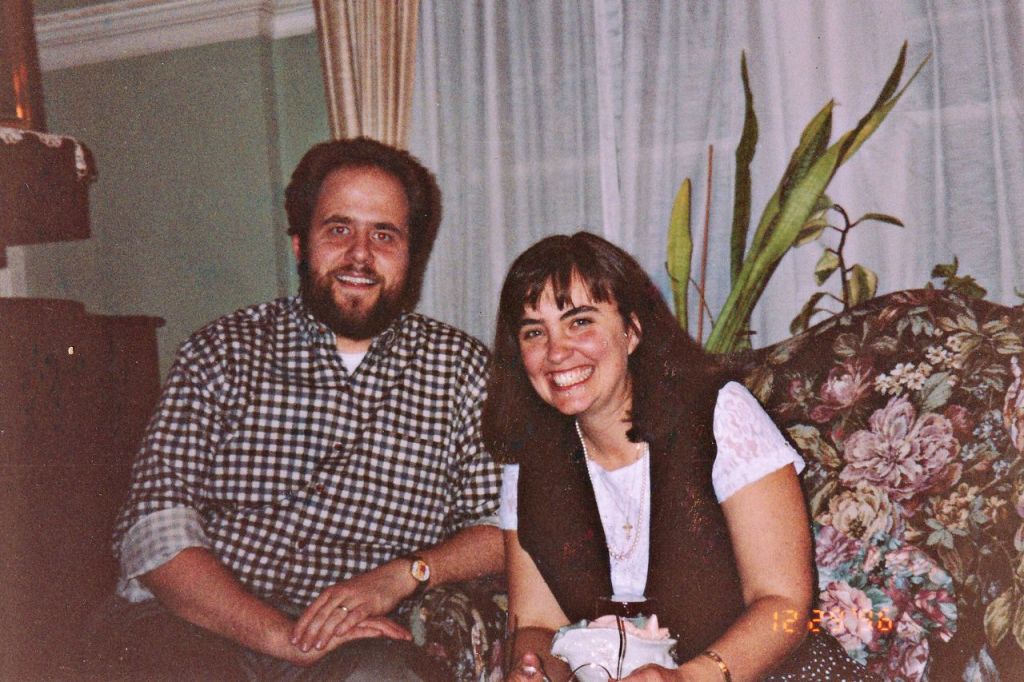
There are so many photos of Jeff and me together at family parties, you might think we were a couple, but really, we were just a couple of introverts!
Picture of a Goat
Liturgy, Retreats, Scripture, Spirituality

Prodigal Mic Drop

The most pointed insight I ever gained into the Prodigal Son story (Luke 15:11-32) came during a retreat skit performed by a group of West Chester University Newman Center students.

I remember no context—only that they’d been put into groups and assigned parables to act out. (BTW I can’t believe I made them do this. I skipped my own college orientation because I heard there were skits!)

Truly, I remember nothing about the enactment of the Prodigal Son until right after the guy playing the older brother—scandalized by the fatted calf’s having been killed to celebrate his rascally sibling’s return—turned on his father, saying, “You never gave me so much as a kid goat to celebrate with my friends.” Christopher Jowett, the tall, ponytailed dude who was playing the father (and who surely wouldn’t mind my quoting him without permission here, because it was awesome), spun around and thundered:

“YOU NEVER ASKED ME FOR A KID GOAT!”

I’m sure the skit went on from there, but I was done. Mic drop done. Convicted done.

Here’s what I grasped, in an instant. The younger boy’s departure had been a dagger in the heart, sure. “Give me the share of your estate that should come to me” was was just a polite way of saying, “I (literally) can’t wait for you to die.” But the older one’s reaction to his brother’s reappearance? That was a knife in the back.

The one who had seemed to serve faithfully by his side was actually in it for the reward? The one about whom he could say “you are with me always, and everything I have is yours” wanted more? The one who had borne witness to the depths of his grief still did not know him well enough to share his heart’s rejoicing?

This was a stranger.

The one who had borne witness to the depths of his grief still did not know him well enough to share his heart’s rejoicing.

Over the course of our lives, we may all vacillate along the continuum from the younger brother’s “dissolute living” to the elder brother’s life of “dutiful service,” with readers of this blog probably mostly avoiding the more dissolute end. We can’t be on our high horses about that, though, because it only means that’s not where our temptation lies.

That’s not where our temptation lies.

Our temptation—should you recognize yourself among the “older brother” types—is to serve dutifully but resentfully. Keeping careful records. Believing all the things that go right in our lives are because of our hard work and responsibility. Not recognizing the four hundred things a day that go right because of happenstance, privilege, or mercy.

Each time we fail to share God’s parental distress over every lost and suffering soul, or wholeheartedly celebrate each return to grace, we are the older brother.

I suspect there’s something there to convict us all, so I’ll end simply with this beautiful poem by Rumi, which I first encountered in Marilyn Lacey RSM’s marvelous book This Flowing Toward Me: A Story of God Arriving in Strangers. May we all recognize God’s flowing toward us today.

For sixty years I have been forgetful,
every minute, but not for a second
has this flowing toward me stopped or slowed.
I deserve nothing. Today I recognize
that I am the guest the mystics talk about.
I play this living music for my host.
Everything today is for the host.

Liturgy, Spirituality

Of Splinters and Beams

Why do you notice the splinter in your brother’s eye,
but do not perceive the wooden beam in your own?
(Luke 6:41)

Thirty years ago tonight, Fr. Sam Verruni left the sacristy at West Chester University’s Newman Center with his vestments a mess. His chasuble was crooked, the back all caught up under the belt of his alb. Utterly oblivious to his disheveled state, he processed from the sacristy to his chair, and later from his chair to the ambo to proclaim the Gospel. After the congregation seated themselves for the homily, he called me out.

You see, I’d been conspicuously distracted, absorbed with trying to undo a knot in the cord of the cross I was wearing around my neck. I hadn’t looked up for the Gospel. I hadn’t looked up as the homily began. “Christine,” Sam said sharply, “Can I interest you in paying a little attention to what’s going on around you?”

“Well, Fr. Sam,” I replied . . . “Maybe you want to straighten out those vestments of yours first?”

The congregation, who’d been frozen in horror at Sam’s totally uncharacteristic meanness, burst out laughing. We took a little bow. I fixed his vestments, and he went on to preach about the Splinter and the Beam. I don’t remember what he said about the human tendency to harp on the faults of others while blithely ignoring our own. He probably doesn’t either.

But I’ll bet many people there that night remember Sam’s wonky vestments, and the homily he preached without words.

To read the Gospel passage in context, click the image above.

Liturgy, Spirituality

The Work of Christmas: Choir Edition

When you sing in a church choir and Christmas falls mid-week, you know you’re going to be spending a lot of time in church: Christmas Eve and/or Day (possibly multiple services); then Saturday and/or Sunday; and then—if you’re Catholic—the Solemnity of the Blessed Virgin Mary, Mother of God. That’s right: on New Year’s Eve/Day, we have a holy day of obligation honoring the woman who convinced her son to make more wine for a party. (And people say the Church doesn’t have a sense of humor.) This pitches us into another weekend, after which even people who’ve had the whole two weeks off are firmly back at work and you’ve been to church like 72 times.

Not that I’m complaining. Really! These liturgies celebrate things that are profound and powerful and—if you’ll pardon the bumper sticker wisdom—the reason for the season.  But that’s not the only thing we’re doing in church these days. Christmas, as it turns out, is also a season for funerals.

Sometimes that’s because people go “home for Christmas” (in the words of a Steven Curtis Chapman song that should come with a pack of tissues) or hold on for one last holiday before letting go. Other times, a loved one has died weeks or even months earlier, and family is spread across the country, and this is the best time to bring everyone together.

We had two funerals at St. Vincent’s this week.  The first was for the matriarch of a large family, whose husband we buried earlier this year. With a full church and two pews’ worth of grandchildren looking on, her three handsome sons stood at the ambo and wept their way through the eulogy. It was beautiful. 

The second was for a woman who had been living in a nursing home for many years, who died two weeks shy of her 100th birthday. She had one mourner: a niece in her eighties. And yet we cut no corners. The five-person bereavement ministry team and other parish staff were there; two of them sat with the niece and found each song in the hymnal for her. We did all the music. Our pastor gave a full-blown homily. It was beautiful.

It’s like eternity in a snow globe.

There is something deeply poignant about a Christmas funeral. It’s like eternity in a snow globe. The light of the paschal candle glows in the twinkle of hundreds of tree lights in the sanctuary. The casket or urn rests just a few steps from the babe in the hay. And above it all looms the crucifix—which at St. Vincent’s is a mural that includes the Blessed Mother reaching for her son, as she does in the manger tableaux below. Birth and death and the promise of new life, all together in that one holy space.

There’s nowhere I’d rather be.

Liturgy, Scripture, Spirituality, Writing

Imagining the Gospel: A Reflection on Mark 10

This is the longest lead-time I’ve ever had on an assignment.

At the August 2023 Ignatian Creators Summit, participants volunteered to write imaginative encounters with Gospel texts for the coming liturgical year; the 28th Sunday of Ordinary Time (October 13) fell to me. I began thinking about it immediately, and even posted a mid-point “work in progress” blog (including a homemade sonnet) when Mark 10:17-30 popped up as a daily Mass reading in May.

Here at last is the “final” product. (Scare quotes only because no wrestling with this challenging reading is ever the last word.)

Enjoy!

a pile of open books
Liturgy, Scripture, Spirituality, Writing

Lost in Translation

I really ought to get over it. The “new” translation of the New American Bible hasn’t been new since I was in college (1986), and it’s been in liturgical use for more than two decades now. But, every once in a while, something about the revised edition hits my ear badly and sets my head shaking again. This was one of those days.

In today’s Gospel, Jesus is on his way to heal the dying daughter of synagogue leader Jairus when they are halted by an afflicted woman who (literally) reaches out for a cure by touching the tassel of Jesus’ cloak. The ensuing conversation delays the trip to Jairus’ house long enough for people to arrive with news that the child has died. Turning to the stricken father, Jesus says . . .

“Do not be afraid; just have faith.”

Seriously?

I suspect it’s the word “just” that bugs me. Such a dismissive little word. Like the “Just Say No” anti-drug campaign of the 80’s, or Nike’s “Just Do It” commercials, the reality is so much harder than the word “just” implies. In the old (1970) New American Bible—the version engraved on my heart—Jesus says: “Fear is useless; what is needed is trust.” That has always moved me. “Fear is useless” sounds so much stronger than “Do not be afraid.”

I remember, in grad school, learning about the continuum of approaches to biblical translation. On one end is literal translation–as close as possible to word-for-word. On the other is paraphrase–rendering the ancient languages in chatty, accessible prose. In the middle is something called dynamic equivalence, which aims to convey the meaning of the original as fluently as possible in the new language. As I understand it, this was the intent of the 1970 NAB, but it was perceived as having gone too far. The 1986 version is more literal, but to me it feels like they’ve sucked the poetry out of all my favorite texts.

I’m on this today not to lobby for the old translation—clearly, that ship has sailed—but because of a realization that hit me as I was fussing about it.

Last week, I reviewed the suggested copyedits for my new book, including the insertion of translation acronyms after every Scripture citation. In addition to the New American Bible Revised Edition (NABRE), I’ve use the New Revised Standard Version Catholic Edition (NRSVCE), the King James and New King James Versions (KJV & NKJV), and even something called the Complete Jewish Bible (CJB). What is wrong with me? I wondered as I went through the text. Why can’t I just pick a translation and stick with it? (Hah! Once again, “just” is harder than it sounds.) This morning, I realized why: it’s because the translation in my head doesn’t exist anymore, so I’m forever searching for the one that comes closest.

The next time a line of Scripture catches your attention, I highly recommend visiting Bible Gateway, where you can see it in over sixty English translations. (But not the 1970 NAB; for that, you have to haunt used bookshops like I do!) Perhaps you’ll discover a nuance you hadn’t grasped, or a phrasing that speaks to your present circumstances. The most important thing is that you let the Word “dwell in you richly” (to cite many translations of Colossians 3:16), remaining close to your heart where it can make a difference in how you approach the world.

As for me, I’m just going to keep muttering “fear is useless” . . .

Liturgy, Scripture, Spirituality

Do You Not Care?

“Teacher, do you not care that we are perishing?” (Mark 4:38)

These words from today’s Gospel are on my shortlist of saddest lines in Scripture. It’s right up there with Martha’s and Mary’s response when Jesus finally shows up after Lazarus has been in the tomb for four days: “Lord, if you had been here, my brother would not have died.”

In the other accounts of the Storm at Sea, the disciples simply cry out “Lord, save us! We are perishing” (Matthew 8), or “Master, master, we are perishing” (Luke 8). Those sound like the desperate prayers any of us might utter in a crisis. But in Mark, they say “Do you not care that we are perishing?” Ouch. (I suspect that “Do you not care?” was the subtext of the sisters’ words as well—implying that a caring Jesus would have arrived in time to save his friend.)

Mark’s Gospel is shorter and terser than than the other two, so it’s unusual that his account would have more words. It’s also the oldest Gospel, though, so perhaps the other evangelists edited out the apostles’ accusation, finding it unseemly. Yet their question strikes me as perfectly human—and refreshingly honest.

Read more: Do You Not Care?

The feeling that we are going under, or that someone we love is about to slip from our grasp, is indeed terrible. This morning, I’m thinking of the people evacuating Ruidoso, New Mexico ahead of raging wildfires, the couple from my parish racing across the country to be there for their son’s brain surgery, and all the suffering souls in Gaza, Israel, Ukraine, Sudan, and countless other places. The enormity of what people endure is staggering; feeling like God is asleep or indifferent compounds the misery.

Does knowing that even Jesus’ closest friends doubted his care for them offer any consolation? Does belief in their eventual rescue—the storm stilled, Lazarus raised—offer the least bit of solace when we’re in the thick of our own distress? That, my friends, is a question only you can answer for yourself.

What helps me is remembering how many times I’ve reached the other side of a metaphorical storm—emotional, medical, financial, interpersonal—and found my feet on the damp sand of life’s next chapter. Awareness of what God has done nurtures trust in what God may yet do, so I try to begin from a place of gratitude.

One of my favorite Easter hymns is “Sing with All the Saints in Glory,” set to the tune of Beethoven’s “Hymn to Joy.” It contains these marvelous lines:

All around the clouds are breaking,
Soon the storms of time shall cease;
In God’s likeness we awaken,
Knowing everlasting peace.

The song doesn’t minimize suffering, but it does put it in perspective. No storm lasts forever. We will know relief, whether in this world or the world to come.

Whatever storms you are experiencing right now, I invite you to be as honest with God as Martha, Mary, and those soaking-wet disciples were with Jesus. From that place of honesty, may you grasp the outstretched hands of gratitude and hope, waiting to lead you to a place of peace.

Liturgy, Scripture, Spirituality

This is Only a Test

“In this you rejoice, although now for a little while you may have to suffer through various trials, so that the genuineness of your faith, more precious than gold that is perishable even though tested by fire, may prove to be for praise, glory, and honor at the revelation of Jesus Christ.” (1 Peter 1:6-7)

For decades, I have maintained that the Lent we get is harder than the Lent we choose.  We choose give-ups and take-ups that feel challenging yet manageable, then life gets busy throwing at us things that are challenging yet unmanageable. That’s why I’m always encouraging people to “Live the Lent You Get,” allowing life to become its own Lenten discipline.  Nevertheless, the intensity of this one caught me by surprise.

Photo of Valerie Lee-Jeter McKenzie with a link to her obituary.
Valerie Lee-Jeter McKenzie
1957 – 2024

Or maybe it was just February. In the first half of the month, four friends lost close relatives—not one at a “ripe old age.” One former colleague died; two others landed in the hospital. On the evening of February 6, one of my aunts broke her hip and my choir director stopped breathing at home. My aunt came through surgery and is progressing well, but Valerie never regained consciousness, dying on the day before Ash Wednesday after forty years at the musical helm of St. Vincent’s.

That’s how this Lent began.

Continue reading “This is Only a Test”
Liturgy, Scripture, Spirituality

When?!?

This weekend, we celebrate the Feast of Christ the King (technically, “The Solemnity of Our Lord Jesus Christ, King of the Universe”). At Mass, we’ll hear Matthew’s account of the Last Judgment (25:31-46), in which Jesus tells a parable about a king who sets the criteria for separating (saved) sheep from (damned) goats:

I was hungry and you gave me food,
I was thirsty and you gave me drink,
a stranger and you welcomed me,
naked and you clothed me,
ill and you cared for me,
in prison and you visited me.

What always moves me about this story is the cluelessness of both the condemned and the righteous. When?!? they both exclaim. When did we see you and do (or not do) what you said? (Cue Felix Unger in The Odd Couple: “When? When? When was I redundant?)

The actual recognizing of Jesus, interestingly, is not the thing rewarded; it’s the behavior alone. The question is not what we professed, but what we did.

We’re not much into monarchs now unless they’re butterflies, but back in Jesus’ day, a monarch was revered (or at least feared). The idea that a king would be present in every human being was astounding—and should be behavior-upending.

Ideally, the conviction that Jesus abides in every person should transform our own random acts of kindness into persistent habits of character and courageous action on behalf of the common good. Yet, too often, Matthew’s warning stirs only a sporadic awareness that any given hungry / thirsty / strange / naked / ill / imprisoned character we meet might be Jesus—as though He had a side hustle as a mystery shopper or undercover boss. The notion fails to compel, as evinced by our own behavior.

After reading Matthew Desmond’s Poverty, by America for the Sanctuary Farm book club (follow-up session January 24; stay tuned), I began wondering what Christ the King might say to us today. How about:

  • I was hungry, and you wouldn’t open a decent grocery in walking distance of my home, forcing me to pay more for less at the corner store.
  • I was thirsty, and you got me hooked on sugary beverages while overlooking the contaminated water flowing from my tap.
  • I was a stranger, and you zoned your neighborhoods so I’d never be able to live there.
  • I was naked, and you flooded the market with cheaply made clothes and other consumer goods that keep profit margins high and workers’ wages low.
  • I was ill, and you wrung your hands and said what a shame it was that the nation couldn’t afford to provide me with health care.
  • I was in prison, and upon release you limited my housing and employment options so severely that I wound up right back where I started.

When?!? we bleat, clueless as a damned goat. We didn’t do ANY of these things personally. Why blame us?

More and more, I’m becoming aware that we are responsible not only for what we do, but for what we tolerate—especially when we benefit from policies that subsidize the already-affluent while penalizing the poor. I am not going to pretend that our societal ills have easy solutions. But if we take Matthew 25 seriously, we have to acknowledge that anything we consent to have done to the “least of these,” we consent to have done to Jesus.

It’s a sobering thought—as befits an end-times Gospel. May you be blessed with friends who keep you thinking.

Liturgy, Spirituality

Remembering Jim Primosch

One year ago today, the world lost an amazing man: as kind as he was talented, which is a rare combination. Knowing that the mosaic of memory is made one tile at a time, I’m re-sharing a blog post that I wrote after an interaction with Jim in December of 2019. Perhaps those of you blessed to know him can respond with a “tile” (AKA memory) of your own.

The heavenly chorus got a serious upgrade when you changed venues, Jim. Rest in jubilation.