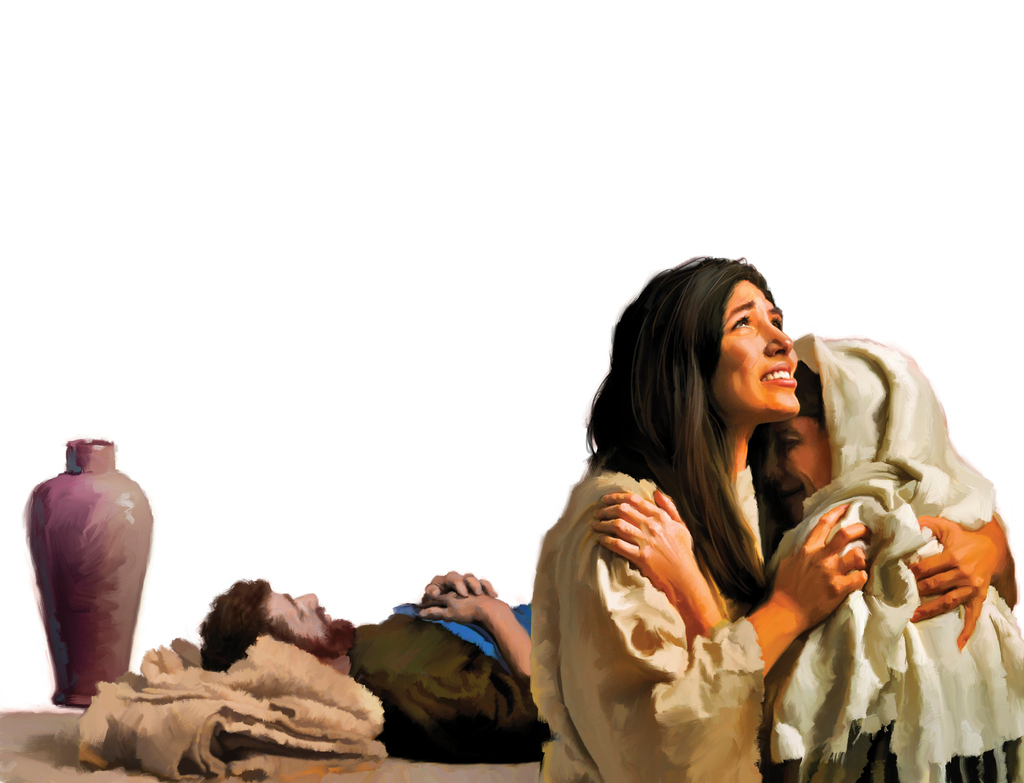
Mary and Martha, grieving the death of their brother Lazarus (Image courtesy of GoodSalt.com)
This weekend, we hear the second-most-famous story about Martha and Mary in the Scriptures. The death and raising of Lazarus is a pivotal point in the events leading up to Holy Week—one of the key “signs” shared by John in his Gospel. But for the grieving sisters, time would have flowed differently.
I’m grateful for the chace to write about about this for the Catholic Preaching Institute’s “From the Pew” reflection. If you are (or have ever been) stuck in the raw space between grief and hope, this one’s for you!
During Jeff Draine’s memorial service last Saturday at Wallingford Presbyterian Church, I had the privilege of speaking about his faith. I have written about Jeff here before, in the 2018 blog post “Eat the Peaches” after he was diagnosed with young-onset Alzheimer’s, and in the the long account of our friendship after he died last month. Here’s what I said at his beautiful, joyful memorial.
When Deb first asked me to speak today, the question she posed was this: how would you have known Jeff was a Christian without being told? Well, you might have spotted the Celtic cross he always wore inside his shirt. A perusal of his home bookshelves sure would have given you a clue. You might have known how important this church was to him. And if you knew him long enough, you might also know he was raised as a Methodist preacher’s kid, attended a Lutheran church in Richmond, flirted with Catholicism for a hot minute, and for many years was an active member of an American Baptist church—which he would want me make sure y’all know was not Southern Baptist.
But what if you hadn’t peeked under his shirt, or stood at his bookshelves, or stalked him on Sunday mornings, would you know Jeff was a Christian? Not necessarily. We all know that Jeff could speak at GREAT length about anything that interested him, but he wasn’t a proselytizer, and while he held forth on many topics, his inner life wasn’t one of them. He expressed his faith in deeds more than words. Too often, Christians use the word “Christian” as a sloppy synonym for “kind” or “nice” or “good.” But the truth is, the good deeds that Jeff did in this world—and they were many—could just as easily have stemmed from Jewish or Muslim or Quaker or any number of secular inspirations.
And yet, to know Jeff was to know that the things we admired about him were the putting-into-practice of his deep-seated Christian convictions. And, while every believer has a selective approach to Scripture—our personally curated go-to passages—the thing that really strikes me about Jeff is how passionately—dare I say, literally—he embraced some of the most challenging lines of the Gospels.
For example, in Matthew 25, in the parable of the last judgement, Jesus says, I was hungry and you gave me food, I was thirsty and you gave me something to drink, I was a stranger and you welcomed me, I was naked and you gave me clothing, I was sick and you took care of me, I was in prison and you visited me. When I met Jeff at Freedom House thirty-eight years ago, he was already working on the first four, tending to the needs of our unhoused guests for food, drink, clothing, and above all, welcome. But for the bulk of his professional career, through his research on the intersection of mental illness and incarceration—Jeff laser focused on the final two. And I can tell you that I was sick and in prison and you visited me are the ones that most people who call themselves Christians rarely take literally. It is much easier to ladle soup in a homeless shelter or donate the clothes that don’t fit us any more than to walk into prisons over and over—to spend your life advocating for those the world considers “the least of these.” But that’s what Jeff did.
I also think of the line in the Sermon on the Mount where Jesus says: Do not judge, so that you may not be judged. Though Jeff certainly could be professionally irritated and politically outraged, he was personally prepared to give just about anyone the benefit of the doubt. He was not given to judgmental rants, nor did he enjoy listening to them; he would rather turn the temperature down than ratchet people up. More than most people I know, Jeff had a keen sense of what was in God’s provenance alone. He was a very smart man who kept an open heart and mind in relation to all that he recognized was unknowable.
My final observation is about Jeff’s equanimity regarding his Alzheimer’s. Although the disease often made him anxious and agitated—especially in the later years—whenever he spoke of what was happening to him, there was never a trace of “poor me” or even “why me?” He recognized his suffering as part of the human condition. He was conscious of the many blessings that still surrounded him, and he wanted, above all else, to be useful. (That’s why he donated that big brain of his to the University of Pennsylvania, so he could keep teaching!) Now, again, one doesn’t have to be a Christian to hold that perspective. And yet . . .
As Pastor Taylor said, Jeff chose every word read and sung today. That includes the passage we just heard from John 21, with these powerful words, “Very truly, I tell you, when you were younger, you used to fasten your own belt and to go wherever you wished. But when you grow old, you will stretch out your hands, and someone else will fasten a belt around you and take you where you do not wish to go.” Jeff knew what was coming. He had no illusions about the hard path ahead. But he held his diminishment in a spiritual context. He understood Alzheimer’s as the particular way he was going to walk with Jesus, all the way to the end of the road. And he gave us that reading today as a gift, a reminder that—even when his mind and body were a mess—it was well with his soul.
Even when his mind and body were a mess, it was well with his soul.
Jeff had no way of knowing that this memorial would take place on “No Kings Day,” but I think it’s appropriate. Not just because, in his better days, he totally would have been out there protesting. But because of the words he picked to begin this service: The King of Love my Shepherd is, whose goodness faileth never. I nothing lack if I am His, and He is mine forever.
Rest in peace, dear friend.
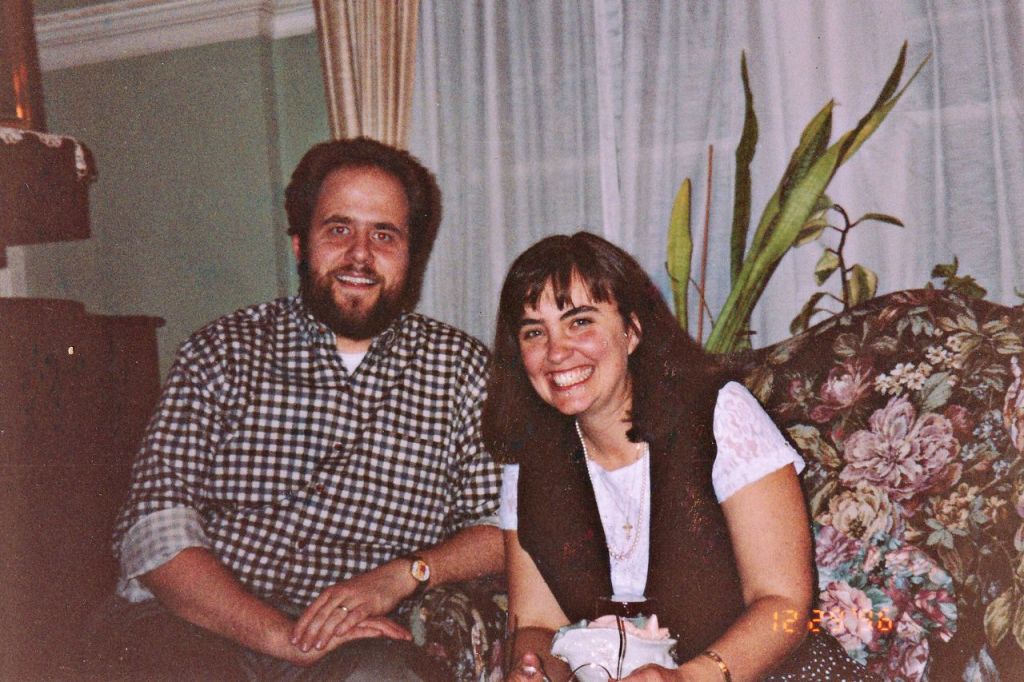
There are so many photos of Jeff and me together at family parties, you might think we were a couple, but really, we were just a couple of introverts!
The world lost a good one this month, when, at the age of 62, Jeff Draine went home to the God he loved after eleven years living and dying with Alzheimer’s. (You can read his beautiful obituary here.) Jeff was the first friend I made as a full-blown adult. After college graduation, I moved into the Freedom House community in Richmond VA, where Jeff and I overlapped for just a week. He left briefly to run a local day care center but soon returned, moving into the bedroom next to mine. (Our headboards each backed up to a connecting door, upon which I frequently pounded when Jeff’s thunderous snoring awoke me. “I dreamed the house was falling down again,” he would say.)
Neither of us would have suspected, in those early days, that we would be friends forever—let alone family—and we certainly never envisioned that I’d be one of the last people to kiss that big head of his before he died. But there you have it. We wound up walking together for thirty-eight years, all the way to the end of his road. Here then, in honor of Jeff, is a “top ten” list of sorts: ten movements that capture our ever-shifting relationship. I hope this chronicle of how one friendship endured and evolved over time will speak to your own uncategorizable loves. Cherish them!
Every time I walk into church and spot my friend Jamey Moses, I can count on him to ask me the same question: What day is it? No matter if it’s Saturday, Sunday, or a random weekday, I always reply, This is the day the Lord has made!
At Easter Mass yesterday, I sang Psalm 118: This is the day the Lord has made; let us rejoice and be glad! And this morning, like the rest of you, I woke up to the heartbreaking news that Pope Francis has gone home to God.
Not feeling very Eastery anymore, I must confess.
And yet. And yet and yet and yet.
The paschal mystery is no respecter of human or even liturgical calendars. Some people’s hearts are awash in gladness, even on Good Friday—as the vibrant music in our parish during the ecumenical Seven Last Words service demonstrated. For others, the “descent into hell” lasts much longer than three days. As Caedemon’s Call sings in their beautiful Valleys Fill First, “It’s like that long Saturday between Your death and the rising day, when no one wrote a word, wondering is this the end.”
In what now appears prescient, my friend Ann Garrido posted a reflection on Good Friday, recognizing in the crucifixion the aching sorrow of our whole world at this political moment. She suggests that, at least for a time, our best response may be silence, “acknowledging that the Word has been taken from us.” I encourage you to read her whole reflection:
As I try to get my mind and soul around the reality of a world without Pope Francis, I’m praying with his Easter message from yesterday—literally, Francis’ final word on many subjects.
More importantly, I’m holding onto this seven-word prayer taught to him by his grandmother: “Jesus, make my heart more like yours.”
This is the day the Lord has made. Whatever day it feels like in your soul, may the blessings of Francis’ witness of life and love carry you along.
“Wait, you knowPaula D’Arcy?” I’ve loved Paula’s writing for decades; my Camino buddy Jane Lafave might as well have told me she’d been hanging out in Ann Patchett’s kitchen! Jane explained that she’d known the author for many years, since going on a pilgrimage she led to Notre Dame (Paris) as part of her grief ministry.
Paula D’Arcy
The ability to write or speak authentically about loss is hard earned, and Paula D’Arcy paid a terrible entrance price to the world of grief ministers. When she was a young mother, pregnant with her second child, her family was struck by a drunk driver. She awoke in the hospital, alone except for the child in her womb. Her beloved husband and twenty-one-month-old daughter were gone.
That she built a beautiful life in the wake of such tragedy is a testimony to the power of resurrection. I first encountered the story in her 2004 book Sacred Threshold: Crossing the Inner Barrier to a Deeper Love. When my mother died a few years later, I clung to D’Arcy’s next book, When People Grieve. It is full of sanity-saving wisdom and practical advice about the physical, mental, and emotional aftermath of a profound loss. I owe much of my patience with the slow course of grief to her gentle guidance.
D’Arcy’s devastating accident was almost fifty years ago. What defines her life now is not the tragedy, but her consequent commitment to helping others keep the doors of their hearts propped open, even in the midst of grief. She is the founder of the Red Bird Foundation, whose mission is to assist others in the transformation of pain and the restoration of hope.
What defines her life is not the tragedy, but her consequent commitment to helping others keep the doors of their hearts propped open . . .”
I am thrilled to announce that Paula soon will be offering a retreat via Zoom through the SSJ Center for Spirituality in Ocean Grove, NJ. Mark your calendars for Thursday, February 13 from 6-8 p.m. for “Beauty Beyond Loss: Finding Your Way Through the Mystery of Grief and Gratitude.” I just signed up; you can learn more and register here.
Knowing that pilgrimage has been a meaningful part of Paula D’Arcy’s life, I asked my friend Jane if she could reach out to her on my behalf. Paula read my manuscript, then swiftly responded with these lovely words: Finding God Along the Way is equal parts adventure and strong spiritual experience; I felt like I was being given a private retreat as I read along. In this beautifully written book, Eberle encourages readers to risk what it means to step into the unknown each day, putting the Camino experience within every person’s reach.
According to the Talmud, every blade of grass has an angel bending over it, whispering “Grow, grow, grow!” For every angel on earth who whispers hope into the hearts of grieving people, I am truly grateful.







 Christine Marie Eberle