
BLOG

Spirituality

Here Comes Valentine’s (Ash Wednes) Day Again!

When this weird overlap of sacred and secular observances happened in 2018, it was the first time in 73 years. But we get a do-over now, and another in 2029, so I guess we should pay attention.

Here, then, is a lightly edited version of my previous post on the topic . . .


Bleeding heart flowers with link to previous blog post

I’m not sure how many people are dismayed by the collision of Catholic and Hallmark holidays. Probably not as many as the Internet would have us believe. But those who would persuade us that this is a conflict are misunderstanding both days, selling us—literally—on an artificial, commercial understanding of love.

Every February, we’re told that we should “say it with flowers,” and the price of roses shoots up. Grocery stores’ seasonal aisles fill—on the day after Christmas—with giant heart-shaped boxes of chocolate.  Jewelry stores run commercials featuring gifts in the the “now I know you love me” price range.

But real love – romantic or otherwise – has never been about that stuff.  Real love is much more akin to the three disciplines of Lent—prayer, fasting, and almsgiving:

Flowers v. Prayer
Whatever the “it” is that needs to be said, I’d rather have the words. Sincere words / meaningful conversation / shared vulnerability—things that don’t wither up and die by next Wednesday. It’s what we need in our personal relationships, romantic or otherwise, and it’s what we need in our relationship with God. Showing up. Saying what we feel. Listening for the response. Being vulnerable before the One we love.  That’s a pretty good description of prayer, and an open invitation to spend a little extra time with God this season.

Candy v. Fasting
I do not understand why chocolate is invested with so much power: THE symbol of Valentine’s Day and THE thing to give up for Lent. Real love is always more about sacrifice than consumption. And by sacrifice I don’t mean “Oh no, I can’t eat that; it’s Lent!”  I mean that we give up stuff for each other all the time. Parents give up sleep for their infants; teachers give up weekends to grade their students’ papers; housemates give up couch time to do the dishes; college students give up whatever when a friend needs a ride or a shoulder or a study partner. That’s the spirit in which we can frame our Lenten sacrifices, too . . . not setting up some sort of Olympic deprivation hurdle for ourselves, but simply asking what we can let go of in order to create more space in our hearts / minds / lives / schedules. This, then, frees us to be more responsive to the needs of those we love and those God loves—which is everyone.

Jewelry v. Almsgiving
TV commercials would have us believe that love is best expressed with a jaw-dropping price tag. We know that’s not true. But real love is generous. Love is open-eyed and openhearted. Love sees the need—the need of the person right in front of us, and the needs of people we will never meet. And love responds—sometimes with money, other times with attention or service or time. Lent invites us to that kind of generosity, and calls it almsgiving.

So as we move into the season of Lent, go ahead and let this divine alignment of Valentine’s Ash Wednesday set the tone.

  • Carve out quality time with the God you love.
  • Give up something that gets in the way of your freedom to love.
  • And let that love overflow with generosity.

Blessings as you go . . .

Christine

Scripture, Spirituality

The Grace of Pajamas

We’ve reached the end of the Christmas season. Today, Luke’s shepherds and angels yield to Matthew’s magi with their exotic gifts. Tomorrow is the Feast of the Baptism of the Lord. On Tuesday, with a sigh of sadness or possibly relief, we return to Ordinary Time.  As we put away our nativity sets, it may be comforting to remember John’s description of the Incarnation, which needs no crèche to hold it:

“And the Word became flesh and made his dwelling among us.”  (John 1:14)

Often, nuances of familiar passages can reveal themselves in unfamiliar translations. Using Bible Gateway, I discovered that the Orthodox Jewish Bible (a 21st century English translation drawing on Yiddish and Hebrew cultural expressions) tells us that “the Dvar Hashem (Word of God) made his sukkah among us.” This is a poignant image for those of us blessed to live in Jewish neighborhoods, where even Catholics know it’s the Feast of Sukkot because of the sukkahs that spring up in nearby yards—or, for the yardless, on decks and balconies.

My favorite translation, however, may be the Message Bible’s chatty paraphrase: “The Word became flesh and blood, and moved into the neighborhood.”

Image by Alisa Dyson from Pixabay

What each of these translations captures in its own way is the startling proximity to which God committed in the Incarnation—experiencing life among and as one of us.  This has me musing about times when I have experienced the goodness of proximity with others, or what I’ve taken to calling The Grace of Pajamas.

Three times during this season, Porter and I have awakened in someone else’s home—with family over Christmas and New Year’s weekends, and now in Boston, at the home of fellow pilgrims from our Ignatian Camino.  As fun as it is to talk on the phone or go out to dinner, there’s nothing quite like sharing space: encountering sleepy relatives or friends over the coffee pot, experiencing their morning routines, cooking together, visiting the local shops that mark their days, accompanying them on their favorite walks or to their beloved place of worship.  There’s a quality of conversation that unfolds over time, an intimacy that grows from the simple sharing of life. 

Such opportunities are as golden as they are rare.  We can’t do it with everyone; a certain threshold of comfort precedes the invitation to pajamas. But these encounters point—as all good and beautiful things do—to an everyday truth.  In Jesus, God has taken on flesh and blood and moved into the neighborhood. God shares life with us not just in the special times, but especially in the ordinary ones.  

The One who made us and loves us and knows us better than we know ourselves promised to be with us always (and thus in all ways). We don’t need to clean up for God. We don’t need to put our face on. We just need to say, Welcome!

In this new year, as you go about the ordinary routines of your days . . . coffee pot, meal prep, dishes, laundry, work, errands, rinse, repeat . . . may you know God’s startling proximity, trust God’s abiding friendship, and experience the grace of those divine pajamas.

Writing

Books I Love by People I Love

‘Tis the season . . . to curate gift lists! If you’re seeking inspiration for that hard-to-shop-for someone, consider one of these. I can vouch for the quality of both the writing and the humanity of each author friend.

Links are to Barnes & Noble, with gratitude to Lynn Rosen at the Rittenhouse Square store for inviting me to sell my books in person next Saturday (12/16) from 1-3; stop by if you’re local! If you have an independent bookstore in your neighborhood, however, I encourage you to shop there or support them by ordering through Bookshop.org. (Be sure to check delivery times if it must be there by Christmas.)

If you want to give my books for Christmas and can’t make it on Saturday, just email me and I’ll move heaven and earth to get personalized, signed copies to you or your chosen recipients. (I’ll even gift-wrap!)

With no further ado, here’s my list of Books I Love by People I Love (alpha by author):

The Little Book of Listening: Listening as a Radical act of Love, Justice, Healing, and Transformation by Sharon Browning et al.
Through her “Just Listening” work, Sharon has been a blessing to people in the Philadelphia area and well beyond; her co-authors’ credentials are equally inspiring. GIFT THIS TO anyone who genuinely wants to do the hard work of listening to people who come from varied life experiences.

Heart of Stone by David W. Burns
Dave is a fellow SJU alum who’s been writing all his life. Like me, he entered a Pitch Week competition at When Words Count in Vermont. Unlike me, he swept all five categories, handily winning the gold. Heart of Stone is the first in a series featuring heroine Kyra Anastas, a Gorgon (yes, snakes for hair) working as a hit-woman in present-day Chicago. GIFT THIS TO anyone who likes fast-paced action with a smart, sassy protagonist and a dash of mythological assassins.

The Diary of Jesus Christ by Bill Cain, SJ
I met Fr. Bill at the Ignatian Creators Summit last summer and quickly became enchanted with his work. A playwright and screenwriter, he retells familiar Gospel narratives as they might have been captured by Jesus himself (if the Lord kept a journal). After reading one of the chapters, I texted Bill to say “I’m weeping reading this,” to which he responded “Well, I was weeping when I wrote it, so . . . ” GIFT THIS TO anyone who wants to grow closer to God through imaginative prayer.

The Language of the Soul: Meeting God in the Longings of Our Hearts by Jeff Crosby
Jeff and I became writerly friends after he discovered my first book by spotting it in a catalog. (Who knew that actually happened?) In this cozy book, Jeff explores the concept of saudade—a “vague and constant desire for something that does not and possibly cannot exist.” He muses through ten longings, adding resources for further reading as well as a musical playlist to accompany each one. GIFT THIS TO: any spiritually-minded person who likes to read with pencil in hand.

Renewable: One Woman’s Search for Simplicity, Faithfulness, and Hope by Eileen Flanagan
How did a former Peace Corps Volunteer wind up living in a big house with a basement full of stuff she didn’t need? Reading my friend Eileen’s beautiful account of the “midlife spiritual crisis” she experienced on the brink of 50 when I was that age myself, I found it familiar, moving, and inspirational. (Check out her other books you might enjoy.) GIFT THIS TO anyone who needs to recover their bearings and move with courage into the second half of life.

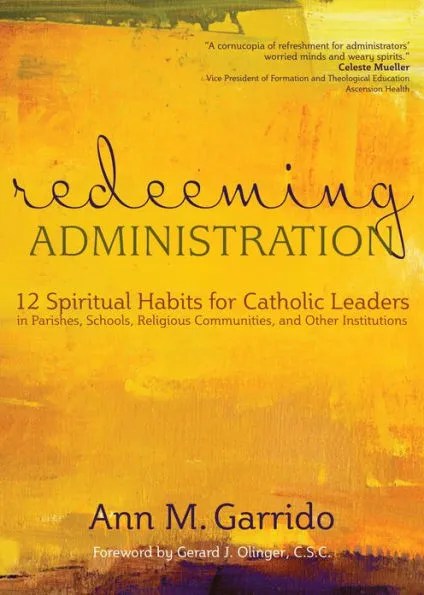
Redeeming Administration: 12 Spiritual Habits for Catholic Leaders in Parishes, Schools, Religious Communities, and Other Institutions by Ann Garrido
You may know Ann from Catholic Women Preach; I fell in love with her voice when we were presenting at the same conference. I own many of her books, but this one really spoke to me when I was trying to find meaning in a ministry marked by too many tedious administrative tasks. GIFT THIS TO anyone who is trying to bring grace and goodness to the art of being “the boss.”

Madonnas of Color by Bro. Mickey McGrath
Confession: I love pretty much everything Brother Mickey has ever drawn, written, published, said aloud, or maybe even thought about, but this one is particularly striking. Though it can be devoured in a morning (as I confess I did), each tile in this gorgeous mosaic of a book is exquisite, worthy of its own prayerful contemplation. GIFT THIS TO: anyone brave enough to pray with the history of racism and the divisions in our country in the company of the Blessed Mother.

The Coffeehouse Resistance: Brewing Hope in Desperate Times by Sarina Prabasi
I met Sarina at When Words Count when we were each at the beginning of our publication journey, and now I’m delighted to call her a friend. One of my favorite things to do in NYC is visit Buunni Coffee, where Sarina and her husband Elias brew good trouble along with their excellent coffee. From Nepal to Ethiopia to Washington Heights, her memoir is riveting. GIFT THIS TO anyone who loves coffee and democracy. (Or just democracy.)

Darling Girl by Terry H. Watkins
Terry and I competed in Pitch Week together; she edged me out by one point and we’ve been friends ever since! This delightful read is a series of vignettes narrated by “DG,” a precocious child from a troubled and peripatetic southern family. We fall in love with five-year-old DG on the first page and root for her all the way to the brink of college. GIFT THIS TO anyone who enjoys curling up with a good story and rooting for the underdog.

Liturgy, Scripture, Spirituality

When?!?

This weekend, we celebrate the Feast of Christ the King (technically, “The Solemnity of Our Lord Jesus Christ, King of the Universe”). At Mass, we’ll hear Matthew’s account of the Last Judgment (25:31-46), in which Jesus tells a parable about a king who sets the criteria for separating (saved) sheep from (damned) goats:

I was hungry and you gave me food,
I was thirsty and you gave me drink,
a stranger and you welcomed me,
naked and you clothed me,
ill and you cared for me,
in prison and you visited me.

What always moves me about this story is the cluelessness of both the condemned and the righteous. When?!? they both exclaim. When did we see you and do (or not do) what you said? (Cue Felix Unger in The Odd Couple: “When? When? When was I redundant?)

The actual recognizing of Jesus, interestingly, is not the thing rewarded; it’s the behavior alone. The question is not what we professed, but what we did.

We’re not much into monarchs now unless they’re butterflies, but back in Jesus’ day, a monarch was revered (or at least feared). The idea that a king would be present in every human being was astounding—and should be behavior-upending.

Ideally, the conviction that Jesus abides in every person should transform our own random acts of kindness into persistent habits of character and courageous action on behalf of the common good. Yet, too often, Matthew’s warning stirs only a sporadic awareness that any given hungry / thirsty / strange / naked / ill / imprisoned character we meet might be Jesus—as though He had a side hustle as a mystery shopper or undercover boss. The notion fails to compel, as evinced by our own behavior.

After reading Matthew Desmond’s Poverty, by America for the Sanctuary Farm book club (follow-up session January 24; stay tuned), I began wondering what Christ the King might say to us today. How about:

  • I was hungry, and you wouldn’t open a decent grocery in walking distance of my home, forcing me to pay more for less at the corner store.
  • I was thirsty, and you got me hooked on sugary beverages while overlooking the contaminated water flowing from my tap.
  • I was a stranger, and you zoned your neighborhoods so I’d never be able to live there.
  • I was naked, and you flooded the market with cheaply made clothes and other consumer goods that keep profit margins high and workers’ wages low.
  • I was ill, and you wrung your hands and said what a shame it was that the nation couldn’t afford to provide me with health care.
  • I was in prison, and upon release you limited my housing and employment options so severely that I wound up right back where I started.

When?!? we bleat, clueless as a damned goat. We didn’t do ANY of these things personally. Why blame us?

More and more, I’m becoming aware that we are responsible not only for what we do, but for what we tolerate—especially when we benefit from policies that subsidize the already-affluent while penalizing the poor. I am not going to pretend that our societal ills have easy solutions. But if we take Matthew 25 seriously, we have to acknowledge that anything we consent to have done to the “least of these,” we consent to have done to Jesus.

It’s a sobering thought—as befits an end-times Gospel. May you be blessed with friends who keep you thinking.

Scripture, Spirituality

Don’t Be Foolish

Today’s Gospel has a title problem. Matthew 25:1-13 is called “The Parable of the Ten Virgins,” but it’s often referred to as the parable of “The Wise and Foolish Virgins” or sometimes, simply, “The Foolish Virgins.” Setting aside the fact that the noun in the title (virgins) makes most of us think Jesus is talking about someone else, I believe the real difficulty lies with the adjectives (wise, foolish). What can I say? Once an English major, always an English major.

Permit me a quick recap. In Matthew, this chapter is the last one in which Jesus tells any stories. (The next one begins, “When Jesus finished all these words. . .” at which point the events leading up to the crucifixion begin to unfold.) So basically this is Matthew’s version of Jesus making sure he’s said everything that most needs saying.

So, what does he say?

Jesus tells three parables, starting with today’s, in which “the kingdom of heaven will be like ten virgins who went out to meet the bridegroom. Five of them were foolish and five were wise.” The wise packed extra oil for their lamps; the foolish did not. The bridegroom, the parable continues, was “long delayed.”

Okay, we think, with our post-resurrection brains. The bridegroom is obviously Jesus, and we know he’s coming again, but we don’t know when. This must be a parable about preparedness; obviously, the Foolish Virgins had never been Girl Scouts.

Sure enough, when the women are awakened by the cry “Behold, the bridegroom! Come out to meet him!” the foolish virgins with their flickering lamps try to bum a little oil off the wise ones, only to be told “No, for there may not be enough for us and you. Go instead to the merchants and buy some for yourselves.”

Now, stop right there. Do we really think “wise” is the right adjective for these gals? Sure, they were prepared, but they also sound like Mean Girls. Maybe this should be called “The Parable of the Stingy Virgins” or even “The Parable of the Manipulative Virgins,” because what lamp oil merchant is open in the middle of the night?

But sure enough, the foolish ones heed the advice of the wise / mean / stingy / manipulative ones; they scamper off in search of a 24-hour convenience store while the bridegroom is in shouting distance. They come back to find the door barred and themselves unrecognized and thus unadmitted, and Jesus concludes the parable with his customary instruction to “Stay awake, for you know neither the day nor the hour.”

But notice this: he doesn’t say “Be sure to pack enough oil, for you know neither the day nor the hour.” Now, that’s interesting. Wasn’t that the whole point of the parable? Wasn’t that the one thing that distinguished the wise from the foolish? Maybe not.

“Be sure to store up enough fuel for an indefinite wait” doesn’t really sound like Jesus, does it? This is the Jesus, after all, who taught us to pray for our daily bread—a clear reference to the manna in the desert that rotted when hoarded—and who elsewhere told a parable actually titled “The Rich Fool” about a man who tore down his grain barns to build bigger ones for his plentiful harvest on what turned out to be the last night of his life. Jesus was pretty clear: “Do not store up for yourselves treasures on earth . . . for where your treasure lies, there your heart will be” (Mt 6:19-21).

I believe that the real foolishness of the Underprepared Virgins was revealed the moment they stopped watching for the bridegroom and ran off to make themselves look better when he arrived.

Of course, this might be where the analogy falls apart, as every analogy does at some point. I don’t know enough about first-century Jewish marriage customs to know what would have happened if half the welcoming committee had unlit lamps. But we’re talking about the kingdom of heaven here, so it’s not some imaginary bridegroom coming; it’s Jesus. He’s not coming in rage or scorn or condescension, unhinged by our frailties. He’s coming as himself: tender, compassionate, loving.

Put yourself in the scene. Imagine for a moment this Jesus approaching as you stand there, wide awake, useless lamp discarded. Imagine how much your desire to be in his presence outshines your desire to hide your ineptitude. Imagine his face as he spots you, approaches you, embraces you.

Now, aren’t you glad you stayed?

Retreats, Spirituality, Writing

While the Kid’s at Camp

Three weeks ago, I emailed the manuscript of Finding God Along the Way to my editor, and now I don’t know what to do with myself. Is this what it’s like to send a child to sleepaway camp? I’d been paying such steady attention to my little darling, guiding it from scattered notes and random chapters into a bona fide grownup book with a table of contents and everything. Now it’s having an NYC adventure without me, and I miss it.

Of course, it’s coming back. Any day now, I’ll open the door of my inbox and there it will be, three inches taller and badly in need of a haircut, with loads of laundry to be done and lots of opinions it didn’t posses before I let it out of the house.

I can’t wait.

I truly love editing season–because I truly love my editor. Peggy Moran gets me; she laughs at my jokes, understands what I’m trying to accomplish, and always makes my work better. I get such a kick out of our conversations in the comments section, where we hash out adverbs and cadence and what-constitutes-a-commonly-known-word. She never fails to challenge obscure expressions (Brigadoon, anyone?) and will call me out on overused vocabulary (like the phrase “of course,” which apparently I often deploy to sneak the reader around to my side of an argument before making it). My manuscript will return to me changed, but that’s not a bad thing.

Until that ragamuffin shows up on my doorstep, however, I am using the time to focus on other work–the freelance equivalent of organizing closets and canning vegetables. I took an eight-week online class this summer for writers of spiritual nonfiction (fascinating), and leave tomorrow for the Ignatian Creators Summit; both of these cool opportunities have been sponsored by the Jesuit Conference. I’ve also been prepping for fall retreats, which include a day of prayer with the IVC Baltimore community and a women’s weekend for St. Elizabeth of Hungary parish in Wycoff, NJ, as well as several Advent engagements. (Check out my Speaker page for details; there’s room for more!)

Another upside to this hiatus: not constantly reading my own book has created space for others’. I know I’m late to this party, but I just devoured Erik Larson’s Devil in the White City and Tara Westover’s Educated. Both were recommended by my friend/Pilates instructor Elysabeth Gelesky, who left this world abruptly (and way too young) in May. How I miss our weekly conversations about books, movies, recipes, travel, and so many other things! I wish I could recommend to her Otherwise, a lovely book of poems by Jane Kenyon which I received as a birthday gift. The closing line of the title poem reminds me of Elysabeth as it invites me to cherish all my loves and friendships, because “one day, I know, it will be otherwise.”

More inspiration that’s come my way this summer includes two preaching podcasts (one new, one new-to-me). If you’re hungry for really solid homilies, check out “believe. teach. practice” by BJ Brown and Fr. Walter Modrys, SJ (who alternate weeks and introduce each other’s sermons) as well as America Media’s new podcast, “Preach,” which presents a homily then invites the preacher to reflect on the process.

Finally, allow me to rhapsodize about a book coming out on September 5 from Woodhall Press: Heart of Stone by David W. Burns. Dave is a college friend of mine (Go Hawks!) who entered the Pitch Week XXV competition at When Words Count in Vermont last year and swept all the categories. His heroine—a fast-thinking, wise-cracking, self-deprecating Gorgon working as a hit-woman in Chicago—takes readers on a satisfying romp, cheating death (in the form of mythical assassins) at every turn. This is an awesome read with a redemption theme; treat yourself and pre-order a copy! (Or, if you’re local, stop by Dave’s table at the Collingswood Book Festival on October 7.)

However you are spending these waning days of summer, I pray that you are carving out quality time for yourself and those you love. In, through, and above all, may you find God along the way!

Blessings,
Christine

Retreats, Spirituality

Ode to the Summer Retreat

I’m preparing to give my first week-long retreat, and it’s got my mind wandering down memory lane to the many times I made a summer retreat at the Jesuit Center in Wernersville.

The pack list was simple: Comfortable clothes, in layers. Quiet shoes for inside, and supportive ones for morning miles. Sketch pad with colored pencils. Weathered Bible. Spanish Bible. Perhaps a book of poetry, or another slim inspirational volume. Whatever cross-stitching project I was working on at the time (which I might not have touched since my last retreat). Above all, my journal and good pens—by which I mean inexpensive medium ballpoints. (Blue.)

rocking chair at sunrise

It would take me a couple days to fall into the rhythm of retreat; some years I’d start twitchy, not quite sure what to do. Other times I’d arrive dog tired, entrusting myself to the assurance of Psalm 127: God pours out blessings on the beloved while they slumber. Until I got my bearings, the framework of retreat would carry me along–meals, Mass, spiritual direction–as would the space itself: a rocking chair in the east garden at sunrise; a cozy cushion in the chapel balcony before bed.

Decades later, certain memories remain fresh. Particularly poignant is the first retreat after my mother died. Bent by grief and not sure how to move forward, I sat for hours in my once-favorite garden, where they’d dug up all the irises (and other perennials) but hadn’t quite figured out what to replace them with. I’d brought Mary Oliver’s book Thirst for company, and found deep solace in her poem “Praying,” which spoke to both the garden and my life:

It doesn’t have to be
the blue iris, it could be
weeds in a vacant lot, or a few
small stones; just
pay attention, then patch

a few words together and don’t try
to make them elaborate, this isn’t
a contest but the doorway

into thanks, and a silence in which
another voice may speak.

(Copyright © 2006, Mary Oliver)

By the end of the week, the other voice I was listening for had spoken, bringing me a measure of peace.

Other years found me praying imaginatively with various Scripture passages. Once, I was on Psalm 116 for so long that I rewrote the words to express my gratitude more personally. And I can still remember the brink of the hill where I was standing when struck by the certainty that, like the Samaritan Woman at the Well, I was seen, known, and cherished by God—an awareness that returned to me powerfully along the Ignatian Camino last fall.

We can and should pray anywhere, at any time, just like we can squeeze in conversations with our beloved friends and family on the fly. But in our relationship with God, as in all those other relationships, there is no substitute for quality time. A retreat week creates the environment for us to settle into prayer and the time for that prayer to become expansive. It trains us to listen for the voice of the one who calls us by name, leading us (as today’s Gospel promises) to abundant life.

I know that not everyone has the time, freedom, money, or even desire to escape for a week of retreat. But oh my goodness, if you do . . .

There are still a few spaces left on the guided retreat I’m leading during the last week of June at St. Joseph Villa, which overlooks beautiful Shinnecock Bay in Hampton Bays, Long Island. Each morning, I will open the day with material for reflection around the themes of Finding God in Ordinary Time. Each afternoon, those who wish may gather for some gentle conversation about what’s been happening in prayer. For the rest of the day, including meals, we’ll enjoy the gift of shared silence. The retreat runs from the afternoon of Sunday, June 25 to the morning of Saturday, July 1, and the cost is $560 (which includes a private room and all meals). Click the link above for more information or to register.

Whatever your summer holds, I hope it finds you somewhere you can listen to the voice of the One who sees, knows, and cherishes you.

Christine

Uncategorized

Implicit Bias Check

Something humbling happened at Trader Joe’s yesterday. 

When I got in the checkout line, there was no one in front of me—just the customer being rung up.  Only when it was my turn did I realize that I was standing on the wrong side of the checkout stand; instead of taking my place behind the customer, I was standing next to the cashier.

Cash Register

I shook my head and relocated myself, puzzled that I would make such a weird mistake. Then I realized something.  The cashier was white.  The customer was Black. Is that why I mindlessly got in line behind the white lady—because I assumed she was the one being waited on? 

Here’s the thing: I don’t know. 

My good friends will tell you that I am a dramatically unobservant person. (Odd for someone with an eagle eye for typos, yet true; I joke that my attention is focused on deeper realities.) In this case, however, I ignored a stunning array of visual data, starting with the fact that I was basically standing behind the cash register instead of in front of it. The cashier was wearing a TJ’s vest and nametag, for pity’s sake. And the customer’s grown daughter joined her, called her mom, and struck up a conversation, leading me to muse only that it was unusual for someone to visit her mother at work in this job.  (Years ago, at a rest stop on a road trip, I walked into the men’s room and mused only that it was unusual for the ladies’ room to have urinals.  I’m telling you—I can be dense!)

I say all this neither to excuse nor condemn myself.  It is possible that I was just distracted and clueless.  But it is also possible that my implicit bias was showing—that, glancing at two women in a suburban grocery store, I assumed that the white one was being served and the Black one doing the serving. If that’s what was happening in my brain, it saddens me. Profoundly.

We are in the home stretch of the Lenten season, when I always encourage people to be on the lookout for God’s daily invitations to prayer, sacrifice, and generosity. I think I need to add one more invitation to the list: repentance. (This is where the Ignatian daily Examen can be helpful.)

Noticing the negative movements in our hearts is humbling (from the Latin root humus, meaning “earth”). Being humbled recalls us to our earthy origins, our limitations, and our need for one another and for God.  In this season of repentance, I pray that God will continue to open my eyes and—like a good gardener—help me uproot implicit bias from my being, one weed at a time.