BLOG

Uncategorized

David W. Burns

Part of the Thankful Thursday Series

There’s an almost thirty-year gap in the story of my friendship with Dave Burns. I have clear (ish) memories of our time together as undergrads at Saint Joe’s: arguing in honors seminars, collaborating on SEARCH retreats, that sort of thing. When the Challenger exploded, Dave and his girlfriend (now wife) Kate and I watched the coverage together in Xavier Hall. There’s a fun cap-and-gown picture of us in front of the student center in 1987, and then . . . I was forty-nine, walking into church for my father’s funeral, trying to figure out who that vaguely familiar middle-aged man was, smiling at me kindly from a back pew.

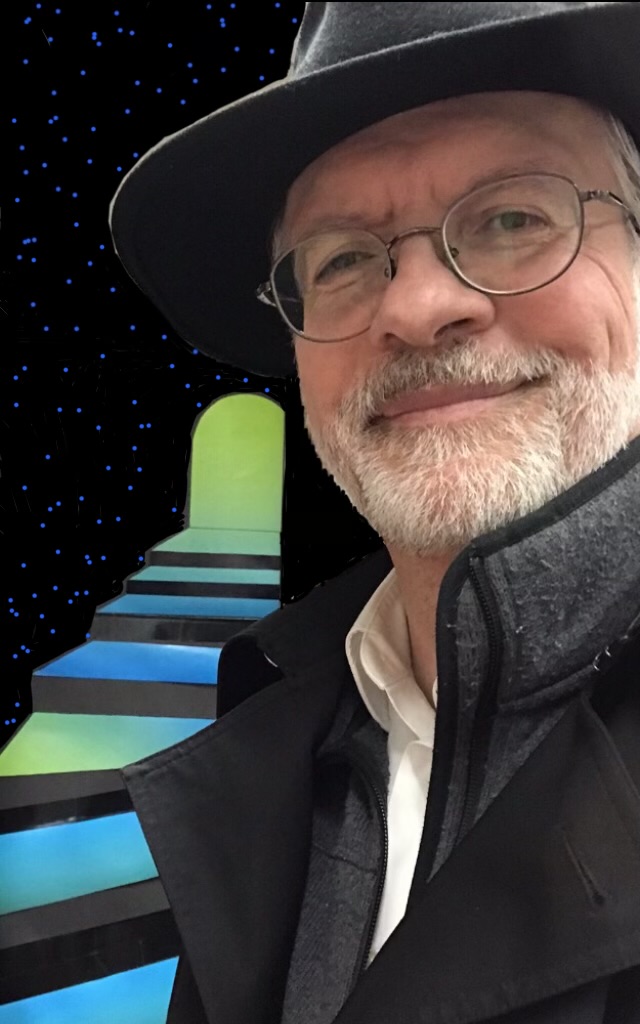
Cultivating the “Man of Mystery” look!

Since I reconnected with Dave ten years ago, our shared passion for writing has helped us make up for lost time.  He sent me an unpublished draft of a fun romp in which his protagonist was a fast-talking, wise-cracking, self-deprecating Gorgon (yup—snakes for hair, paralyzing death-gaze). Then he confessed to having also written a six volume post-apocalyptic series with some surprisingly Biblical turns. I asked for the manuscripts one at a time, and thoroughly enjoyed the ride.

Dave’s writing chops garnered some attention in 2019 when his excellent short story “Night Surf” won a Writer’s Digest grand prize. (You can read the story and an interview about it here.) And in 2022, he entered a Pitch Week competition at When Words Count—the writers’ retreat in Vermont that opened the door to my first published book—and swept all the categories, winning the top prize with that little Gorgon tale, now out in the world as Heart of Stone: Book One of The Medusa Chronicles. (Keep writing, Dave; we want to know what’s next for Kyra!)

Besides being a prolific writer, Dave is a New Jersey trial attorney. What do world-building in a fantasy novel and making a persuasive case to a jury have in common? They both rely on his gift for storytelling. In the Writer’s Digest interview, he says that’s the aspect of trial work he enjoys most: “having the opportunity to tell what I hope is a true story to a jury and then letting them weigh in on what they think of it.”

I haven’t seen Dave in the courtroom, but as a fan of his fiction, I believe that the truth at the core of each of his stories is what makes them so good. His characters wrestle with eternal, relatable themes of meaning and purpose, even when they’re battling mythological assassins or defending a citadel from vampire attacks.

His characters wrestle with eternal, relatable themes of meaning and purpose, even when they’re battling mythological assassins or defending a citadel from vampire attacks.”

Dave was one of the early readers for Finding God Along the Way, and I can picture exactly where I was when he called to tell me he had finished reading itI was giving a retreat in Hampton Bays NY, out for a long walk after dinner when my cell phone rang. “I remember finishing the last Lord of the Rings book as a kid,” Dave said, “and bursting into tears because I knew it was over and there wouldn’t be any more. Not since then have I been so sorry to reach the end of a book!”

Here’s what he had to say in writing: “Do you want to go for a walk with me?” With this deceptively simple question, author Christine M. Eberle launches us on a journey that is both physical and spiritual as she recounts her month-long, 300-mile trek through northern Spain with a group of fellow pilgrims to visit the key sites in the life of Ignatius of Loyola. In Finding God Along the Way: Wisdom from the Ignatian Camino for Life at Home, Eberle shares the perils and pitfalls of each stage of her travels, as well as the moments of sublime grace and beauty she encountered, while recreating each wild and wide vista of the Ignatian Camino trail—from the formidable heights of its mountains to the fragrant vineyards and arid deserts of its lowlands.

With her trademark tongue-in-cheek wit and relentless honesty, Eberle crafts both an entertaining and accessible memoir and a guidebook for meditating life’s most important questions. At turns harrowing and joyous, this is a book that lets the reader inhabit each step of an uplifting and transformative odyssey few will get to experience firsthand. By the time the author reaches the pinnacle of her journey and arrives at the monastery at Montserrat, the reader will feel an undeniable sense of accomplishment and triumph.

For new iterations of old friendships, I am truly grateful.

Book Tour, Spirituality, Travel, Writing

Sneak Peek: How We Began

Today marks a big anniversary: On October 5, 2022, at a retreat house in Azpeitia, Spain, my band of pilgrims gathered for our first group meeting with Fr. José Iriberri, the Director of the Ignatian Camino. We had no idea what the next twenty-seven days (or three hundred miles) would hold. In honor of that anniversary, here’s a little excerpt from the beginning of Finding God Along the Way, coming in January from Paraclete Press. Enjoy!

On an October evening in 2022, fifteen pilgrims still trying to remember each other’s names shifted anxiously in a circle of hard plastic chairs, eyes trained on our fearless Jesuit guide. The fluorescent-lit conference room’s unadorned walls gave no hint that we were in the shadow of the tower house of Loyola—the long-envisioned starting point of our grand adventure.

The youngest of us was fifty-five, the oldest seventy-nine. We were ten women and five men, hailing from across the United States as well as Canada, Australia, and Malaysia. The group included couples, widows, singles, and married folks traveling solo. Some were old friends; others knew no one. Although many were part of the Ignatian Volunteer Corps, the rest were drawn simply by their love of Ignatian spirituality. Seventeen days and some two hundred miles later, ten more people would be joining us for the final hundred miles of our journey.

“Introduce yourself briefly and tell us why you’re here,” Fr. José began, “then name your biggest fear about the Camino.” The man knew how to get to a point. A less skilled facilitator might have started with an easier icebreaker, but Fr. José didn’t want us to skim the surface. He wanted us to practice going deep.

Our fears were surprisingly similar. Most of us were worried that we’d packed the wrong things, that our bodies were going to fail us, or that somehow we would fail ourselves by not engaging the experience properly. Betsy—a petite woman with an endearing Southern accent and perfect comic timing—put it best when she confessed to fearing “pilgrim envy.” Her husband, Charlie, was the Ignatian volunteer; what if she turned out to be a remedial pilgrim, not “holy” enough for the Camino to be effective? When more than one head nodded in recognition, Fr. José encouraged us to resist the temptation to compare ourselves to one another, assuring us that, while each person’s experience would be different, God would not be stingy with the divine gifts.

While each person’s experience would be different, God would not be stingy with the divine gifts.

As the meeting drew to a close, Fr. José paused and looked around the circle slowly, letting the anticipation grow, then leaned in and offered one more bit of inspiration. “Pilgrimage can change the world,” he said. “I really believe this. Now, let’s get ready for tomorrow.”

Spirituality, Writing

Jeff Crosby

Part of the Thankful Thursday Series

Beginnings are fascinating. Without Jeff Crosby’s introduction, I would not have found Paraclete Press. But the early threads of our connection could have been dropped without either of us noticing.

After Finding God in Ordinary Time came out in 2018, it was selected as a finalist for the Foreword Indies book awards. Jeff—who at the time was Publisher/CEO of InterVarsity Press—bought my book on the strength of its description in the magazine. Then he did two rare and wonderful things: he 1) wrote beautiful reviews on Amazon and Goodreads, and 2) dropped me a note to let me know. (Book lovers: embrace this practice!)

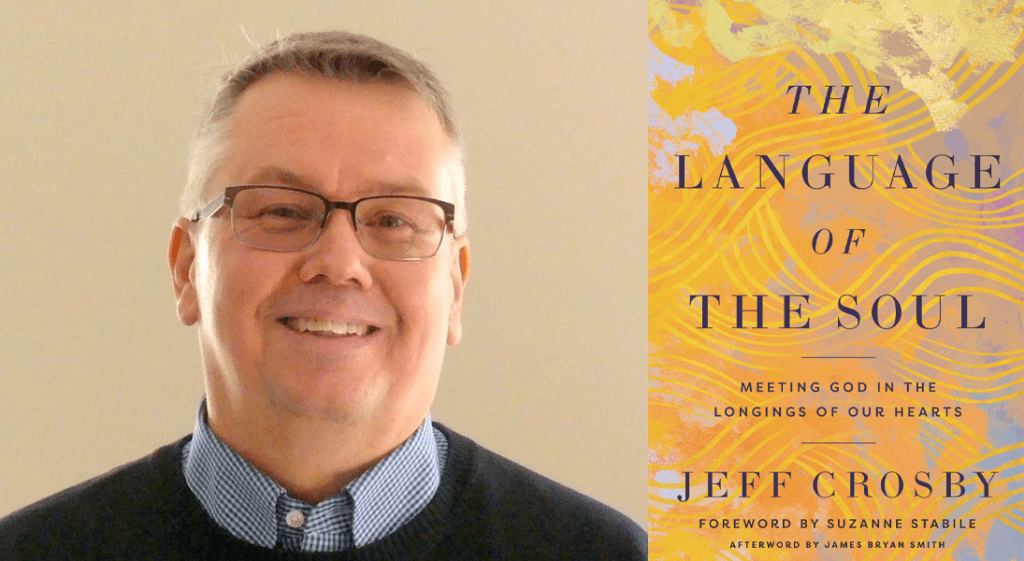
Jeff Crosby and the cover is his book

By the time Finding God Abiding entered the world in 2022, Jeff was serving as president and CEO of ECPA, a trade association of Christian publishers, and working on his own book, The Language of the Soul: Meeting God in the Longings of Our Hearts. I was honored to serve as one of his early readers, and included the book in my 2023 “Books I Love by People I Love.”

In that post, I wrote, “In this cozy book, Jeff explores the concept of saudade—a ‘vague and constant desire for something that does not and possibly cannot exist.’ He muses through ten longings, adding resources for further reading as well as a musical playlist to accompany each one. Gift this to any spiritually minded person who likes to read with pencil in hand.” (As a bonus: now you can download a beautiful, 32-page conversation guide and journal for Jeff’s book on the Broadleaf website.)

Jeff explores the concept of saudade—a ‘vague and constant desire for something that does not and possibly cannot exist.’

When I finished the first draft of Finding God Along the Way last year, Jeff was one of the first people I sent it to for thoughtful feedback, which he provided—then offered to help me find a publisher, should I need assistance. (Here’s where I should point out that Jeff and I have never met in person or even spoken on the phone.  Ours is an entirely epistolary friendship—so old fashioned!)

After several months of fruitless attempts to connect with publishers or agents, I turned to Jeff for advice. He sent me three ideas, of which Paraclete was clearly the strongest, but their website said they weren’t accepting unsolicited manuscripts. Jeff kindly shared my pitch with an editor friend on a Friday afternoon; by Monday morning, she’d asked to see the whole manuscript. Many editorial and marketing team meetings and a lot of discernment ensued, and now I’m part of the Paraclete Press family.  (As is Jeff, by the way; next year they are publishing his new book, World of Wonders: Reading as a Spiritual Discipline. I can’t wait to read it!)

Here’s Jeff’s kind endorsement: A three-cord strand of wonder awaits you in Finding God Along the Way, an inviting book that artfully weaves together Christine Marie Eberle’s pilgrimage along the Ignatian Camino in Spain with history of Ignatius of Loyola and the author’s own deep reflection on what she experienced and learned about herself—and her God—as she made her way. The scriptures she shares and the prompts for our own reflection as readers are icing on the cake. Whether or not you have shared the experience of pilgrimage, you will find much to savor in this book from one who has.

For our mutual delight in seeking just-the-right words to express the ineffable, I am truly grateful.

Scripture, Spirituality, Writing

Cameron Bellm

Part of the Thankful Thursday Series

I met Cameron in the summer of 2023 at my first Ignatian Creators Summit (a truly cool undertaking of the Jesuit Media Lab). I was a nervous newcomer, but she quickly put me at ease with her welcoming spirit, quirky sense of humor, and undergraduate major even less practical than my own: Russian Literature!

Cameron Bellm: Attention and Astonishment

In classic Ignatian fashion, Cameron describes herself as a contemplative in action. She’s a writer and speaker based in Seattle, where she and her husband are raising two cutie-pie little boys. In 2020, she had the internet version of fifteen-minutes-of-fame when her Prayer for a Pandemic went viral. (Just for fun, Google that and see how many places it was shared!) Here’s the beautiful original and a 2022 follow-up, which contains my favorite line: “Above all, as we gaze upon our frayed social fabric / may we who have spare threads set to weaving.”

As we gaze upon our frayed social fabric,
may we who have spare threads set to weaving.”

Formed by both Ignatian spirituality and Catholic Social Teaching, Cameron has written several devotionals over the years. She is now hard at work wrapping up the manuscript of a book that will be published by Eerdmans in 2025:  The Sacrament of Paying Attention: Contemplative Practices for Restoring Sacred Human Communion.  She publishes a short weekly missive on Substack called “Attention and Astonishment,” which always includes thought-provoking nuggets. (The title is a shout-out to a line from “Sometimes” by Mary Oliver):

Instructions for living a life:
Pay attention.
Be astonished.
Tell about it.

Indeed, Cameron’s attention to—and ability to be astonished by—both the big and little things in life is one of her many endearing / enduring qualities.

Here’s what she said about Finding God Along the Way“What a delight it is to journey along the Ignatian Camino with Christine Eberle as our wise and thoughtful guide! Scripture, story, and Ignatian principles are woven together in a meditative and inspiring guide not only for those making a literal pilgrimage, but for all of us who lace up our shoes each morning to walk through the holy and challenging terrain of our own lives.”

For people you can see once a year for forty-eight hours yet still rejoice like Elizabeth greeting Mary the next time you meet, I am truly grateful!

Spirituality, Writing

Elizabeth Grace Matthew

Part of the Thankful Thursday Series

“Great stories are all the same beneath the splendid array of differences that makes each one unique. The answers (whom to kill, whom to marry, how to cope) are specific to the place, the time, the characters, and the circumstances. But the questions (Who am I? What is my life about? What is my legacy?) that necessitate those answers are universal to the human condition.”

For years, I’ve been quoting this snippet from Elizabeth Grace Matthew during my retreat / keynote called “The Stories that Form Us”—explaining that I encountered it in an America magazine review of the Sex and the City reboot, of all things.  After encouraging people to brainstorm their favorite childhood books or current television series on streaming loops, I ask, “What questions—universal to the human condition—do they address?”

Elizabeth Grace Matthew

A few years ago, at a grade-school faculty retreat not far from my home, a teacher rushed up to me after the session. “Liz Matthew is a friend of mine! Do you want to meet her? I think you’d really like each other!”

It had never occurred to me that a writer I’d read in the Jesuit Review (note reverent tone) would be a mom who lived one town over from me—friendly and funny and fond of our local coffee shop. We met there and hit it off at once, chatting about writing and editing and creative-life balance, right to the outer limit of her childcare.

Several times since then, I’ve found myself sufficiently struck by the quality of writing in an America article to flip back to the beginning and see who wrote it, only to discover Liz’s name again.  (You can check out her articles here.) In addition to writing for many other publications, this mother of four boys is busy working on a book about Little Women and feminism. Sign me up!

It had never occurred to me that a writer I’d read in the Jesuit Review would be a mom who lived one town over from me—friendly and funny and fond of our local coffee shop.

While juggling all that, she made time to read my manuscript and had this to say:  “With humor and insight, Christine Eberle invites us to tag along from afar on her Ignatian Camino. At first glance, this is a book about how extraordinary circumstances super-charged one woman’s spiritual growth. Dig deeper, and it’s really about how ordinary life can also reveal our own opportunities to grow with God. Eberle gives us the context and the questions to better understand our own journeys, and where to look for those opportunities, through the evocative lens of Ignatian spirituality.”

For the serendipity that precedes the exclamation “How have we never met?” and the delight of discussing shared passions, I am truly thankful!

Spirituality, Travel, Writing

Katie (Haseltine) Mullin

Part of the Thankful Thursday Series

During my pilgrimage, one of the practices that sustained me was the Ignatian daily Examen. Even though Ignatius said the prayer should take no longer than fifteen minutes, on the Camino I sometimes devoted up to an hour, wringing every drop of grace from the previous day. Walking through the steps of gratitude, light, rumination, contrition, and hope each morning helped me view my experience through a spiritual lens instead of getting stuck on the physical level. Therefore, when it came time to seek endorsements, Katie (Haseltine) Mullin was at the top of my list of “ambitious asks.” I didn’t know her personally, but had loved her book, All The Things: A 30-Day Guide to Experiencing God’s Presence in the Prayer of Examen. 

Katie came to the Examen as an outsider—an evangelical Christian who found “breathing room” in a Protestant liturgical church where she began receiving spiritual direction, eventually becoming a spiritual director herself. This renders her writing direct and accessible. She’s not parroting insider terminology as someone who grew up in the Jesuit soup might do. Instead, she serves as a translator—a teacher of “Ignatian for Speakers of Other Spiritualities.” As she approaches the Examen from thirty different starting points, she is beautifully clear: this prayer is not a hurdle to be cleared or a set of boxes to be checked, but a golden opportunity to draw close to the God who loves us by rummaging backwards through our days together. Each chapter includes a personal, practical example of how using a particular angle of approach led her to notice something she might otherwise have missed, and thus to grow in friendship with God.

This prayer is not a hurdle to be cleared or a set of boxes to be checked, but a golden opportunity to draw close to the God who loves us by rummaging backwards through our days together.”

In addition to being a writer and spiritual director, Katie offers a variety of coaching services around both the Enneagram and self-care, all in the service of helping people live the lives they’ve been given with hope and purpose. She also works with the Center for the Formation of Justice and Peace. You can learn more about her many hats here on her website.

Katie had such lovely things to say about my book: “Christine Marie Eberle’s Finding God Along the Way felt like an unexpected, long catch up with your best friend on a Sunday afternoon. I found myself in tears as I read the beginning question, ‘Do you want to take a walk with me?’ and they came often as I read in the pages so many relatable struggles wrapped in countless encouraging words and prayers. As a lover of all things Ignatius, I imagined enjoying this book. Spiritual exercises? Yes, please. The Examen? Of course. What I didn’t count on was having my soul respond with such “serenity” (something the author herself found on the pilgrimage) to reading the familiar language and understanding of how I see God. I also I found myself challenged to pray for others on my daily walks with a deeper commitment and to notice the vulnerable in and around me. You don’t have to walk the Camino (though it remains my top bucket list item!) to go on a meaningful journey with Christine and her friends. St. Ignatius wrote in the First Principle, ‘All the things in this world are gifts from God,’ and Christine’s recollections and reflections on her pilgrimage were an incredible gift to me–one I will look back on and savor for its graces.”

As an unexpected grace, Katie and I decided that two women with a shared enthusiasm for the Examen, Ignatian spirituality, writing, and the Enneagram (we’re both Ones) might also enjoy one another.  At her initiative, we hopped on Zoom and shared a marvelous getting-to-know you hour and have stayed in touch ever since.

For the gifts of serendipitous friendship and mutual delights, I am truly grateful!

Uncategorized

Ann Garrido

Part of the Thankful Thursdays Series

I can’t remember when I first heard Ann Garrido’s name, but it may have been when an Ave Maria Press catalog landed on my desk, advertising a little book called Redeeming Administration: Twelve Spiritual Habits for Catholic Leaders. I ordered it at once and benefitted immediately from Ann’s fluent integration of prayer and practice, delivered in bite-sized, memorable concepts. My takeaways included things like (and here I paraphrase): The administrator’s job is to create an environment where everyone on the staff can thrive and Do what only you can do . . . in the service of which, make sure everyone knows how to change the toner in the copier!

Ann Garrido: Educator, Writer, Preacher, Podcaster, and more!

When I was on the planning team for a gathering of campus ministers from Catholic colleges and universities, I jumped at the chance to invite Ann to speak and discovered that she is even more delightful in person. And get this cool day job: she’s an Associate Professor of Homiletics at the Aquinas Institute of Theology in St. Louis.  No wonder she speaks as well as she writes! 

Since then, I’ve come to love some of Ann’s other books. As a campus minister, I often used her Redeeming Conflict in student leadership workshops. I still try to practice its principles, such as maintaining an awareness of the difference between intent and impact as well as approaching potential conflicts with curiosity and a presumption of goodwill.  But my favorite is Preaching to the Choir, a collection of forty selections of her preaching with the Aquinas Institute community. Not only are her reflections powerful, but they illustrate the potency of breaking open the Word in a setting where we know and are known by the congregation. (Ann also has contributed to Catholic Women Preach, so you experience her there.)

Ann’s reflections illustrate the potency of breaking open the Word in a setting where we know and are known by the congregation.”

From reading Ann’s monthly newsletter, I know that—in addition to her teaching, writing, and postcasting work—she maintains a busy travel schedule, giving talks and workshops across the county.  For my campus ministry peeps, here’s an exciting virtual event coming October 3: a CCMA symposium on “Embracing the Spirituality of Administration.” Check it out!

Ann has been a gracious mentor of my writing career for many years. I remember a long conversation when I was working on my first book, in which she talked me through some of the nuances of the publishing industry. I’ve circled back to her for advice and endorsements several times since then, and she has been beautifully responsive.

Here’s what she had to say about Finding God Along the Way: “Although I have never walked the Ignatian Camino, I feel as if I have reaped the benefits of doing so by reading Eberle’s spiritual travelogue of her pilgrimage. The questions she asks at the end of each reflection remind me that life is a pilgrimage and that whether I travel through Spain or my own backyard, it is the same God who is leading the way.”

For Ann Garrido’s commitment to excellent preaching in the Church, and her encouragement of my own efforts to connect spirituality, Scripture, and everyday life, I am truly grateful.

Uncategorized

Let’s Not Burn It Down

In the spring of first grade, I was pulled out of class one day to attend First Communion practice. A second-grader was absent, which would throw off the pew location of every girl behind her in line. (The boys were on the other side of the aisle). To avoid that, the good (IHM) sisters chose me as a seat-filler.

I remember only two things about that day. The second always makes me smile: how momentarily thrilled my mother was when I told her all about it over milk and cookies that afternoon. Had the sisters recognized how spiritually precocious I was, and decided I should skip a grade, sacramentally? (Oh, Mom . . . I love how you loved me.)

The first is something I still recall at almost every Mass, more than half a century later. The line the children were memorizing that day was “May the Lord accept the sacrifice at your hands, for the praise and glory of His name, for our good and the good of all His holy Church.”

I’m guessing most Catholics rarely think about that line (beyond, perhaps, slaloming around the male language for God). It riveted me, however—because I misunderstood it. At six years old, my sense of “Church” was limited to the physical edifice—the wonder of marble and stone that was St. Alice’s in Upper Darby. That day, and for the next few years, I believed we prayed “for the good of all His holy Church” so that the building would not burn down. (Whether this caused or was caused by my childhood terror of fire, I do not know.)

I found myself thinking about that misunderstanding during Mass yesterday morning in light of a conversation I’d had with my friend Eileen Flanagan on Saturday night about risk factors for political violence. (Sorry, that was an abrupt pivot; I should have warned you to fasten your seatbelt!)

My parish is relatively homogenous, politically; maybe your is, too (if you have a parish). Or maybe you worship in a place that is more representative of our nation: well-meaning people passionately committed to opposing parties. The divide across that aisle can feel cavernous. I remember a time when people could hotly debate political topics over appetizers then enjoy a convivial dinner together. No more. We may avoid the subjects that divide us, but more likely we avoid the people.

And this is where the good of all God’s holy Church comes in. There’s more than one way to burn a thing down.

So, back to those risk factors. Apparently there are three: 1) a recent history of election-related violence, 2) scapegoating / blaming / fear mongering on the part of one or both sides and 3) mistrust of election results. While there’s nothing we can do about our appalling recent history (attempts at both insurrection and assassination, with threats to poll workers in between), there is plenty we can do about numbers two and three.

Scapegoating / Blaming / Fear Mongering
Let me say this clearly: we can not control how other people speak. We can only control how we speak—to and about other people. Scripture is full of good advice in this regard. “Let everyone be quick to listen, slow to speak, slow to anger; for your anger does not produce God’s righteousness” (James 1:19-20). Or this: “Should anyone ask you the reason for this hope of yours, be ever-ready to reply, but speak gently and respectfully” (1 Peter 3:15-16).

This weekend, I had a gentle, respectful email exchange with someone whose partisan convictions differ sharply from my own, which made me realize how rarely I have any conversation at all with people “on the other side.” I was grateful for the relationship-preserving graciousness. When such opportunities arise, we should remember that “flamethrower” language never convinces anyone of anything. Even when we are speaking to those in total agreement, colorful demonizing is entertaining, but does not contribute to the building up of the common good.

As Scripture says, “Those who guard mouth and tongue guard themselves from trouble” (Proverbs 21:23). This doesn’t mean we shouldn’t speak about important topics—far from it. But we need to be deeply mindful of how we speak.

Not Trusting Election Results.
On this, I’ll be briefer. If you are are skeptical about election integrity, come watch the sausage be made. As a poll worker, I see firsthand the care with which each voter and vote is handled, and the extensive training we go through, twice a year, to ensure it. Of course, this does not eliminate systemic threats, like rules that make it harder for every person to vote and the electoral college system that makes it harder for every vote to count. But if you are skeptical about the process itself, please know that—before, during, and after election day, on the ground, district by district—more than half a million of your fellow citizens are hard at work preserving your right to cast your ballot. Be kind to them!

. . . be ever-ready to reply, but speak gently and respectfully.”

A commitment to civil discourse is vital for the good of “all God’s holy Church” . . . or whatever body you call home. These communities—vital to our well-being—are going to be around long after this election, this presidency, this decade. Peacemaking begins at home.

Let’s not burn it down.

Blue Ridge Mountains
Book Tour, Service, Spirituality, Travel, Writing

Senator Tim Kaine

Part of the Thankful Thursday Series

Fresh out of college in the summer of ’87, I lived in community in Richmond, Virginia and served as a full-time volunteer at a house of hospitality for homeless people.  Our board chair was a sharp young civil rights attorney who was also a cantor in our parish.  I trusted Tim’s wisdom at board meetings and loved his voice singing “Taste and See” at Mass.  A few years later, he ran for Richmond City Council. I was glad to be home in Philadelphia by then, but sorry not to be able to vote for him.

Picture of a young Tim Kaine
Young civil rights lawyer Tim Kaine chaired the board of Freedom House in the late 80’s.

Tim continued to run for things and win elections: Mayor; Lieutenant Governor; Governor; Senator. After following his career from another commonwealth for almost thirty years, I finally got to pull a lever with his name on it in 2016:  Senator Tim Kaine for Vice President of the United States. Of course, we all know how that went. But for a few shining months, I got to dream of a world in which this Jesuit-educated champion of racial justice and housing equality could be a heartbeat away from the presidency.

After the election, Tim went right back to work. But he also decided to do something to re-ground himself (no pun intended). Over three summers, just after his 60th birthday, he hiked the Virginia portion of the Appalachian Trail, cycled through the Blue Ridge Mountains, and canoed the length of the James River: a quest totaling 1,228 miles. You can read his account of those journeys and the reflections they inspired in his new book, Walk, Ride, Paddle: A Life Outside. (Or better yet, get the audiobook and hear it in his own voice.)

An insight from early in the book has stayed with me.  After losing the election for national office, Tim realized that his political aspirations “didn’t need to go higher; they needed to go deeper.” Following his call, he realized, is not about climbing the next rung of an already tall ladder; it’s about making the most meaningful impact he can in however many years of public service he has left.  In a culture that always encourages us to pursue the next big thing, “higher vs. deeper” is a choice worth pondering.  What will be—in the words of St. Ignatius— “conducive to the greater service of God and the universal good”?  Hint: It might not come with a shiny new title.

In a culture that always encourages us to pursue the next big thing, “higher vs. deeper” is a choice worth pondering.

Still wondering if you want to read Tim’s book? Check out his interview with the National Catholic Reporter’s EARTHBEAT blog: “Sen. Tim Kaine on the Spirituality of Walking, Cycling, Paddling.”

On a series of plane trips this spring, Tim read the manuscript of Finding God Along the Way and shared these kind words: “As one so influenced throughout my life by Jesuit teachers and missionaries, I relished Christine’s account of her walk in the footsteps of Ignatius. A long hike provides space for meditation and epiphanies, and this book provides them on every page, together with the everyday challenges of blisters, variable weather and quirky but delightful international companions. Christine’s observations will illuminate your own walk—whether halfway around the world or in your own backyard.”

For Tim Kaine’s generosity in word and deed, I am truly thankful!

Spirituality, Travel

It’s the People. (And the Dogs)

Seventy-seven miles walked. Nine buses, six ferries, five trains, three flights, two subways, and one tram. What do I remember most from two weeks in Scotland and Ireland? The people. (And their dogs.)

Maybe my introverted self is just more inclined to talk with strangers abroad, or maybe the Scots/Irish are more naturally garrulous and convivial. Either way, on a trip in which gorgeous scenery was a given and meaningful time with pilgrim friends (Iona) and dear family (Omagh) an expected high point, many surprising human and canine encounters linger in my imagination.

Having arrived in Edinburgh at the time of the King’s Garden Party, Porter and I were treated to the sight of many ladies in fancy hats and men in full kilt regalia. At a pub for dinner that night, we struck up a conversation with an older couple at next table. They’d come all the way from the Orkney Islands to have tea at Holyrood Palace with Charles, Camilla, and eight thousand fellow Scots. They were absolutely radiant about the experience, but also about their home island—so far north that it was formerly owned by Norway! Despite the challenges of the man’s thick brogue, Porter and the husband quickly launched into a conversation about gardening, while his wife and I discussed the delights and difficulties of life in such a far-flung place. (I had an easier time, as she was striving to “speak more properly” in the capitol!)

In the port town of Oban, we had dinner in a pub with shared tables, where we met a young couple whose English bulldog, Bluebell, was doing a fine job of keeping the floor crumb-free. (Scotland, you had me at dogs-in-pubs!) Later in the meal, we chatted with a man named Ari who was riding his motorcycle to Ireland—from Finland. Crossing countries by bike and channels by ferry, he was following his bliss with precious little baggage. Though I’d been feeling pretty good about my streamlined packing (no giant suitcase for me this time), I felt a flurry of envy for the freedom he described.

Monty

On the isle of Iona, we took a boat to the tiny isle of Staffa to see nesting puffins and their pufflings. Cuter birds may not exist anywhere! But again, the highlight was a conversation I struck up with boat mates Gerry and Lynn, who were staying on the Isle of Mull with Monty, their three-year-old “flat haired double poodle” (the shaggy offspring of a cockapoo and a golden doodle). Though they’d done a lot of international traveling earlier in life, now they only want to go where they can take their dog. Consequently, they are getting to see some beautiful parts of their own country. (Thank goodness Monty likes boats!)

The next day, we bundled up and took a long walk to one of Iona’s beaches, sharing a picnic lunch while sitting on the damp sand with our backs against a warm rock. Walking back, we passed an English bulldog whose people looked familiar. “Bluebell?” Yes indeed–and her companions Andy and Sara, who were on a day trip from Oban. While we were marveling at running into each other again, approaching from the other direction came Monty, Gerry, and Lynn on a day trip from Mull. What were the odds that we’d simultaneously encounter two dogs whose names we knew—who were staying on two other islands? The magic of Iona knows no bounds!

Andrew and his “wee highland coo”

Leaving Iona for Glasgow, we took a quick ferry hop to Mull and then a 75-minute bus ride across its length on a (mostly) one lane road. Our bus driver, Andrew, entertained us the whole way, greeting people out the window, telling us their occupations and bits of their life stories. Passing his own house, he said “Look, there’s me wee dog—and ach, the gate is open!” Shouting at his phone (no hands off the wheel for him), he called his wife to alert her.

Glasgow was our last stop in Scotland. We arrived under the weather, less energized to navigate another new city. On our second night, walking through a quiet neighborhood on our way to an Indian restaurant, we were greeted by a lady wrangling trash cans outside an Episcopal church. Our American accents outed us at once, so she asked how our holiday was going. I mentioned how much we’d been enjoying the people, but confessed that she’d been the first in Glasgow to speak to us. “That’s terrible,” she exclaimed. “You should come in for a cup of tea!” Clearly, she meant it, and had we taken her up on the offer, I’m sure it would have been a fabulous conversation. Just minutes from our dinner reservation, we declined, but were comforted to know that, even in the big city, Scottish folks have open doors and open hearts.

Of course, it’s not just the Scots. Regional cultures vary, but people are people and warmth abounds. Catching a glimpse into the lives of some of God’s other children and discovering fond connections there is one of travel’s great gifts.

How to open myself to such delightful encounters when not protected by travel’s anonymity—now there’s a question. How to be one of those people for those I encounter back home is an even better one.

How might you open yourself to a delightful encounter today?

Puffins
Puffins on Staffa (photo courtesy of Charlie Eisenmann, who got closer)