Ben was the publicist for my first two books, so we’ve been chatting about writing, passion projects, evolving career paths, and life/work balance for more than seven years now. I’m delighted to call him a friend.
Every time one of my books enters the world, Ben celebrates by hosting me on “This Podcast Will Change Your Life.” In 2018 he titled our conversation The Power of Stories; in 2022, it was A Whole Life.
Dip into our latest delightfully meandering conversation—aptly titled I Wanted to Write the Book—and see if the third time really is the charm.
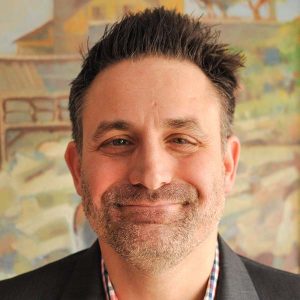
Ben Tanzer: Teacher | Storyteller | Coach | Podcaster | Principal, HEFT Creative Strategies | Lover of All Things Book, Run, Gin & Street Art
I’m grateful to my Jesuit Media Lab friend Alli Bobzien for pitching and writing this beautiful review of Finding God Along the Way, which just posted in Today’s American Catholic. I’ve never had a book reviewed before! Two others may be pending, but props to Alli for being first across the finish line.
This is my second time as a guest on Finding Favorites (here’s the first), and I must say that Leah Jones is a fabulous interviewer, for two reasons you’ll discover when you listen:
1) She walks me through the whole pilgrimage (no pun intended), asking great questions about the logistical and emotional aspects of our month-long adventure. I did not have any of those questions in advance, but quickly realized I could count on Leah to take the lead, allowing me to be fully present. (A very pilgrim-y experience!)
2) She brings her whole self to the conversation, from her Jewish faith to her cancer diagnosis. Even though I’ve only spoken with Leah twice in my life, recording the podcast felt like sliding into a diner booth with an old friend, skipping the superficial chit-chat and diving right into what really matters.
My gosh, did I have fun with this one. Fr. Brendan McManus’ The Way to Manresa helped prepare my heart for pilgrimage, and his newest gem, Living the Camino Back Home, is a filled with good advice for how to sustain one’s pilgrim heart. (Also, he kindly blurbed my book; what a guy!)
We shared stories and insights in a rich hour’s conversation with talented interviewer Eric Clayton. (That hour was preceded by almost half an hour of tech troubles, which may be why we sound so comfortable with one another!)
You can play straight from the image below, or visit the AMDG show notes for more information about the podcast and Fr. McManus’ books. (And while you’re there, you can check out the many other awesome AMDG episodes.) Enjoy!
When I returned from the Ignatian Camino, my challenge was to transform a personal experience of pilgrimage into a book that could touch the hearts of people who might never be able to walk away from their life for a month. Now that Finding God Along the Way is out in the world, a new challenge has arisen: transforming words on a page into living, interactive retreat experiences.
I can’t think of a more hospitable place to begin than the Cranaleith Spiritual Center, where last Saturday I led a morning retreat called “The Long Pilgrimage to Justice.” Moved by a spectrum of concerns, ten souls braved the cold to gather in a sunny room and ground themselves for the work ahead. Together, we considered how the metaphor of pilgrimage could allow us to keep our goal on the horizon while staying deeply present to what is right in front of us. Drawing on wisdom from the Ignatian Camino, we discussed finding our “one thing,” taking the next step, redefining failure, and equipping ourselves spiritually.
My favorite part came near the end. Thoughout the morning, I’d been sharing snippets that speak to me—Scripture verses, songs, poems, quotes, etc. Finally, I read a passage from Chapter Sixteen of my book, “It’s in There,” and invited people to share what they carry in their own “go-bag” of inspiration.
The responses began as slowly as an afternoon snowfall, but each offering encouraged the next until the room was blanketed by consolation. It was such a joy to hear people ask one another, “Wait, who was that author?” “What was the name of that song ?” “Tell me that website again!” Phones came out so folks could look things up; pens came out so we could write them down.
One gentleman shared a reflection from Unfolding Light that captured the spirit of the day. It began: Hope is not anticipation of a certain outcome, but trusting goodness. Though the world around us abounds in hateful rhetoric right now—with even people on “our side” (whichever side that may be) delighting in mean memes and zinging caricatures—it was refreshing to remember how much goodness dwells in people’s hearts and memory banks.
Hope is not anticipation of a certain outcome, but trusting goodness.
Steve Garnaas-Holmes
It made me realize that, just as January is a month in which many of us return to a healthier diet after the excesses of the holiday season, so is this a time to be careful about our mental consumption. What we read, watch, and listen to has a profound effect on our spiritual health. Let’s resolve to choose wisely!
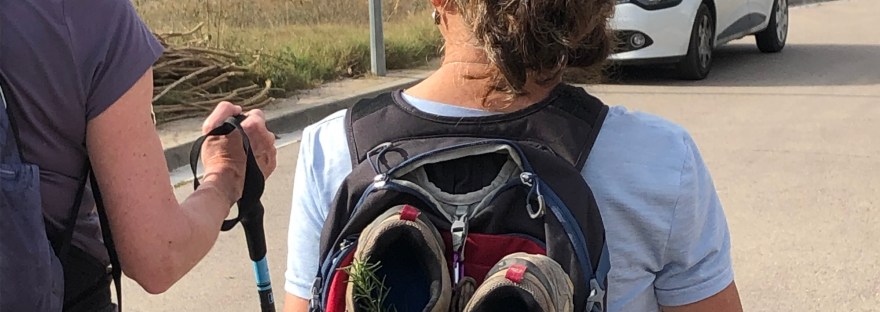
Can you spot the potassium-rich banana in Betsy’s backpack? What’s in your “go-bag” of inspiration?
Excerpt from Chapter Sixteen, “It’s in There”
“I know we’re supposed to be praying during the first two hours of every walk. Does repeatedly taking the name of the Lord in vain count?”
I cracked this joke at the end of a particularly pressured segment of hiking, but I wasn’t actually swearing my way across Spain. The only truth in that snarky remark was the word “repeatedly.” When the pace or terrain overwhelmed my ability to pray deeply (by which I mean conversationally, meditatively, or imaginatively), I took comfort in repeating words and phrases lodged in my memory.
It began during that long ascent to Arantzazu. Knowing that we were going to “visit” the Blessed Mother, I was thrown back to one of my mom’s favorite prayers, the Memorare. As I grew more exhausted by the climb, I resorted to repeating the last sentence like a mantra, in cadence with my steps: O Mother of the Word Incarnate, despise not my petitions, but in your mercy hear and answer me.
Gradually, other words emerged from the deep. Once upon a time, I’d memorized a few prayers in Spanish, so I was able to pass a satisfying hour trying to drag those beloved lines out of the mental vault. Later, I challenged myself to piece together all four verses of Tagore’s “Friends Whom I Knew Not,” which I’d quoted extensively in my book Finding God Abiding. In both cases, something about the combination of meaningful words and mental exercise sustained me for quite a while.
Various Scripture passages joined the parade of words in my head. Walking through the mountains, I recalled the beginning of Psalm 121: “I will lift up my eyes unto the hills, from whence shall come my help.” On another day, I clung to St. Peter’s incredulous exclamation after Jesus asked if he wanted to jump ship like other faint-hearted followers: “Lord, to whom shall we go? You have the words of everlasting life.” Mile after mile, the rhythmic “Lord, to whom shall we go?” reminded me that there was nowhere I’d rather be.
Certain hymns also provided prayerful refuge. Gospel songs such as “Guide My Feet” and “We’ve Come This Far by Faith” encouraged me to press on. The sight of a little dead bird evoked “His Eye is on the Sparrow,” assuring me that I was not alone.Even though such repetitive prayer isn’t ordinarily my style, I’m grateful to have had access to such richness under duress.
In the age of smartphones, the ability to “look anything up” is both a gift and a curse. Though vast amounts of information are there at our fingertips, the convenience discourages committing things to memory. But even if I’d had cell service in the Cantabrian mountains, what would I have done—pulled out my phone and said, “Hey Siri: What’s a good prayer, poem, Scripture, or song for when you’ve climbed higher than you would have thought possible but still have an impossible distance to go?” (Okay, I just tried it, and got a link to “30 Prayers to Give You Peace of Mind When You Need It Most,” but there’s no way I could have flipped through them without dropping my phone or dropping out of the pack!)
Back in the late 80s, a series of Prego spaghetti sauce commercials featured the slogan “It’s in there!” (All the ingredients a home cook could want, right in one convenient jar.) Prego is Italian for “You’re welcome,” so perhaps that’s God’s response as I offer thanks for all the heartening words that dwell in my memory banks and offer themselves as needed. “Prego!”
I am grateful to my friend Alli Bobzien (whom I met during the amazingly generative “Ignatian Creators Summit” offered by the Jesuit Media Lab last summer) for offering me a guest spot on her Substack, The Pondering Heart.
In it, I dive into my long-standing gripe about tomorrow’s Gospel and how I finally got my heart around it.
While you’re on Alli’s site, be sure to poke around and read some of her own beautiful writing. My favorites among recent posts are “The Heart of the Fire” and “The Inkeeper’s Daughter.” The first is a poem and the second a dive into historical/biblical fiction, but both are gorgeous!
My book is in the wild, so you know what that means . . . It’s podcast season! I’m grateful to my friend Mary Fran Bontempo for being first out of the gate with this fun conversation. Click the image below to listen.
Note: Mary Fran’s latest book, From Broken to Brilliant, made my 2024 list of Books I Love by People I Love. Check it out!
When you sing in a church choir and Christmas falls mid-week, you know you’re going to be spending a lot of time in church: Christmas Eve and/or Day (possibly multiple services); then Saturday and/or Sunday; and then—if you’re Catholic—the Solemnity of the Blessed Virgin Mary, Mother of God. That’s right: on New Year’s Eve/Day, we have a holy day of obligation honoring the woman who convinced her son to makemore wine for a party. (And people say the Church doesn’t have a sense of humor.) This pitches us into another weekend, after which even people who’ve had the whole two weeks off are firmly back at work and you’ve been to church like 72 times.
Not that I’m complaining. Really! These liturgies celebrate things that are profound and powerful and—if you’ll pardon the bumper sticker wisdom—the reason for the season. But that’s not the only thing we’re doing in church these days. Christmas, as it turns out, is also a season for funerals.
Sometimes that’s because people go “home for Christmas” (in the words of a Steven Curtis Chapman song that should come with a pack of tissues) or hold on for one last holiday before letting go. Other times, a loved one has died weeks or even months earlier, and family is spread across the country, and this is the best time to bring everyone together.
We had two funerals at St. Vincent’s this week. The first was for the matriarch of a large family, whose husband we buried earlier this year. With a full church and two pews’ worth of grandchildren looking on, her three handsome sons stood at the ambo and wept their way through the eulogy. It was beautiful.
The second was for a woman who had been living in a nursing home for many years, who died two weeks shy of her 100th birthday. She had one mourner: a niece in her eighties. And yet we cut no corners. The five-person bereavement ministry team and other parish staff were there; two of them sat with the niece and found each song in the hymnal for her. We did all the music. Our pastor gave a full-blown homily. It was beautiful.
It’s like eternity in a snow globe.
There is something deeply poignant about a Christmas funeral. It’s like eternity in a snow globe. The light of the paschal candle glows in the twinkle of hundreds of tree lights in the sanctuary. The casket or urn rests just a few steps from the babe in the hay. And above it all looms the crucifix—which at St. Vincent’s is a mural that includes the Blessed Mother reaching for her son, as she does in the manger tableaux below. Birth and death and the promise of new life, all together in that one holy space.
Just before Christmas, the Catholic Faith Network interviewed me about my forthcoming book. While I’m always happy to talk about Finding God Along the Way, maintaining “eye contact” with the red dot at the top of my screen as instructed was challenging! How’d I do?
The “O Antiphons” begin today, which means we hear Matthew’s genealogy of Jesus at Mass. Seems like a good moment to reblog my reflection that Busted Halo published this time last year!






 Christine Marie Eberle