

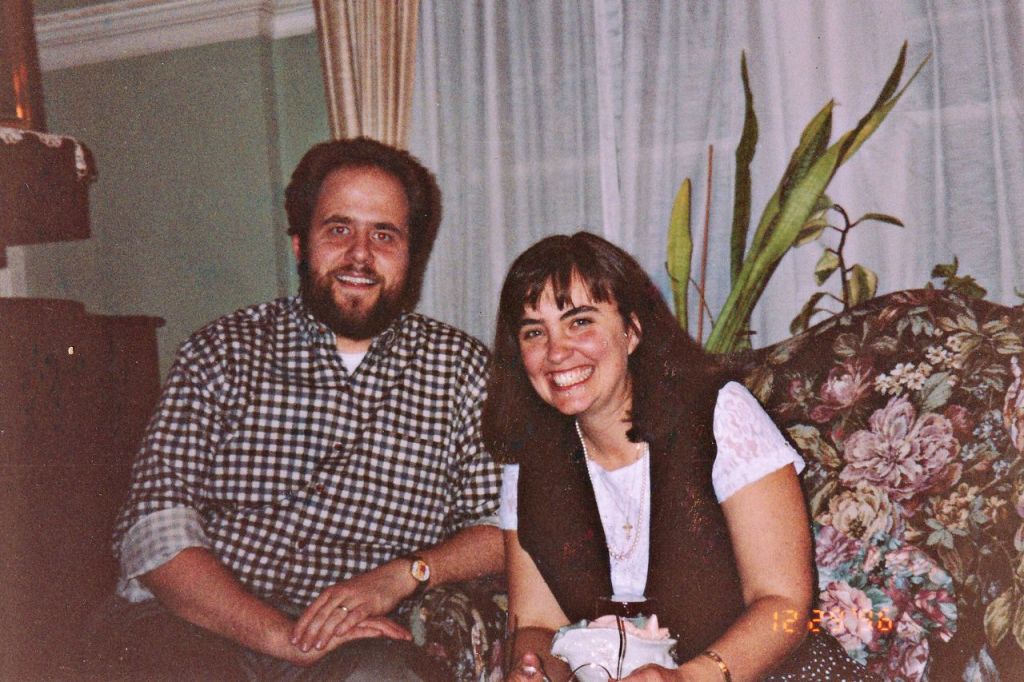
During Jeff Draine’s memorial service last Saturday at Wallingford Presbyterian Church, I had the privilege of speaking about his faith. I have written about Jeff here before, in the 2018 blog post “Eat the Peaches” after he was diagnosed with young-onset Alzheimer’s, and in the the long account of our friendship after he died last month. Here’s what I said at his beautiful, joyful memorial.
When Deb first asked me to speak today, the question she posed was this: how would you have known Jeff was a Christian without being told? Well, you might have spotted the Celtic cross he always wore inside his shirt. A perusal of his home bookshelves sure would have given you a clue. You might have known how important this church was to him. And if you knew him long enough, you might also know he was raised as a Methodist preacher’s kid, attended a Lutheran church in Richmond, flirted with Catholicism for a hot minute, and for many years was an active member of an American Baptist church—which he would want me make sure y’all know was not Southern Baptist.
But what if you hadn’t peeked under his shirt, or stood at his bookshelves, or stalked him on Sunday mornings, would you know Jeff was a Christian? Not necessarily. We all know that Jeff could speak at GREAT length about anything that interested him, but he wasn’t a proselytizer, and while he held forth on many topics, his inner life wasn’t one of them. He expressed his faith in deeds more than words. Too often, Christians use the word “Christian” as a sloppy synonym for “kind” or “nice” or “good.” But the truth is, the good deeds that Jeff did in this world—and they were many—could just as easily have stemmed from Jewish or Muslim or Quaker or any number of secular inspirations.
And yet, to know Jeff was to know that the things we admired about him were the putting-into-practice of his deep-seated Christian convictions. And, while every believer has a selective approach to Scripture—our personally curated go-to passages—the thing that really strikes me about Jeff is how passionately—dare I say, literally—he embraced some of the most challenging lines of the Gospels.
For example, in Matthew 25, in the parable of the last judgement, Jesus says, I was hungry and you gave me food, I was thirsty and you gave me something to drink, I was a stranger and you welcomed me, I was naked and you gave me clothing, I was sick and you took care of me, I was in prison and you visited me. When I met Jeff at Freedom House thirty-eight years ago, he was already working on the first four, tending to the needs of our unhoused guests for food, drink, clothing, and above all, welcome. But for the bulk of his professional career, through his research on the intersection of mental illness and incarceration—Jeff laser focused on the final two. And I can tell you that I was sick and in prison and you visited me are the ones that most people who call themselves Christians rarely take literally. It is much easier to ladle soup in a homeless shelter or donate the clothes that don’t fit us any more than to walk into prisons over and over—to spend your life advocating for those the world considers “the least of these.” But that’s what Jeff did.
I also think of the line in the Sermon on the Mount where Jesus says: Do not judge, so that you may not be judged. Though Jeff certainly could be professionally irritated and politically outraged, he was personally prepared to give just about anyone the benefit of the doubt. He was not given to judgmental rants, nor did he enjoy listening to them; he would rather turn the temperature down than ratchet people up. More than most people I know, Jeff had a keen sense of what was in God’s provenance alone. He was a very smart man who kept an open heart and mind in relation to all that he recognized was unknowable.
My final observation is about Jeff’s equanimity regarding his Alzheimer’s. Although the disease often made him anxious and agitated—especially in the later years—whenever he spoke of what was happening to him, there was never a trace of “poor me” or even “why me?” He recognized his suffering as part of the human condition. He was conscious of the many blessings that still surrounded him, and he wanted, above all else, to be useful. (That’s why he donated that big brain of his to the University of Pennsylvania, so he could keep teaching!) Now, again, one doesn’t have to be a Christian to hold that perspective. And yet . . .
As Pastor Taylor said, Jeff chose every word read and sung today. That includes the passage we just heard from John 21, with these powerful words, “Very truly, I tell you, when you were younger, you used to fasten your own belt and to go wherever you wished. But when you grow old, you will stretch out your hands, and someone else will fasten a belt around you and take you where you do not wish to go.” Jeff knew what was coming. He had no illusions about the hard path ahead. But he held his diminishment in a spiritual context. He understood Alzheimer’s as the particular way he was going to walk with Jesus, all the way to the end of the road. And he gave us that reading today as a gift, a reminder that—even when his mind and body were a mess—it was well with his soul.
Even when his mind and body were a mess,
it was well with his soul.
Jeff had no way of knowing that this memorial would take place on “No Kings Day,” but I think it’s appropriate. Not just because, in his better days, he totally would have been out there protesting. But because of the words he picked to begin this service: The King of Love my Shepherd is, whose goodness faileth never. I nothing lack if I am His, and He is mine forever.
Rest in peace, dear friend.
 Christine Marie Eberle